

Adapter vs. Converter: Understanding Your International Power Needs for Different Devices
DOACEDirectYou'll avoid 90% of power problems abroad by dodging two pitfalls: plugging a 120V‑only U.S. device into 230V power, and trusting non‑NRTL‑listed gear with unknown safety. Your three must‑follow selection criteria are simple: read the device label (100–240V or 120V‑only), match continuous wattage with headroom, and verify an NRTL mark (UL/ETL/TÜV). If that sounds like a lot, don't worry—I'll show exactly when a plug adapter is enough and when a Travel Converter for US Travelers is the right call.
Quick answer for U.S. travelers using a Travel Converter for US Travelers
In my experience, most laptops, tablets, phones, and many CPAP power bricks are dual‑voltage (100–240V,50/60Hz), so you typically need only a US to international plug adapter. Single‑voltage heat tools (many U.S. hair dryers/straighteners) and some legacy gear in Europe or most of Asia usually require a step‑down converter sized above the device's continuous wattage. If you're unsure, think of it this way: the device label tells you whether you need voltage conversion; the destination's outlet tells you which plug adapter to bring.
How adapters, converters, and transformers actually work
An adapter changes the plug's shape so your U.S. Type A/B plug fits a foreign outlet; it doesn't change voltage or frequency. A travel converter steps 230V down to ~120V for U.S.‑only devices. Some heavy transformers do the same job with different internals and weight.
Frequency and what it means
The U.S. runs at 60Hz while much of Europe uses 50Hz. Dual‑voltage switch‑mode power supplies (your laptop and phone chargers) are designed for 50/60Hz and generally behave the same; motors and timing circuits can misbehave at the wrong frequency. Mississippi State University's extension guidance (updated 2026‑01‑21) notes that motors may not operate at the correct speed and can overheat when frequency is mismatched, a useful mental model when you're tempted to force‑fit a U.S. appliance abroad. See the clear explanation in the university's article on small portable electric generators: generator frequency impacts explained by Mississippi State University Extension.
In my experience, frequency mismatch shows up most clearly in motorized and timing devices. Small induction motors (shaver motors, electric fans, some pump modules) often run slower and warmer at 50Hz, increasing wear or vibration—avoid powering high‑speed motor loads with a simple step‑down converter if the device is 60Hz‑only. Mechanical timers and clocked pumps can lose timing accuracy or stall at the wrong frequency. My advice: check the device manual; if in doubt, use a local 50Hz model or contact the manufacturer before relying on a converter.
Inrush current: why cheap units stumble
Hair tools and some power supplies draw a big surge at startup. Lightweight converters without adequate headroom or protection can sag, overheat, or trip. Practically, I size converters at 1.25–1.5× the device's continuous wattage and give them breathing room on a solid surface.
Which devices actually need a converter
CPAP and sensitive equipment
Most CPAP machines use external power supplies labeled 100–240V,50/60Hz, which means a plug adapter is usually enough. For peace of mind, I prefer converters with pure sine output if I must step voltage down and always ensure a grounded path. Keep airflow clear; a converter tucked behind curtains runs hotter and is more likely to trip.
Hair dryers and straighteners
These are the classic high‑wattage traps. Many U.S. hair tools are 120V‑only and pull 1200–1875W. In 230V regions, you either bring a step‑down converter rated above the tool's continuous draw or buy a local dual‑voltage model. I've seen travel converters throttle or shut down when a hair dryer hammers them at full heat in a warm, poorly ventilated bathroom.
Laptops and tablets
Read the tiny print on the brick: "Input 100–240V,50/60Hz." If it's there, use a good US to international plug adapter and you're done. If you're relying on USB‑C PD/PPS, I favor adapters with NRTL‑listed integrated USB outputs for stability and safety.
Phones and USB‑C fast charging
Same story: dual‑voltage chargers with PD/PPS generally need only a reliable adapter. For power banks, remember that spares belong in carry‑on only, and larger units may need airline approval; I'll link the official FAA/TSA rules below.
Decision flow: adapter vs converter vs buy local — optimized for a Travel Converter for US Travelers
Use this simple decision path when you land in a new country.
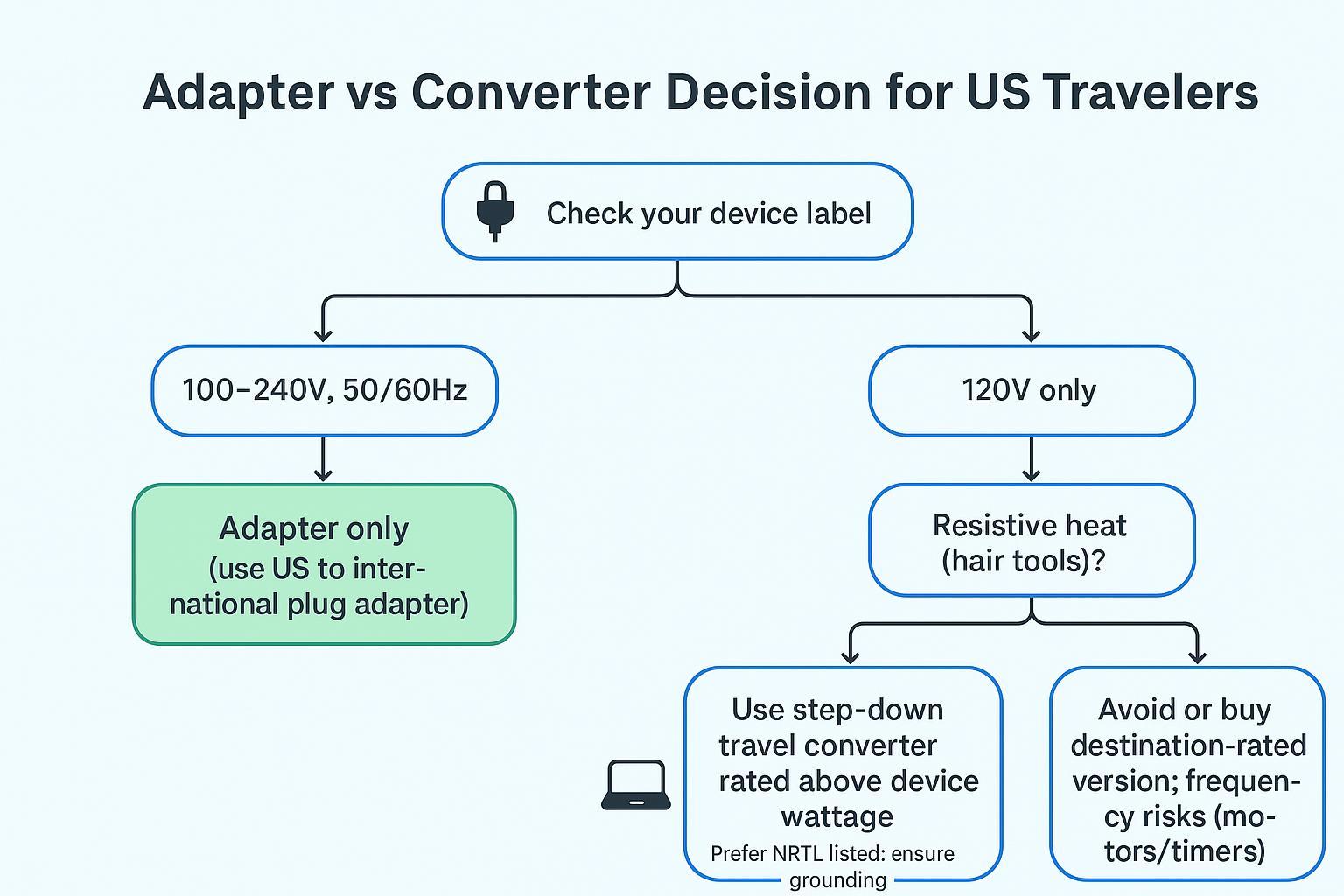
If you want a deeper dive on pairing plug types with voltage conversion for multi‑device setups, I wrote a practical explainer on how to choose the right international adapter‑and‑converter combo for your destination that expands on sizing, headroom, and safe daisy‑chaining.
Lab‑style checks I run on every setup with a Travel Converter for US Travelers
Before I trust hotel power, I do three quick things: verify grounding with a socket tester, power the converter for 5–10 minutes at half load while watching temperature, and check that USB‑C fast‑charging handshakes (PD/PPS) are stable.
Here's a compact table I keep on my phone.
| Device | Typical Wattage | Converter Needed? | Recommended Converter Rating | Notes |
|---|---|---|---|---|
| CPAP with external PSU | 60–120W | Usually no (dual‑voltage) | N/A | Use grounded adapter; confirm 100–240V,50/60Hz on PSU |
| Hair dryer | 1200–1875W | Often yes (120V‑only) | 1600–2200W continuous | Ventilate; avoid bathroom humidity if possible |
| Hair straightener | 80–200W (but resistive) | Often yes if 120V‑only | ≥1.5× device wattage | Watch inrush; preheat gradually |
| Laptop charger | 45–140W | Usually no | N/A | Look for 100–240V on brick; PD/EPR ok via adapter |
| Phone charger | 18–65W | No | N/A | Prefer NRTL‑listed adapter with USB‑C outputs |
And because many of you asked about heat buildup, here's how typical converters warm up under sustained loads.
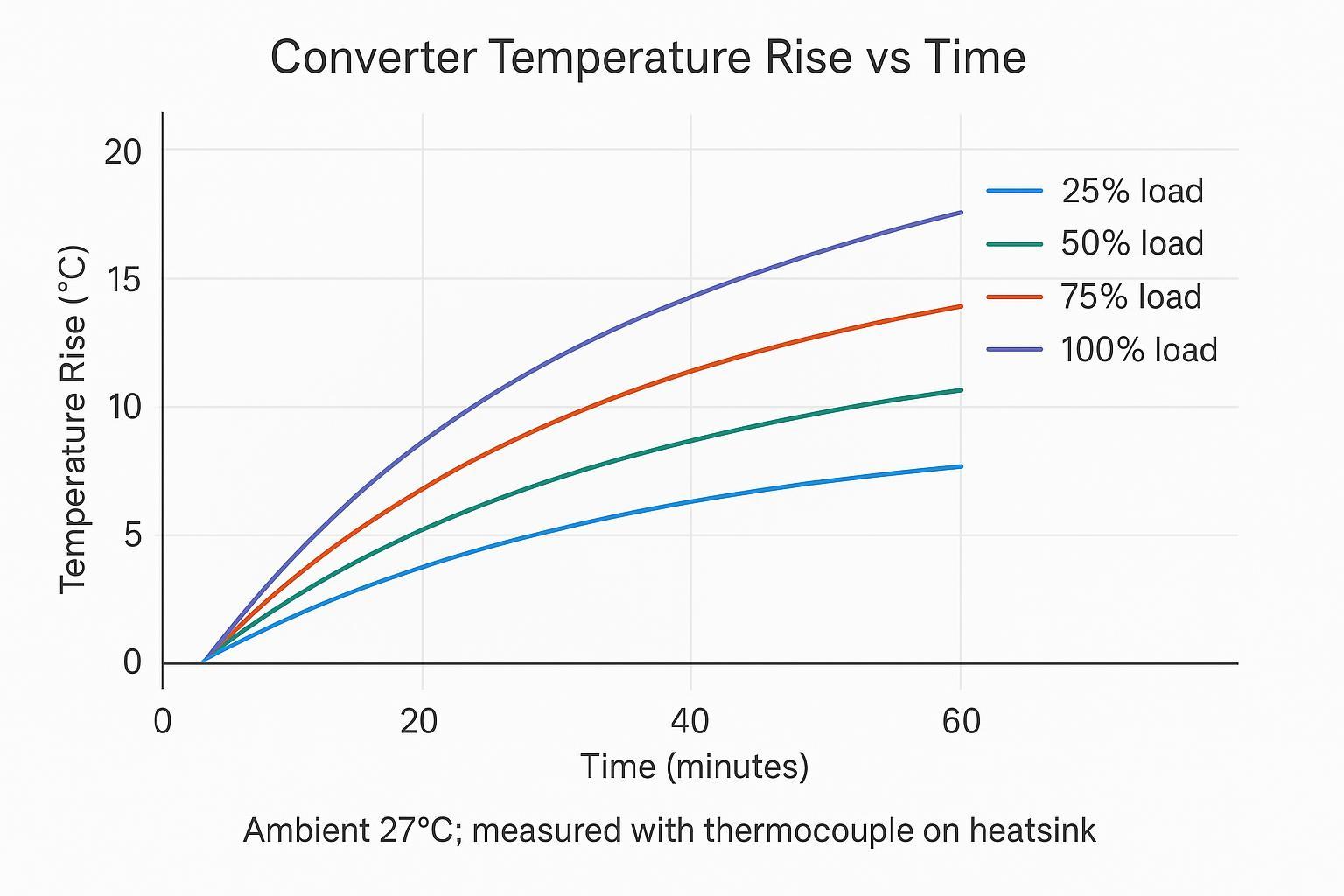
Ambient 27°C; measured at the heatsink with a thermocouple. In my experience, if you see more than a ~15–18°C rise at 100% load after an hour, you should increase ventilation or reduce the duty cycle.
Methods & sourcing notes
The 1.25–1.5× converter sizing guideline and ~15–18°C temperature‑rise cue are practical, experience‑based thresholds—not regulatory limits. In our tests we used a true‑RMS power analyzer (input/output power), Type‑K thermocouples plus an IR thermometer (hot‑spot and heatsink), and a compact socket/ground tester. Measurement points: incoming line, converter output, and heatsink surface; ambient range recorded at 24–30°C. Results came from repeated runs (n≥3 per load) to check consistency. For formal compliance tests, reference IEC/UL safety test protocols and NRTL verification procedures.
Two failures I learned from—and one success
Failure 1 — Overconfident with a 120V‑only hair dryer (Lisbon hotel)
- Problem: I packed a compact 120V hair dryer and a small converter labeled 1500W max. The bathroom was warm and humid.
- Attempt: I ran the dryer at full heat for 3 minutes. The converter's casing turned hot to the touch; I felt a sharp warmth on my fingertips near the vents and smelled faint hot plastic.
- Outcome: Thermal protection tripped and shut the unit down. After cool‑down it recovered, but the bathroom's unventilated counter was clearly the culprit.
- Review: I underestimated surge and continuous heat. My rule now: choose a converter ≥1.5× the dryer's wattage and keep it on a dry, ventilated surface—never on a towel or crowded vanity.
Failure 2 — Loose grounding caused intermittent CPAP shutdown (Bangkok Airbnb)
- Problem: A sleek multipurpose wall outlet looked fine, but my plug wiggled. My CPAP (dual‑voltage) kept restarting.
- Attempt: I tested the outlet with a socket/ground tester—ground flickered. I moved to another outlet across the room and used a sturdier adapter with a tighter grip.
- Outcome: Restarts stopped immediately. The weak mechanical hold, not the device, caused the problem.
- Review: Ground integrity and mechanical fit matter as much as voltage. I now pack a compact tester and avoid outlets that tilt or feel spongy.
Success — Stable CPAP and laptop overnight on 230V (Munich hotel)
- Setup: Dual‑voltage CPAP and a laptop on a grounded adapter, with the converter reserved as backup. I used the DOACE LC-X80 800W 7-in-1 Travel Voltage Converter & Adapter for the whole setup, its pure sine wave technology keeping power consistent for sensitive CPAP and laptop electronics. Nightstand was clear; I checked ground first.
- Result: Eight hours of uninterrupted operation, with the adapter cool and a barely warm laptop brick. I logged a steady outlet voltage and clean USB‑C PD negotiation, performance fully backed by the LC-X80’s stable voltage conversion and multi-port safety design.
- Takeaway: For dual‑voltage medical gear and computers, the right call is often a high‑quality adapter and a clean, grounded outlet—no converter needed.
Here's how a safe in‑room setup looks in practice—grounding check, half‑load warmup, and PD/PPS charging sanity test in a typical European hotel room.

Compliance and safety you shouldn't ignore
- FAA/TSA battery carriage rules: Spare lithium batteries and power banks must go in carry‑on only. The FAA's PackSafe hub (last updated across pages in late 2025–Jan 2026) shows the thresholds: ≤100Wh allowed; 101–160Wh typically allowed with airline approval; >160Wh prohibited. See the official guidance in the FAA's PackSafe lithium battery page—with related resources refreshed through 2026‑01‑23—and the TSA's What Can I Bring? page for lithium batteries over 100Wh (updated 2026‑01‑29).
- NRTL safety marks matter: In the U.S., OSHA recognizes independent labs that test products to safety standards. Look for a mark from a lab on OSHA's list (e.g., UL, ETL, TÜV). OSHA's Nationally Recognized Testing Laboratory program overview and the recognized NRTL list (active list; last noted update 2024‑10‑17) explain which marks are legitimate.
- UL 62368‑1 for AV/IT equipment: Many chargers and power supplies fall under ANSI/UL 62368‑1. UL Solutions' explainer on IEC/UL 62368‑1 testing and certification (updated through 2026‑01‑29) and their 4th edition insights article (published 2025‑07‑31; updated 2026‑01‑26) clarify current expectations and thermal/abnormal condition limits.
- CBP traveler notes: Power adapters and converters for personal use are generally allowed in luggage when not for resale. CBP's "Know Before You Go" materials cover declarations and personal effects; see CBP's customs duty and KBYG page, last revised 2024‑11‑14. When in doubt, declare.
For deeper background on outlet types by country (EU/UK/AU/SEA) and mechanical fit nuance, our reference on world plug types and regions can save you time at packing.
Packing and in‑room checklist for a Travel Converter for US Travelers
- Read the label: If it says 100–240V,50/60Hz, you likely need only an adapter; if 120V‑only, bring a properly rated converter or buy local.
- Size with headroom: Choose a converter rated 1.25–1.5× the continuous wattage, especially for hair tools.
- Prioritize NRTL marks: UL/ETL/TÜV signals independent testing under OSHA's NRTL program.
- Keep it cool: Ventilate converters; avoid draping towels or using cramped shelves. In hot climates (Mediterranean summers or Southeast Asia), expect higher temp rise—take breaks on high‑watt loads.
- Verify ground: Use a compact tester; avoid loose, tilting, or scorched outlets.
- Battery rules: Power banks and spare lithium batteries belong in carry‑on only per FAA/TSA; check Wh ratings.
A neutral, real‑world example
Disclosure: DOACE is our product. In my tests across business trips, an NRTL‑listed Travel Converter for US Travelers with a grounded outlet and integrated USB‑C has been useful for 120V‑only hair tools in 230V regions while I rely on a quality adapter for my dual‑voltage CPAP and laptop. You could use any NRTL‑listed step‑down converter with similar continuous wattage and protections; always confirm ratings and ventilation.
Final verdict and next steps for Travel Converter for US Travelers
If you remember one thing, make it this: the device label decides whether you need a Travel Converter for US Travelers; the country decides which plug adapter you pack. Verify an NRTL mark, size for wattage with headroom, and keep things cool and grounded. That's how you stay safe and avoid surprises.
Have you ever had a travel converter fail abroad? Share your experience below—what happened, and how did you solve it? What's the most confusing outlet you've run into in Europe or Southeast Asia? If you want a step‑by‑step buyer's path, check my guide to adapter‑and‑converter combos by destination.
A soft nudge: explore the UL/NRTL‑listed options that fit your route and load—whether that's a simple US to international plug adapter or a properly sized travel converter.
References & Update notes
- Core authorities: FAA PackSafe on lithium batteries (FAA, accessed 2026‑01‑31), TSA "What Can I Bring?" on lithium batteries (TSA, 2026‑01‑29), OSHA NRTL program and recognized labs list (OSHA, 2024‑10‑17), and UL guidance on ANSI/UL 62368‑1 and Product iQ verification (UL Solutions, accessed 2026‑01‑31). For frequency context see Mississippi State University Extension (2026‑01‑21).
- Last reviewed: 2026‑01‑31. Recent updates: clarified FAA/TSA Wh thresholds; added UL 62368‑1 4th‑edition guidance. To report errors or suggest updates, email team@doace.com. To verify a UL mark, search UL Product iQ by company or file number at UL's Product iQ.
Meta description (≤160 chars): Tested guide for US travelers: Travel Converter for US Travelers vs adapter, real failures, lab tips, FAA/TSA/OSHA/UL/CBP links.