

If you're planning a trip from the US to Europe, "Do I need a voltage converter?" is probably one of the most confusing questions on your packing list. According to research from travel and electronics experts like Rick Steves, Ceptics, and Roaming Historian, 90% of American travelers don't actually need a voltage converter—but the remaining 10% who get it wrong could destroy hundreds of dollars worth of electronics.
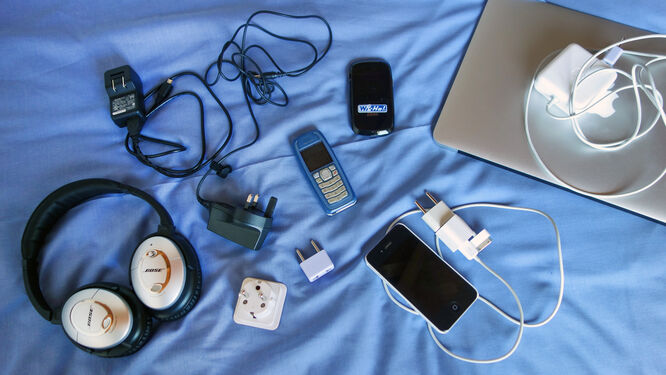
Image source: Rick Steves - Common electronic devices for international travel
This guide is based on real user questions and professional answers from the first page of Google search results, giving you the most practical decision criteria and pitfall avoidance strategies.
The Core Difference: US vs European Power Systems
| Feature | United States | Europe (Most Countries) |
|---|---|---|
| Voltage | 110-120V | 220-240V |
| Frequency | 60Hz | 50Hz |
| Plug Types | Type A/B (Flat) | Type C/E/F (Round) |
Key Fact: European voltage is nearly 2x the US voltage. This means if you plug a 110V-only American appliance directly into a European outlet, the device will burn out instantly and could even cause a fire.
Adapter vs Converter: The Most Confusing Concept
This is the most common mistake travelers make—confusing plug adapters with voltage converters. According to Ceptics' professional explanation, these two have fundamental differences:

Image source: Ceptics - Adapters only change plug shape; converters change voltage
Plug Adapter
- Function: Only changes plug shape to fit European outlets
- Changes Voltage?: NO
- Use For: Dual-voltage devices (100-240V)
- Price: $5-15
- Size: Small and lightweight
Voltage Converter
- Function: Converts European 220-240V to US 110-120V
- Changes Voltage?: YES
- Use For: Single-voltage devices (110-120V only)
- Price: $30-100+
- Size: Larger and heavier, like a small brick
Important Warning: Many small plug products labeled as "converters" online are actually just adapters. A real voltage converter is a substantial, heavier electrical device.
Does Your Device Actually Need a Converter?
No Converter Needed (Adapter Only)
The following modern electronic devices are 99% dual-voltage and only need a plug adapter:
- Smartphones and chargers (iPhone, Android)
- Tablets (iPad, Surface)
- Laptops (MacBook, Windows laptops)
- Cameras and chargers (DSLR, mirrorless, GoPro)
- USB chargers (including multi-port chargers)
- Power banks
- Modern electric shavers (check label)
- Modern electric toothbrushes (check label)
How to Check: Look at the device or charger label. If you see "100-240V, 50/60Hz" or "INPUT: 100-240V", congratulations—you only need an adapter.
May Need Converter (High-Power Heat Devices)
The following devices are most likely to cause problems and must be carefully checked. According to Roaming Historian's research, hair tools are the most common "victims":

Image source: Roaming Historian - Classification of electronic devices needed for international travel
- Hair dryers (most common problem device!)
- Hair straighteners/curling irons
- Clothing irons
- Coffee makers/electric kettles
- Some electric toothbrushes (must check charger bottom)
- Older electric shavers
Real Case: Rick Steves Forum and Reddit users shared experiences of bringing US 110V hair dryers to France. As soon as they plugged them in, they emitted burning smells and were completely destroyed.
European Plug Type Map
Not all European countries use the same plug type. Ceptics' global plug guide shows the various plug standards used around the world:

Image source: Ceptics - Global Type A-M plug types comparison chart
| Country/Region | Plug Type | Features |
|---|---|---|
| Germany, Austria, Netherlands, Spain | Type F (Schuko) | Two round pins + grounding clips |
| France, Belgium | Type E | Two round pins + grounding pin |
| Italy | Type L | Three round pins in a row |
| Switzerland | Type J | Three round pins in triangle |
| UK, Ireland | Type G | Three rectangular pins |
Good News: Type C (two round pins, no grounding) is the most universal adapter in Europe and fits into Type E and Type F outlets. If you're only visiting mainland Europe (excluding UK and Switzerland), one Type C adapter is sufficient.

Image source: Ceptics - Modern universal travel adapter example with multiple USB ports
5 Common Pitfalls to Avoid
Myth 1: "Small Converters" Can Convert Voltage
Most small plug products labeled as "converters" are actually just adapters. As Ceptics warns, real voltage converters are larger and heavier, not those small plug-style products.
Myth 2: All Modern Devices Are Dual-Voltage
While most electronic devices are dual-voltage, hair tools (hair dryers, straighteners) are the most common exception. Rick Steves specifically warns that even dual-voltage labeled hair tools may not perform well in Europe, recommending hotel-provided or locally purchased devices instead.
Myth 3: Hotels Provide Adapters
European hotels typically don't provide adapter borrowing, or only have limited supplies that run out during peak times. Preparing in advance is wise.
Myth 4: USB Charging Is Universal
While USB standards are universal, not all places globally have USB charging ports. Preparing traditional chargers is safer.
Myth 5: One Universal Converter Solves Everything
"Universal converters" are usually just universal adapters and cannot convert voltage. If you need real voltage conversion, you must buy a dedicated voltage converter.
Practical Decision Flowchart
(99% of cases)
"100-240V"?
(may lack power)
Required
charger label
Pre-Departure Checklist
- List all electrical devices you're bringing
- Check each device's voltage label (look for "100-240V" or "110-120V Only")
- Determine plug types for your destination countries
- Purchase necessary adapters (recommend 2-3 spares)
- If you have single-voltage high-power devices, purchase a voltage converter
- Consider buying a hair dryer locally in Europe (cheaper and more reliable than bringing a converter)
If You Need a Voltage Converter, Consider These DOACE Products
DOACE LC-X35 500W Max

- Power: 500W Max (350W continuous, 500W peak for heat tools like curling irons)
- Core Advantage: 100% pure sine wave output—the only true sine wave converter on the market
- Why It Matters: Regular converters produce square waves that can damage sensitive electronics; LC-X35's sine wave is identical to household power
- AI Chip: Automatically converts European 50Hz to US 60Hz, protecting your devices
- Best For: CPAP machines, sensitive medical equipment, high-end hair styling tools
- Switch: Touch-sensitive, requires long-press 2-3 seconds (prevents accidental activation)
- Note: Built-in surge protection, not suitable for cruise ships
DOACE LC-X30 350W Max

- Power: 350W Max
- Portability: 20% smaller and 30% lighter than LC-X35, better for light travel
- Switch: Physical toggle switch, intuitive and easy to use
- Best For: Laptops, cameras, phones, medium-power devices
- Cruise-Friendly: No surge protection, allowed on cruise ships
- Frequency Conversion: Supports 50Hz → 60Hz, protecting US devices in Europe
Recommendation:
- If you need to power CPAP machines, sensitive medical equipment, or high-end hair tools → Choose LC-X35 (pure sine wave)
- If you're mainly powering laptops, cameras, and other medium-power devices, or planning cruise travel → Choose LC-X30 (more portable, cruise-approved)
The Bottom Line
90% of modern electronic devices (phones, tablets, laptops) only need a plug adapter; only single-voltage high-power devices (older hair dryers, some hair tools) need a real voltage converter. Spending 5 minutes checking your device labels before departure can save you hundreds of dollars in equipment damage and luggage space.


