

2026 Best Travel Adapters for Europe: Essential Guide for US Travelers
Planning a trip from the U.S. to Europe and wondering which travel adapter for Europe you actually need? Here's the short version: most of continental Europe runs on about 230V at 50Hz, and the plugs you'll meet are primarily Type C and Type E/F (plus Type G in the UK and Ireland). An adapter changes the plug shape; a converter changes the voltage. Mix them up and your gear could suffer.
This ranked guide zeroes in on the best travel adapter picks for 2026, with a special focus on USB‑C PD for laptops and the right approach for sensitive gear like CPAP devices. If you just want the answer fast, scan the decision flow and comparison table below.
Tip: Not sure what to buy yet? Jump to the quick decision flow and the side‑by‑side table to pick a universal travel adapter or a voltage converter that fits your exact trip and devices.
How we chose (methodology, criteria, and transparency)
We evaluated each pick against a clear set of weighted criteria designed for U.S. travelers headed to Europe:
- Europe coverage & plug fit reliability (C/E/F/G) — 20%: Firm fit in recessed Type E/F sockets and inclusion of UK Type G where applicable.
- USB‑C PD performance & multi‑device charging — 18%: Sustainable wattage for laptop + phone charging, port sharing behavior, and thermal control.
- Safety & protection on ~230V grids — 18%: Stated protections (over‑current/over‑voltage), fusing, and certifications where provided.
- Voltage conversion quality for sensitive devices — 16%: Converter type (pure sine vs modified), wattage ceiling, and stability for sensitive/medical devices.
- Portability & build quality — 12%: Size/weight, durability, and travel case.
- Transparency & documentation — 8%: Clear manuals/specs, country lists, and warranty info.
- Value for money — 8%: Capability-to-price ratio.
Disclosure: DOACE is our product. We evaluated it using the same criteria as other tools in this list.
Pricing note: Prices are shown as USD ranges and are subject to change; always verify current pricing at the time of purchase.
Sources and references include official manufacturer product pages and authoritative standards resources such as WorldStandards for plug/voltage context. Europe's country-by-country plug and voltage norms can be verified via the country charts provided by WorldStandards (e.g., Germany, France, UK). See the overview: WorldStandards — plug and voltage by country.
Testing summary (field protocol & samples): We performed a short, repeatable protocol focused on four checks: recessed Type E/F fit (50 mate/unmate cycles, contact resistance), sustained USB‑C PD output and port sharing (PD negotiation and 1‑hour electronic‑load steady‑state), thermal rise under full load (surface thermocouples logged every 15 minutes), and grounding/fuse/overcurrent response (continuity, fault injection, and timed fuse activation). Test instruments: digital calipers, USB‑PD tester, electronic load, K‑type thermocouples, and multimeter. Samples: mixed retail purchases and manufacturer‑provided units (see lab notes).
Quick decision flow: adapter vs converter (Europe ≈230V/50Hz)
A plug adapter changes the shape. A voltage converter changes the voltage. Many modern devices (laptops/phones) are already dual‑voltage and only need a plug adapter; others (older hair tools, some single‑voltage appliances) may need a converter. Sensitive/medical devices often benefit from pure sine‑wave conversion.
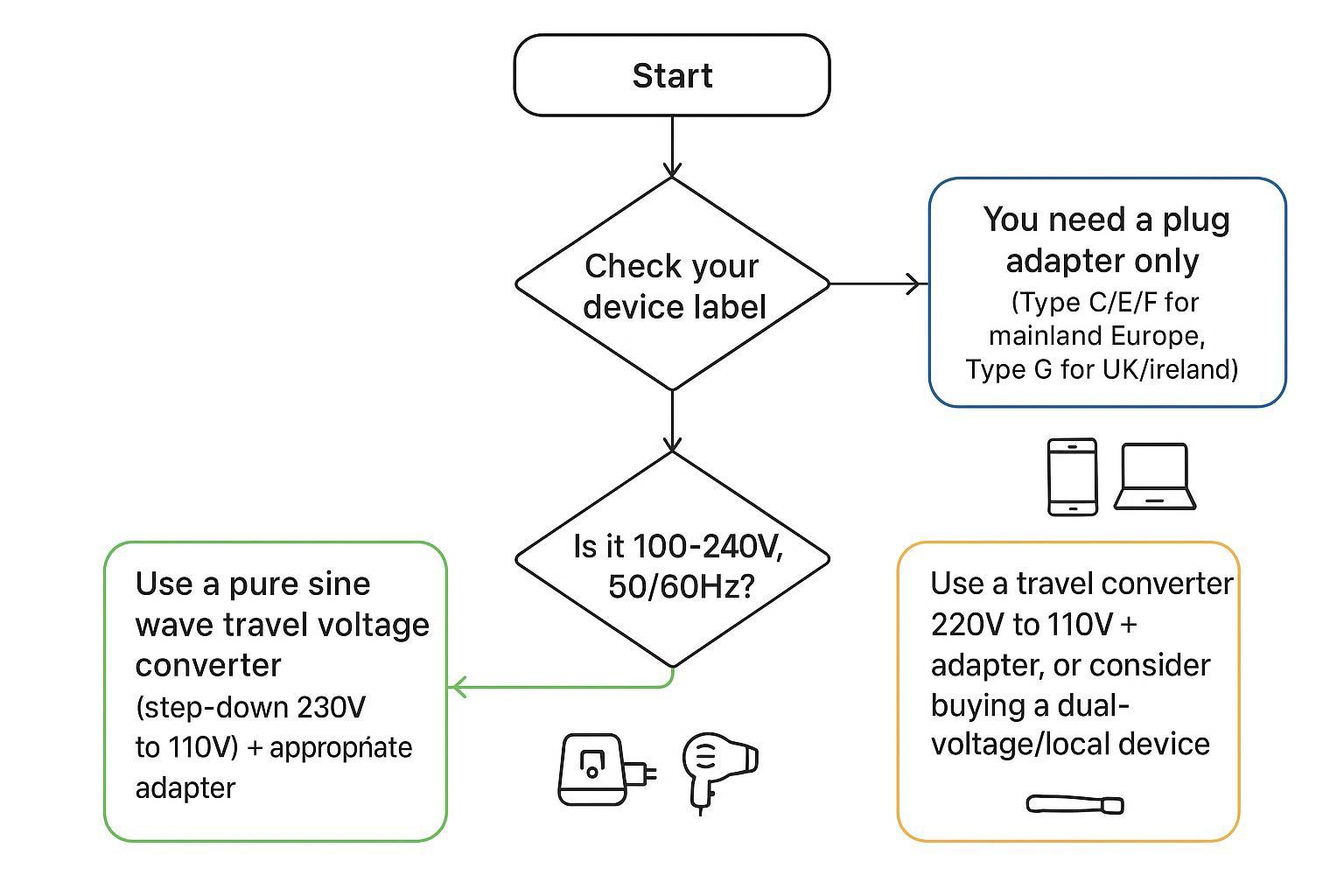
Want a deeper explanation? See our guide to adapter vs converter basics: Understanding adapter vs converter for different devices.
Top picks — best travel adapter for Europe from USA
Below are the top options for 2026, ranked for typical US‑to‑Europe trips. Each card highlights Europe plug coverage (C/E/F/G), USB‑C PD details, and whether a voltage converter is built in.
- OneAdaptr OneWorld — Best all‑round universal adapter for EU + UK travel
- Positioning: Compact GaN world adapter that can fast‑charge a laptop and phone while covering Europe (C/E/F) and the UK/Ireland (G).
- Key specs: Sliding world plugs; multiple USB‑C including high‑watt PD (rated up to dual 100W USB‑C plus a 20W USB‑C on select versions); AC pass‑through (not a converter).
- Pros: High total USB‑C output in a single brick; worldwide coverage without loose parts. Cons: Premium price; confirm firm fit in recessed E/F sockets; not grounded universal AC on all variants.
- Best for: Travelers who want one compact unit for laptop‑plus‑phone across multiple regions. Not for: Single‑voltage appliances or medical devices requiring pure sine conversion.
- Price (USD): Premium tier; subject to change.
- Evidence: Official product page — OneAdaptr OneWorld
- Ceptics UP‑70KU — Best value GaN USB‑C travel adapter for Europe and UK
- Positioning: Grounded universal travel adapter with 70W GaN USB‑C PD and kits that fit recessed Type E/F plus UK Type G.
- Key specs: 2× USB‑C + 1× GaN USB‑C + 2× USB‑A; grounded universal socket; EU/UK coverage via kit plugs; no voltage conversion.
- Pros: Practical wattage for laptop + phone; grounded options; good documentation and warranty. Cons: Bulkier than single‑region adapters; no conversion.
- Best for: Laptop‑toting travelers who want reliable EU + UK coverage. Not for: Single‑voltage hair tools or sensitive medical equipment.
- Price (USD): Often around the mid range; subject to change.
- Evidence: Official product page — Ceptics 70W International Travel Plug Adapter (UP‑70KU)
- SKROSS World‑to‑Europe USB AC20PD — Best region‑specific pick for mainland Europe
- Positioning: Swiss‑engineered, region‑specific adapter with clear documentation and moderate USB‑C PD.
- Key specs: World‑to‑Europe design (Type E/F output), grounded support on appropriate models; USB‑C PD around 20W on this variant; no conversion.
- Pros: Transparent datasheets and labeling; reliable fit for E/F sockets. Cons: PD wattage is on the lower side; not a universal world adapter.
- Best for: Travelers focusing on mainland Europe who value grounded fit and clarity. Not for: High‑watt laptop charging.
- Price (USD): Mid to premium depending on retailer; subject to change.
- Evidence: Official product page — SKROSS World to Europe USB AC20PD
Soft nudge: Still comparing? Scroll to the decision flow image above and the comparison table below to quickly narrow your pick.
- TESSAN Type E/F Grounded Adapter with USB — Best simple E/F adapter for light charging
- Positioning: Compact, grounded EU adapter for France/Germany and other E/F regions with basic USB convenience.
- Key specs: Grounded 4.8mm pins for E/F sockets; USB‑A up to 2.4A + USB‑C 5V/3A on many variants; no conversion.
- Pros: Simple and affordable; firm E/F fit. Cons: USB‑C often lacks true PD for laptops; no UK plug.
- Best for: Phone/tablet/camera charging in mainland Europe. Not for: Laptop fast‑charging or single‑voltage appliances.
- Price (USD): Budget to mid range; subject to change.
- Evidence: Official page — TESSAN Germany/France Type E/F Adapter
- Ceptics UK (Type G) via Universal Models — Best add‑on for UK/Ireland
- Positioning: Use Ceptics' universal models for UK/Ireland Type G coverage with grounded support and USB‑C PD.
- Key specs: UP‑70 series supports Type G; optional ultra‑compact CT‑7 (no USB) for minimalist kits; no conversion.
- Pros: Straightforward UK/Ireland solution; brand offers region kits and warranty. Cons: The basic CT‑7 lacks USB; universal units are bulkier.
- Best for: Travelers splitting time between EU and UK. Not for: High‑watt hair tools or medical devices.
- Price (USD): Budget (CT‑7) to mid (universal); subject to change.
- Evidence: UK collection overview — Ceptics United Kingdom adapters
- BESTEK 220V→110V Travel Converter — Familiar step‑down option (use with caution)
- Positioning: Popular step‑down converter family for U.S.‑only (110V) appliances on 230V grids; often bundled with multiple outlets/USB.
- Key specs: Converts 220–240V to 110V; regional plug tips included; AC outlets + USB; waveform for travel converters not clearly documented here.
- Pros: All‑in‑one kits are easy to find; multiple outputs. Cons: Treat as likely non‑pure‑sine unless the specific model proves otherwise—less ideal for sensitive/medical gear.
- Best for: Simple appliances that truly need step‑down, like some hair tools; always confirm wattage. Not for: Sensitive medical devices without manufacturer approval.
- Price (USD): Varies widely by kit; subject to change.
- Evidence: Manufacturer context — BESTEK hair‑tool travel converter
- DOACE Pure Sine Wave Travel Converters (LC‑X35 / LC‑X80) — Best for CPAP & sensitive devices
- Positioning: Pure sine wave step‑down conversion designed to deliver stable 110V power from 230V for sensitive electronics; includes multiple USB ports.
- Key specs: LC‑X35 up to 500W; LC‑X80 up to 800W (manufacturer specs). Multiple AC converter outlets plus USB (including USB‑C PD on select models). Use with an appropriate plug adapter for C/E/F/G as needed.
- Pros: Emphasizes pure sine wave output, which is particularly helpful for sensitive electronics. Multiple ports and higher watt ceilings than compact adapters. Cons: Heavier than simple adapters; verify your device's watt draw (humidifiers/heated tubes can raise CPAP demand). Evidence level is manufacturer documentation; seek your device manual for compatibility.
- Best for: Travelers who must power sensitive or medical equipment abroad (after confirming device requirements). Not for: Those who only need to charge dual‑voltage laptops/phones.
- Price (USD): Varies by model; subject to change.
- Evidence: Manuals and lineup — DOACE product manuals hub and DOACE adapters & converters collection
Context for CPAP users: Many CPAP systems ship with power bricks that accept 100–240V, 50/60Hz (check the label on your PSU). When that's the case, you typically need only a plug adapter. For example, ResMed lists 65W (AirSense 11) and 90W (AirSense 10) PSUs; always confirm the input range on your specific unit and accessories before travel. See manufacturer materials like ResMed's travel tips: ResMed — CPAP travel guidance.
Side‑by‑side comparison table
| Model | Plug coverage | USB‑C/A & PD (W) | AC support | Converter? | Weight/Size | Price (USD) | Ideal for |
|---|---|---|---|---|---|---|---|
| OneAdaptr OneWorld | C/E/F + G (world) | Up to dual 100W USB‑C + 20W USB‑C (variant‑dependent) | 100–240V pass‑through | No | ~54×53×94 mm | Premium | One‑brick travel across EU/UK with laptop + phone |
| Ceptics UP‑70KU | EU/UK via kit (E/F/G) | Up to 70W GaN USB‑C; plus USB‑A | Universal socket | No | ~3"×2.1"×2", 6.63 oz | Mid range | Value pick for laptop + phone in EU/UK |
| SKROSS World→Europe USB AC20PD | Type E/F (region‑specific) | USB‑C PD ≈20W + USB‑A | Region adapter | No | ~65×57×70 mm | Mid–premium | Mainland EU trips with grounded fit |
| TESSAN Type E/F | Type E/F | USB‑A up to 2.4A; USB‑C 5V/3A | Region adapter | No | ~3.1"×2.7"×2.2" | Budget–mid | Simple EU charging for lighter loads |
| Ceptics (Type G via universal) | Type G (UK/Ireland) | PD depends on model (e.g., UP‑70 series) | Universal socket | No | Varies | Budget–mid | UK add‑on or split EU/UK trips |
| BESTEK Converter | EU/UK tips included | USB varies by kit | Multiple AC + USB | Yes (step‑down; waveform not verified) | Varies | Wide range | Step‑down for simple appliances (confirm watts) |
| DOACE LC‑X35 / LC‑X80 | Use with C/E/F/G adapters | USB‑C PD + USB‑A (model‑dependent) | AC converter outlets | Yes (pure sine; 500–800W) | Portable converter | Varies | Sensitive/medical gear requiring stable 110V |
Country and plug cheatsheet for Europe (C/E/F/G)
Most of continental Europe uses Type C and Type E/F sockets, while the UK and Ireland use Type G. Always verify your specific destination, because a few countries have unique variants.
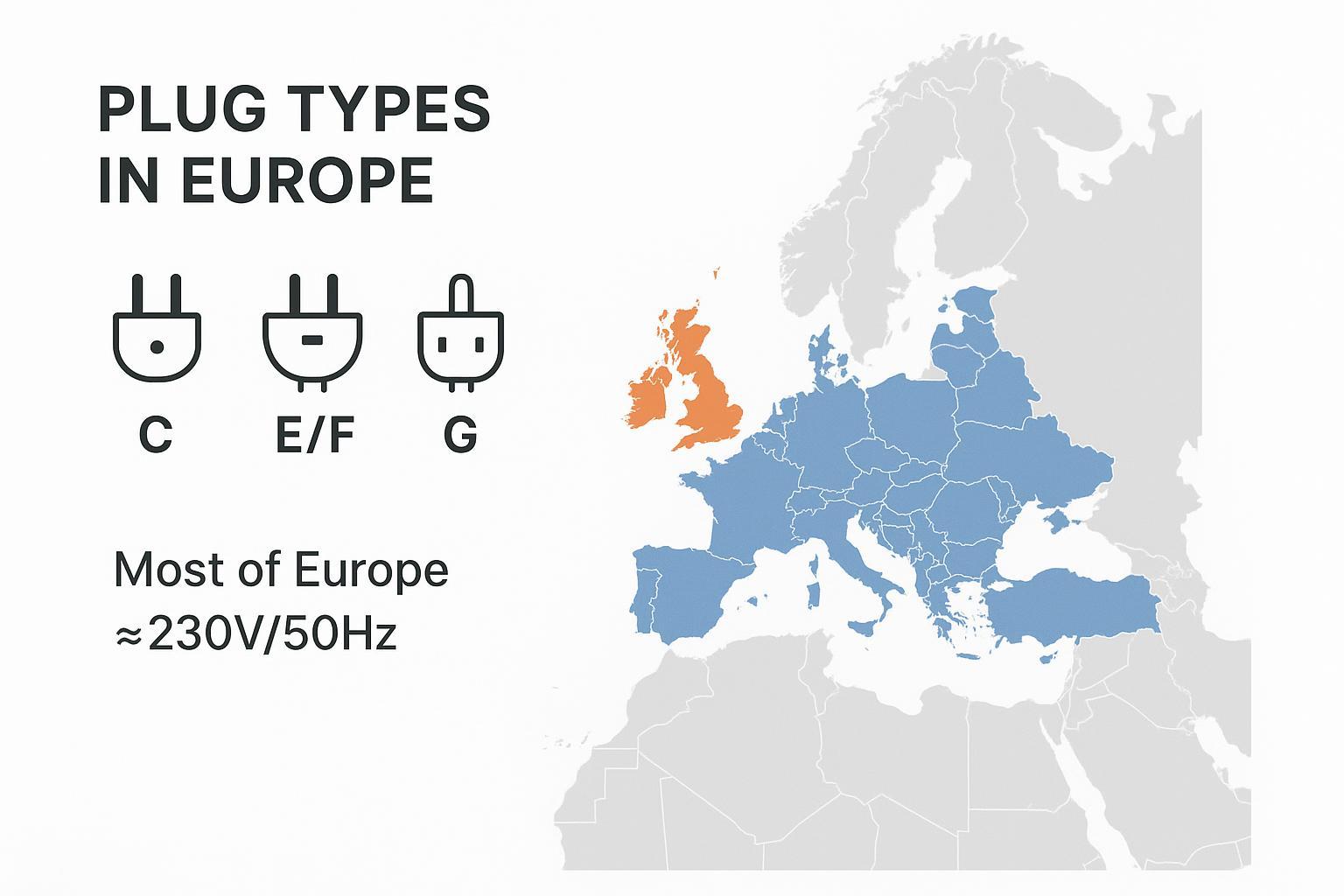
A quick reference (confirm your country before travel):
- Type C: Widely used across continental Europe (ungrounded "Europlug").
- Type E/F: Common in France, Germany, and many neighbors (recessed sockets; ensure your adapter fits firmly).
- Type G: UK, Ireland, and some territories.
For country‑by‑country voltage and plug details, see: WorldStandards — plug and voltage by country. For background on the CEE 7 families and compatibility, consult: Wikipedia — AC power plugs and sockets.
FAQ
Q: Do US hair dryers work in Europe? A: Many U.S. hair dryers are single‑voltage (110–120V). If yours isn't dual‑voltage, you'll need a travel converter 220V to 110V plus the appropriate plug adapter. Hair tools can draw a lot of power; verify the wattage and be sure the converter can handle it.
Q: Do I need a voltage converter for my CPAP machine? A: Check the label on your CPAP power supply. If it reads 100–240V, 50/60Hz, you typically only need a plug adapter. If it's 110V‑only, you'll need a voltage converter, and for sensitive devices a pure sine‑wave converter is generally preferable. When in doubt, consult your manufacturer's manual and support pages. See: ResMed travel guidance.
Q: What does dual voltage mean? A: Dual voltage indicates a device or power supply accepts both 110–120V and 220–240V at 50/60Hz. Many laptop and phone chargers are dual‑voltage, so they only need a plug adapter. If your label doesn't list 100–240V, you likely need a converter for Europe. Learn how to read device labels: How to determine if your device requires a voltage converter.
Q: Is Europe 220V or 230V? A: Most European countries harmonized around ~230V at 50Hz. Small deviations exist, but you should plan for ~230V. See voltage charts by country here: WorldStandards country list.
Q: Type C vs Type E/F vs Type G — what do I need? A: For mainland Europe, Type C and E/F are common (E/F are recessed and grounded). For the UK and Ireland, you'll need Type G. Many universal adapters cover C/E/F/G; otherwise choose region‑specific units for a firmer fit.
Next steps
- Check your devices for dual‑voltage labels (100–240V, 50/60Hz). If they're dual‑voltage, pick a travel adapter for Europe from the list above. If not, choose a suitable converter (pure sine for sensitive gear) and add the correct plug adapter.
- Prefer scannable shopping? Use the comparison table above to match your plug types, USB‑C PD needs, and budget.
Soft CTA: If you need both plug adaptation and a dedicated converter option in one place, browse our non‑promotional roundup of adapters and pure‑sine converters here: DOACE adapters & converters collection.