

120V only should be treated as a voltage-converter case first. For ordinary compatible single-voltage devices, match the wattage to a converter. For sensitive electronics, choose pure sine wave conversion. Only devices labeled 100-240V should move to the Type G adapter or GaN charger track.Singapore and Malaysia are wonderfully straightforward in one way: Type G is the plug shape to expect. But the voltage is not US-style. If you plug a 120V-only device into a 230V outlet with only a shape adapter, the adapter did its job and your device still loses.
1. Singapore and Malaysia Power Snapshot
| Place | Voltage / Frequency | Common plug | US traveler warning |
|---|---|---|---|
| Singapore | Commonly 230V / 50Hz | Type G | Adapter changes shape, not voltage |
| Malaysia | Commonly 230V / 50Hz | Type G | Check heat tools and appliances carefully |
2. DOACE 4-Check and Device Matrix

| Device | Recommended setup | Why |
|---|---|---|
| Laptop / phone / tablet | Type G adapter or GaN charger only after the label says 100-240V | Most chargers are wide-voltage, but the label is the proof |
| 120V-only CPAP or sensitive electronics | Pure sine wave converter | Overnight and waveform-sensitive use deserves cleaner output |
| US hair tool | Dual-voltage or compatible converter only | 230V can damage 120V-only tools |
| Kettle / rice cooker | Buy local | High-watt daily appliances are poor converter candidates |
3. Recommended DOACE Setup
Because Singapore and Malaysia are 230V destinations, I would start the recommendation with 120V-only devices. If a device truly has to travel and the wattage fits, the DOACE LC-X80 800W Travel Voltage Converter is the first product to consider for compatible single-voltage appliances. This is the voltage step-down layer, not just the plug-shape layer.

For a 120V-only sensitive device, CPAP, audio equipment, or anything that runs for hours, I would move to the DOACE LC-X35 Pure Sine Wave Voltage Converter. Pure sine wave output is smoother than a basic stepped or modified wave, which matters more when the device has sensitive electronics or a motor.


Figure: Pure sine wave output is smooth; modified wave output is stepped.
For normal electronics, only after the label says 100-240V would I pack the DOACE 100W GaN International Power Adapter. It handles Type G plug adaptation and multi-device charging for wide-voltage electronics. It does not convert voltage.

4. Hotel and Apartment Reality
Business hotels in Singapore usually have solid outlet access. Malaysian hotels and rentals vary more by building age and room layout. In both places, the question is not only “Do I have Type G?” It is “Can this outlet safely handle what I am about to run?”
- Ask before using high-watt appliances in a rental.
- Do not use a converter under pillows, behind curtains, or in a cramped corner.
- Keep CPAP and medical gear on a stable outlet, not a cheap multi-plug chain.
5. Common Mistakes
- Buying only a Type G adapter for a 120V-only device.
- Assuming a hotel universal outlet converts voltage.
- Packing US kitchen appliances instead of buying local.
- Using a high-watt converter for sensitive electronics.
- Forgetting that Malaysia rentals can vary more than major Singapore hotels.
Figure: The big risk in Singapore and Malaysia is voltage, not plug identification.
6. Real Singapore and Malaysia Scenarios
Singapore is often straightforward in modern hotels: Type G outlets are common, rooms are well equipped, and business travelers can usually charge laptops and phones without drama if their chargers are wide-voltage. But the same rule remains: a Type G adapter changes the prongs, not the voltage. A 120V-only hair tool or steamer is still a bad match for 230V.
Malaysia adds more variety because travelers may move from Kuala Lumpur hotels to island resorts, older guesthouses, or family homes. The outlet shape is still commonly Type G, but outlet placement and available sockets can be less predictable. If you travel with camera gear, a laptop, a phone, a watch, and earbuds, your real problem may be charging traffic, not adapter shape.
For business trips, the best setup is boring and reliable. Keep your laptop on a 100-240V charger, use one higher-output GaN charger for smaller devices, and do not rely on hotel USB ports for a full workday recharge. Hotel USB ports can be slow, worn, or unavailable at the desk where you actually need them.
7. Read the Label Before You Decide
| Label text | Singapore / Malaysia decision | Practical note |
|---|---|---|
Input: 100-240V 50/60Hz |
Type G adapter only | This covers most modern phone, laptop, tablet, and camera chargers. |
Input: 120V 60Hz |
Converter required | Do not plug directly into 230V outlets. |
| High-watt heater or motor | Avoid packing it | Use hotel/local equipment unless you have a properly rated solution. |
8. Packing Plan for Singapore and Malaysia
- Business traveler: Type G support, original laptop charger, DOACE 100W GaN for USB-C devices, and spare cables.
- Family trip: Multi-port charging matters because hotel rooms rarely have enough convenient outlets for everyone.
- Island resort: Bring a power bank and charge camera batteries whenever outlets are available.
- Beauty tools: Bring only dual-voltage tools or plan to use hotel/local-rated equipment.
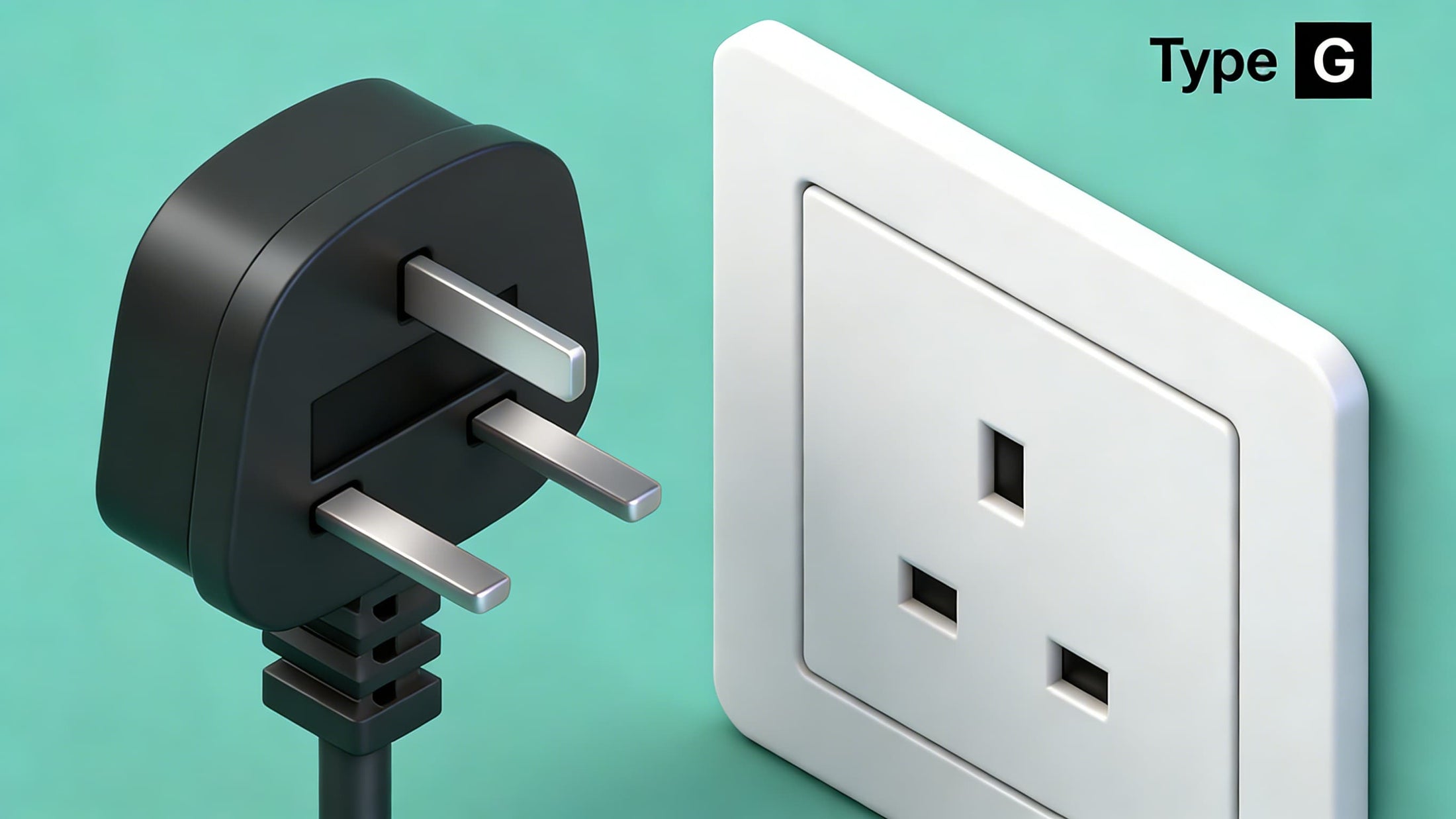
Singapore and Malaysia are good examples of a clear plug shape with a real voltage warning. Once you see the large Type G socket, the shape question is solved. The remaining question is whether your device is designed for 230V.
9. Troubleshooting in Singapore and Malaysia
If your charger does not fit a Type G outlet, do not force it. Type G outlets are large, grounded, and often shuttered. A proper adapter should open the shutters and sit firmly. A weak or badly shaped adapter can make charging unreliable even when the voltage decision is correct.
If a device charges slowly from a hotel USB port, use your own wall charger. Built-in USB ports are convenient for phones, but they may be too slow for tablets, battery packs, and travel routers. Business travelers should treat hotel USB as a backup, not the primary charging plan.
If a heat tool smells hot, makes unusual noise, or trips the room power, unplug it. A 120V-only tool on 230V is not a small mismatch. It can fail quickly, and a plug adapter cannot protect it. For grooming routines, dual-voltage tools or hotel equipment are the safer options.
10. Final Decision Flow
- Get Type G plug support first. Shape is the obvious barrier in both Singapore and Malaysia.
- Check for
100-240V. If you see it, use plug adaptation only. - For
120V-only devices, choose a properly rated converter or leave the device home. - For high-watt heat devices, prefer hotel or local-rated equipment unless you have verified compatibility.
This decision flow prevents the common Type G mistake: buying the right plug shape and assuming the rest is solved. Shape is only step one. Voltage and load decide whether the device is actually safe.
11. How to Choose What to Buy
For Singapore and Malaysia, start with Type G. A Type G adapter is not optional if your US plug does not fit. But once the plug shape is solved, separate your devices into two groups: wide-voltage electronics and 120V-only appliances. Most modern electronics belong in the first group, and they are easy with the right adapter or GaN charger.
The second group is where mistakes happen. A 120V-only steamer, hair dryer, curling iron, or small kitchen appliance is not made for 230V. A plug adapter will let it connect physically, but that physical connection is exactly the problem. You need either a properly rated voltage converter, a dual-voltage version, or a decision to leave it home.
For business travelers, the most useful purchase is usually a compact high-output charger. It keeps the laptop, phone, tablet, watch, and headphones moving without depending on hotel USB ports. For families, one reliable charging station can reduce the pile of small chargers fighting for one outlet.
For island or resort travel, add redundancy. A power bank and spare cable can matter more than a second plug adapter. Outlets may not be exactly where you want them, and camera or phone charging often happens during short breaks. The goal is not just compatibility; it is a calmer nightly charging routine.
12. FAQ
Do I need a voltage converter for Singapore?
Only for 120V-only devices. Dual-voltage electronics need a Type G adapter.
Do I need a voltage converter for Malaysia?
The same rule applies: 120V-only devices need conversion; wide-voltage electronics do not.
What plug type do Singapore and Malaysia use?
Type G is the main plug type.
Can I use my laptop charger?
Usually yes if it says 100-240V.
Can I bring a US hair dryer?
I would not. Use a local or hotel dryer unless your exact model is compatible.
Is a GaN adapter enough?
For wide-voltage electronics, yes. For 120V-only appliances, no.
Is Singapore power the same as the UK?
The plug style is Type G and the voltage is commonly in the same 230V family, so many UK-rated devices are comfortable there. US travelers still need to check labels because a US-only 120V device is a different story.
Can I use a US extension cord with a Type G adapter?
Be careful. An extension cord does not convert voltage and may not be appropriate for 230V or high-watt loads. For travel electronics, a properly rated multi-port charger is usually a cleaner solution than adapting a whole US power strip.
Do resorts in Malaysia have universal outlets?
Some do, but do not depend on it. Resorts vary by age, room type, and renovation history. Bring Type G support and a charger you trust instead of building your plan around a universal outlet photo from a booking site.
What about camera batteries and drones?
Most official chargers are wide-voltage, but check the label. If you travel for beaches, diving, or content creation, bring enough ports to charge several batteries during limited downtime.
Should I buy a converter for a short Singapore stopover?
Usually no if you only charge phones, tablets, laptops, or cameras with wide-voltage chargers. A Type G adapter or international GaN charger is normally enough for a short stopover.
13. Bottom Line for Singapore and Malaysia
Singapore and Malaysia are not difficult power destinations if you respect the two-step decision. Step one is plug shape: prepare for Type G. Step two is voltage: do not plug 120V-only appliances into 230V through a simple adapter. Once those two facts are separated, most traveler confusion disappears.
For modern electronics, pack light and charge well. For heat tools, steamers, kettles, or any device with a motor, check the label and wattage before departure. For family travel or business travel, prioritize enough reliable USB-C output over carrying extra single-purpose adapters. The best setup is the one that lets you charge everything at night without guessing, overloading, or borrowing a hotel front-desk adapter.
For Singapore and Malaysia, pack for Type G, then decide by device label. That one habit prevents most expensive mistakes. Before you leave, group your gear into "USB-C electronics," "medical or overnight devices," and "heat appliances." The first group usually needs charging organization. The second needs reliability. The third needs the strictest voltage check. If a device falls between categories, treat it as higher risk until the label proves otherwise. This is especially useful when packing with family, because one unlabeled bathroom charger can create the only real power problem in an otherwise simple trip. Check it before the airport, not after arrival, and pack accordingly.


