

1. Voltage and Frequency
Slovakia Standard: 230V voltage, 50Hz frequency.
US Standard: 120V voltage, 60Hz frequency.
Key Differences:
- Slovakia voltage is nearly double the US (230V vs 120V)
- Different frequency (50Hz vs 60Hz): Most modern switched-mode power supplies are unaffected, but devices with induction motors (such as older coffee makers with mechanical timers) or AC-frequency-dependent clocks will keep inaccurate time
- Completely incompatible plugs: US uses Type A/B, Slovakia uses Type C/E
Risk Warning: Plugging 110V-only US appliances (like hair dryers, curling irons) directly into Slovakia outlets will cause immediate device burnout or even fire hazards.
2. Local Outlet Types
Slovakia primarily uses Type E outlets, and Type C (Europlug) plugs fit directly into them.
Type E outlets feature two round holes with a grounding pin, and are the standard across Slovakia, Czech Republic, France, and Belgium.

Type C (Europlug) has two round 4mm pins with no grounding. It fits directly into Type E sockets and is commonly found on low-power devices like phone chargers.
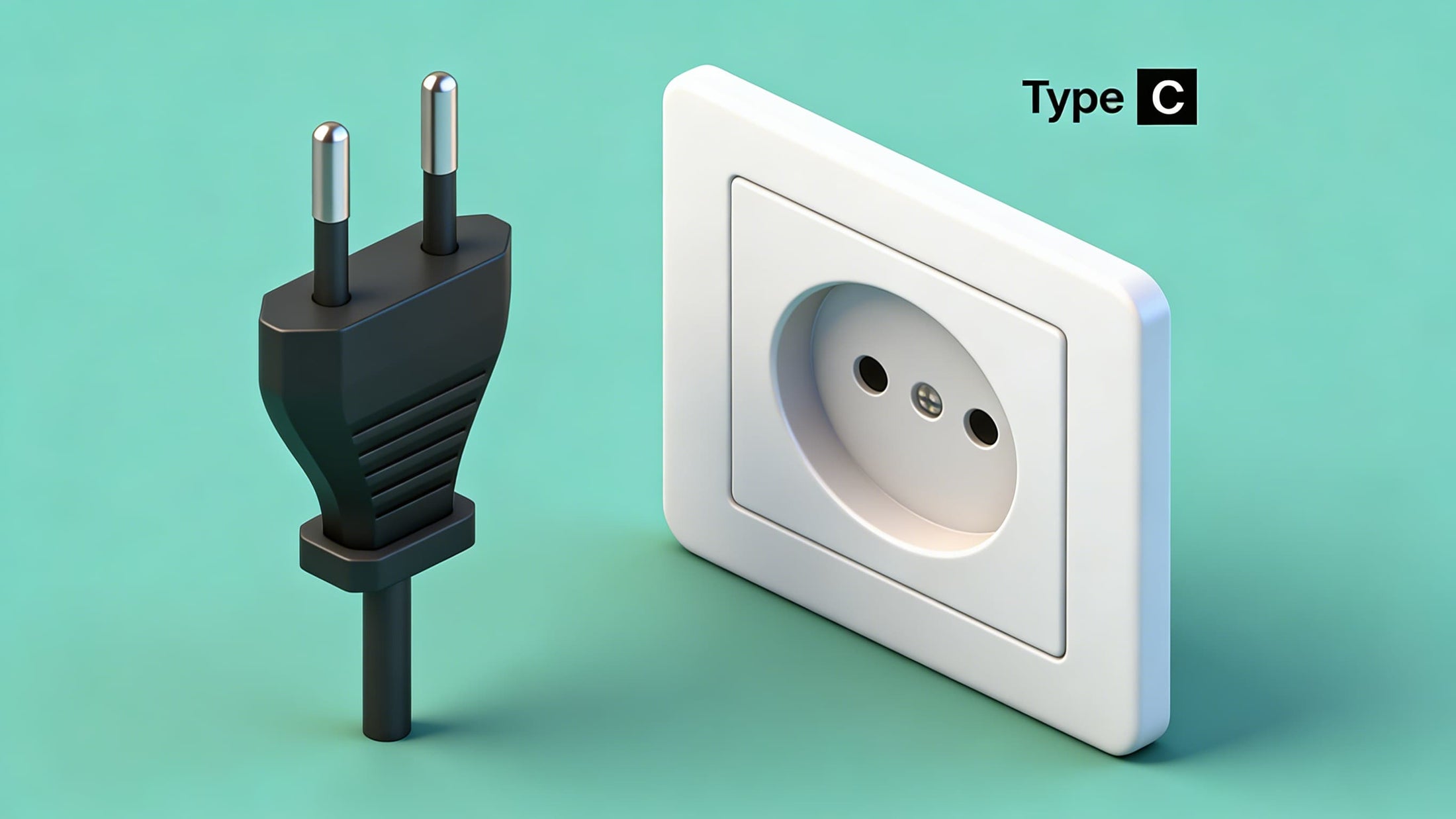
On-the-Ground Outlet Situation
In Bratislava's Old Town and other historic areas, some older buildings may have vintage two-pin sockets without reliable grounding. Modern hotels, shopping malls, and new apartments are all equipped with standard Type E grounded outlets. Mountain resorts and rural guesthouses may have older installations — bring adapters with proper grounding to handle the variety.
3. Device Classification + Travel Essentials
Dual Voltage Devices (Adapter Only)

Check your device label:
- If labeled "100-240V" or "110-240V": Adapter only, no converter needed
- Common devices: Phone chargers, laptops, camera chargers, iPads, electric toothbrushes, shavers
Single Voltage Devices (Converter Required)
- If labeled "110V" or "120V": Voltage converter is mandatory
- Common devices: US hair dryers, curling irons, straighteners (unless you bought a dual-voltage travel version)
4. Product Selection Guide
How to Choose the Right Voltage Converter
Step 1: Identify Your Device Type
- Dual Voltage Devices (100-240V): Only need a plug adapter, no voltage converter required. Includes: Phone chargers, laptops, camera chargers, iPads, etc.
- Single Voltage Devices (110-120V): Must use a voltage converter. Includes: US hair dryers, curling irons, some electric toothbrushes, etc.
Step 2: Choose Based on Power Requirements
| Device Type | Power Range | Recommended Converter Power |
|---|---|---|
| Phones/Laptops/Cameras | 10-100W | 200W+ |
| Curling Irons/Straighteners | 50-200W | 300W+ |
| Hair Dryers | 1000-2000W | 2000W+ |
| CPAP Machines | 40-90W | Pure sine wave model |
Step 3: Consider Key Features
-
Waveform Type:
- Pure Sine Wave: Best for CPAP machines, cameras, precision electronics, and other high-end appliances
- Modified Sine Wave/Square Wave: Suitable for regular heating tools (mechanical switch hair dryers, curling irons)

- Frequency Conversion: 50Hz to 60Hz conversion is important for precision devices
- Surge Protection: Protects devices from voltage fluctuations (but may be prohibited on cruise ships)
- USB Charging Ports: Convenient for charging multiple devices simultaneously
Reliable Brand References
Popular brands include Anker, Tessan, Epicka, Bestek, and DOACE. We recommend searching "voltage converter for travel" on Amazon and comparing different brands based on power, waveform type, and user reviews to find the product that suits your needs.
5. Practical Travel Tips
Phones/Laptops/Power Banks: Adapter only is sufficient (almost all modern devices are dual voltage). Note that power bank air transport regulations in Europe may differ from US rules — confirm your power bank is under 100Wh (approx. 27,000mAh at 3.7V). Units over 100Wh require airline declaration, and those over 160Wh are prohibited on flights.
Hair Dryers/Curling Irons: Buy a dual-voltage travel version, bring a voltage converter, or purchase a local-voltage hair dryer at Slovakia's electronics chains (such as Nay or Datart) — affordable and eliminates the need for a converter altogether.
Prepare in Advance: Purchase "US to Slovakia adapters" + "Voltage Converter" on Amazon or at retail stores, and bring 2-3 spares.
Hotels/Airports: Hotels typically have limited adapters for borrowing, but supplies run out during peak times.
Outlet Selection: Slovakia's power system is stable with minimal voltage fluctuations, though older buildings may occasionally have outdated sockets. Prioritize adapters with grounding features.
Frequency Note: AC-frequency-dependent clocks will run about 17% slow in Slovakia's 50Hz environment compared to the US 60Hz standard — use battery or quartz clocks instead. Devices with induction motors (e.g., mechanical timers in older coffee makers) may also behave abnormally. Modern switched-mode power supplies (phone chargers, laptops) are completely unaffected by frequency differences.
Check Device Labels: Always verify voltage specifications before departure. If labeled "100-240V", only an adapter is needed; if labeled "120V only", a transformer is mandatory.
Long Press to Activate: Some converters use touch switches and require a long press of 2-3 seconds to activate output. Please check the product manual.
Avoid Specific Appliances: We strongly recommend not using juicers, coffee makers, irons, or steamers with portable transformers, as their startup peak power is extremely high and may trigger overload protection.
Outlet Depth Note: Some outlets in Slovakia may be recessed. If your adapter feels loose, choose an adapter that meets the CEE 7/7 standard — this is a universal plug compatible with both Type E (French grounding pin) and Type F (German grounding clips), providing a secure grounded connection throughout Slovakia and continental Europe.
Cruise Policy: Most cruise lines prohibit converters with surge protection, not all converters. We recommend choosing pure transformer models without surge protection, and checking your specific cruise line's policies in advance (e.g., Royal Caribbean, Virgin often have such restrictions).
6. Frequently Asked Questions (FAQ)
Q1: Can I use my iPhone charger in Slovakia?
A: Yes. iPhone chargers are dual voltage devices (100-240V). You only need a plug adapter to convert your US Type A/B plug to Slovakia's Type E. No voltage converter is required.
Q2: Do I need a voltage converter for Slovakia?
A: It depends on your devices. Phones, laptops, and other dual voltage devices only need adapters; US hair dryers, curling irons, and other single voltage devices (labeled 110V/120V) must use a converter — plugging them in directly will destroy them instantly.
Q3: Are Slovakia outlets the same as Czech Republic and Austria?
A: Very similar. Slovakia and Czech Republic both primarily use Type E outlets. Austria mainly uses Type F (Schuko). A CEE 7/7 adapter (compatible with both Type E and Type F) works throughout Slovakia, Czech Republic, and Austria — as well as most of Central Europe.
Q4: Why can't my Dyson hair dryer work with a 2000W transformer?
A: 2000W transformers typically use SCR technology for voltage reduction, which produces an incomplete waveform. Precision devices like Dyson with electronic chips will detect this as a fault and shut down automatically. Even with a pure sine wave converter, Dyson officially advises against using their US-market products in countries with different voltages, as the motor is prone to long-term damage when running on non-native voltage. The safest option is to buy a local-voltage version at your destination or choose a dual-voltage travel hair dryer.
Q5: How do I choose the right voltage converter for my needs?
A: First, check the power rating on your device's label and choose a converter with 1.2-1.5 times the device's power. For precision electronics, choose pure sine wave output; for regular heating tools, modified sine wave is acceptable. Note that motor-based devices may have startup peaks 3-7 times their rated power.
Q6: Can I use a voltage converter on a cruise ship?
A: Yes, but cruise ships typically prohibit devices with surge protection. Choose models without surge protection and confirm the cruise line's specific policies in advance.


