

Kitchen appliances are the opposite of phone chargers: they are usually single-voltage, high-wattage, heat-producing devices.
This article explains why travel adapters are not enough for most countertop appliances. If you need the basic adapter-versus-converter distinction first, read why a universal adapter is not a voltage converter.
That adapter-versus-converter distinction becomes especially important with heat-producing kitchen appliances because the wattage margin is much smaller than it is for phone chargers.
Figure: Heating appliances quickly exceed the range of compact low-watt travel converters.
Why a Plug Adapter Is Not Enough
A plug adapter only changes the shape of the plug. It does not turn 230V European, Australian, or Asian power into 120V US power. A 120V appliance plugged into 230V can overheat, burn out, or trip protection immediately.
Most Instant Pot and similar US kitchen appliances are sold in region-specific voltage versions. Check the silver label near the cord entry or underside before packing. If it says 120V 60Hz, it is not ready for 220-240V outlets.
Device-by-Device Decision Table
| Appliance | Typical US rating | Bring abroad? | Better option |
|---|---|---|---|
| Instant Pot | 120V, around 700-1200W | Usually no | Buy or borrow a local-voltage cooker |
| Rice cooker | 120V, around 300-1000W | Only with proper converter | Use accommodation kitchen appliance |
| Electric kettle | 120V, often 1000-1500W | Usually no | Use hotel kettle or buy local |
| Coffee grinder | 120V motor load | Maybe, but check wattage | Dual-voltage travel grinder |
| Phone/laptop charger | 100-240V | Yes | Plug adapter only |
For hair tools and other high-watt travel devices, the same wattage logic applies. Our hair tool wattage tier guide explains how converter capacity changes by device type.
If You Must Bring One
- Read the label: note voltage, watts, and frequency.
- Add headroom: do not run a converter at its limit for a heating cycle.
- Consider duty cycle: a kettle heats fast but draws high peak power; a cooker may run longer.
- Avoid stacking adapters: loose connections around heat loads are a bad travel setup.
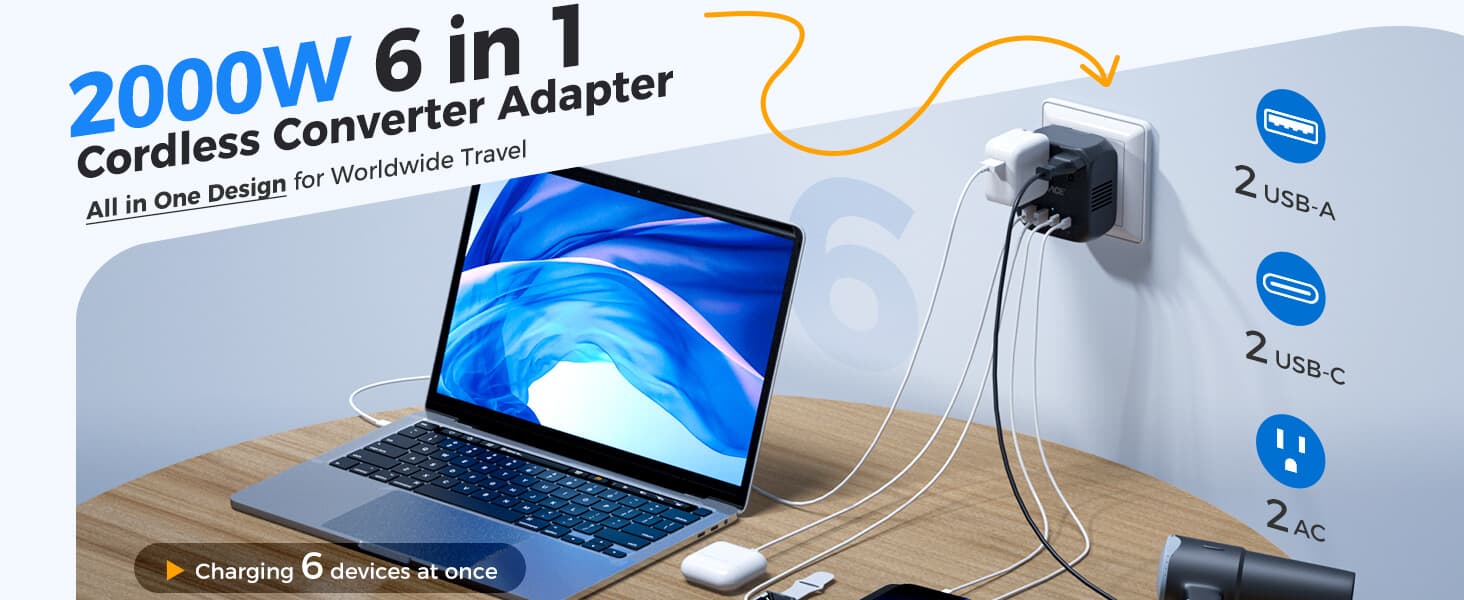
For high-watt 120V heating appliances under the supported range, a converter such as the DOACE C15 2000W voltage converter is the category to consider. It is still not a blanket approval: match your appliance wattage and follow the appliance manufacturer instructions.
Frequency: The 50Hz Detail Travelers Miss
The US uses 60Hz. Many 220-240V countries use 50Hz. Pure heating elements usually care more about voltage than frequency, but appliances with timers, motors, pumps, or electronic controls may behave differently. That is another reason bulky kitchen appliances are poor travel candidates.
FAQ
Can I use a 2000W converter for a 1500W kettle?
Possibly, but only if the converter is rated for continuous heating loads and the kettle manufacturer does not forbid converter use. Leave headroom and monitor heat.
Are dual-voltage kettles real?
Yes, some travel kettles are dual-voltage, but you must switch or verify the voltage before use.
Is an Instant Pot worth bringing for a long stay?
For a long stay, buying a destination-voltage model is usually cleaner, safer, and less bulky than carrying a heavy converter.


