

A creator kit fails in a different way from a normal vacation kit. A tourist can wake up with one phone at 60% and still have a good day. A photographer with two empty camera batteries, a drained drone controller, and a laptop waiting to offload cards has a production problem. So the question is not just "Do I need an adapter?" The better question is: which device must be charged first, which port needs the most wattage, and which battery cannot go in checked luggage?
Start with the DOACE 4-Check method: Shape, Voltage, Load, and Use Case. Shape is the local wall outlet. Voltage is the INPUT line on each charger. Load is your real simultaneous charging demand. Use Case is the shooting rhythm: overnight hotel charging, a quick top-off between locations, same-day editing, or a multi-day assignment with limited outlets. For the basics, see our power label reading guide and adapter vs converter guide.
Figure 1: Creator power planning is driven less by voltage conversion and more by simultaneous wattage demand across camera, drone, and editing devices.
The Creator Power Problem Is Scheduling, Not Just Plug Shape
Most modern camera battery chargers from major brands are designed for worldwide input, but that does not mean the kit is simple. The hard part is that every device wants to charge during the same window: after a shoot, before a sunrise call time, or while files are being copied. A weak hotel USB port or a low-watt phone brick becomes the bottleneck.
Think of your power kit like a call sheet. The laptop gets priority when you must offload cards or edit. Drone batteries get priority if tomorrow's location is aerial-heavy. Camera batteries get a rotation slot all night. Phones, earbuds, microphones, and action cameras charge last because they draw less power and recover faster.
Device Matrix for Photographers and Videographers
| Device | What to read before travel | What usually matters most | Travel power answer |
|---|---|---|---|
| Mirrorless camera battery charger | INPUT line on charger or USB-C charging spec | Voltage is usually fine; charge time is the issue | Plug adapter or USB-C PD charger if 100-240V |
| Cinema camera batteries / V-mount charger | AC input range, wattage, battery airline limits | Higher power draw and lithium transport rules | Verify charger label; pack batteries according to airline rules |
| Drone batteries and charging hub | Hub input, USB-C PD requirement, battery Wh rating | Airline carry-on rules and charging order | Adapter/PD charger for wide-voltage hub; no checked loose lithium batteries |
| Laptop for backup or editing | Power brick input and required USB-C wattage | 65W, 100W, or 140W headroom | High-output GaN adapter with a rated cable |
| Monitor, LED light, audio receiver | Each AC adapter label, not the device name | Third-party chargers vary | Adapter only if 100-240V; otherwise investigate before packing |
The 4-Check Workflow for a Camera Bag
1. Shape: plan for the countries, not the camera brand
Your Sony, Canon, Nikon, Fujifilm, DJI, or Blackmagic charger does not determine the wall outlet. The destination does. If the trip crosses the UK, continental Europe, Australia, and Asia, a universal adapter is more useful than a pile of single-region plugs. For outlet shapes, use the DOACE World Plug Types library.
2. Voltage: read the charger, not the camera body
Look for `INPUT: 100-240V, 50/60Hz` on the actual charger or power brick. If you see that, you usually do not need a voltage converter. If a charger says only `120V`, stop and investigate before travel. Do not guess from the brand name or from a forum comment about a different charger.
3. Load: count peak charging demand
A phone plus one camera battery is easy. A laptop, two camera batteries, a drone hub, and a wireless mic case is a different load. USB-C PD wattage has to be shared across ports, and some chargers reduce output when multiple ports are active. This is why creator kits benefit from more headroom than a basic tourist kit.
4. Use Case: build a charge order
Do not plug in everything and hope. Put devices into tiers: mission-critical capture batteries first, laptop/backup second, phone and small accessories third. On a paid shoot, a simple charging order is often more valuable than another cheap adapter.
Recommended DOACE Setup: 140W GaN for Creator Kits
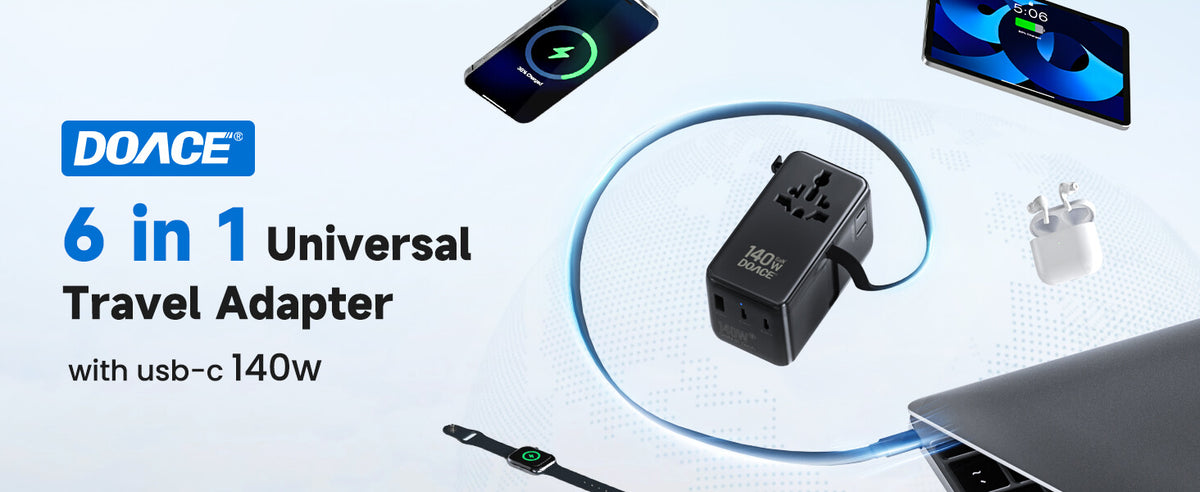
For photographers and videographers carrying a laptop plus camera or drone gear, the DOACE 140W GaN Travel Adapter is the most appropriate DOACE recommendation because the article's problem is USB-C PD headroom, not voltage conversion. It can consolidate charging for a laptop, phone, camera accessories, and many USB-powered creator devices while covering international plug shapes.
What Not to Bring
- A voltage converter for every camera charger when the labels already say 100-240V.
- Unrated USB-C cables for laptop, drone hub, or high-watt charging.
- Loose lithium batteries in checked luggage.
- A bulky surge power strip for a hotel, cruise cabin, or conference venue without checking rules.
- Only one charging cable for a paid assignment.
Common Mistakes
- Mistake 1: reading the camera body instead of the charger. Voltage compatibility lives on the power brick or charging hub.
- Mistake 2: using hotel USB ports for mission-critical batteries. They are often slow and may not support the required protocol.
- Mistake 3: ignoring cable ratings. A high-watt USB-C port cannot help if the cable is the limiting factor.
- Mistake 4: charging everything at the same priority. Capture batteries and backup drives should win over convenience accessories.
- Mistake 5: forgetting airline battery rules. Wall power does not matter if the battery cannot legally travel the way you packed it.
FAQ
Do I need a voltage converter for camera batteries overseas?
Usually no, if the charger says 100-240V, 50/60Hz. You still need the right plug shape or a universal adapter.
Do drone chargers work internationally?
Many modern drone chargers and hubs support worldwide input, but check the exact charger label. Also check airline rules for lithium battery watt-hour limits and carry-on packing.
Is 70W enough for a photographer?
It can be enough for a phone, one camera charger, and light accessories. A laptop-plus-drone kit is more comfortable with 100W or 140W headroom.
Can I charge my laptop and camera batteries at the same time?
Yes if your adapter has enough shared output and your cables are rated for the required wattage. If charging slows down, charge the laptop first, then rotate batteries.
Should I bring original camera chargers or USB-C chargers?
Bring the original charger when reliability matters, especially for paid work. USB-C charging is convenient, but original chargers are useful backups and may charge batteries more predictably.
Can I rely on hotel USB ports?
Not for camera batteries, drone hubs, or laptops. Treat hotel USB ports as slow phone ports, not as production charging infrastructure.
What is the best one-bag creator power kit?
One high-output GaN travel adapter, two rated USB-C cables, one short phone cable, one original charger for the most critical camera system, and a written charging order for the shoot.
When would a photographer need a voltage converter?
Only when a specific charger or production accessory is single-voltage, such as 120V-only. That is uncommon for modern camera chargers but possible with older or specialized equipment.
This article is for informational purposes only. Always verify your exact charger label, airline battery rules, venue policy, and DOACE product specifications before using electrical equipment abroad.


