

Hair tools are one of the easiest travel power categories to get wrong because they look familiar but behave very differently inside. A 45W curling iron, a 90W flat iron, an 1100W dryer brush, a 1875W blow dryer, and a Dyson-style digital motor tool do not ask the converter for the same kind of power.
The safe order is simple: check voltage first, then wattage, then load type. A plug adapter can make a US plug fit a European outlet, but it does not reduce 230V to 120V. Country references such as IEC World Plugs and WorldStandards show why plug shape, voltage, and frequency must be checked separately.
| What you see on the label | What it means | What to pack |
|---|---|---|
| 100-240V 50/60Hz | Wide-voltage tool | Plug adapter only |
| 120V 60Hz 60W | Low-watt US single-voltage tool | Step-down converter in 220-240V countries |
| 125V 1875W | High-watt dryer class | High-watt route only if compatible; local or hotel dryer is often safer |
| 120V 15A | About 1800W because watts = volts × amps | Treat as high-watt dryer class |
| Dual voltage with 125/250V switch | Manual dual-voltage tool | Set the switch before plugging in, then use plug adapter |
| No readable label | Unknown risk | Do not guess; check manual or use a clearly labeled travel tool |
Typical planning ranges. Always use the number on your own tool label.
Step 1: Voltage Comes Before Wattage
If your tool says 100-240V or 110-240V, it is designed to accept both low-voltage and high-voltage regions. You normally need only the correct plug adapter. If it says 120V or 125V only, it is a North American single-voltage tool. In Europe, the UK, Australia, New Zealand, India, and many other 220-240V destinations, it needs voltage conversion or replacement.
This is why a plug adapter can be dangerous when used with the wrong tool. Electrical Safety First describes a travel adaptor as a way to connect a plug to a foreign socket; it is not the same thing as a voltage converter. Their Germany travel adaptor guidance and similar destination pages list voltage as a separate item from plug type.
Step 2: Match the Wattage Tier
After voltage, read the wattage. If watts are not printed but amps are printed, estimate watts with this formula:
A label that says 120V and 15A is about 1800W. That is not a small styling tool; it is dryer-class power.
| Tier | Common tools | Typical route | Important warning |
|---|---|---|---|
| Under 100W | Mini curling iron, basic curling wand, many flat irons | LC-C30 or LC-X35 if voltage conversion is needed | Best converter-friendly category, but label still decides |
| 100-300W | Wide-plate flat iron, hot rollers, heated brush | LC-X80 or higher depending on label and load type | Do not confuse a heated brush with a hot air dryer brush |
| 300-800W | Some compact or specialty tools | LC-X80 only if the tool is compatible | Many dryer brushes exceed this tier |
| 800-1875W | Hot air brush, dryer brush, standard hair dryer | C15 or HC-X11 only for compatible traditional tools | Hotel, local-voltage, or dual-voltage dryer is often safer |
| Smart motor or over-limit | Dyson, Shark, Laifen, salon dryer | Do not rely on generic travel conversion | Use travel-ready or local-voltage version |
Under 100W: Curling Irons and Many Flat Irons
This is the easiest converter category when the tool is single-voltage. Many simple curling irons, curling wands, mini straighteners, and basic flat irons use modest wattage and behave mostly like resistive heating loads. A mainstream curling iron such as Conair’s Instant Heat curling iron is a useful category example: these tools are very different from a full-size hair dryer.
If your label says 120V only and the wattage is under 100W, the DOACE LC-C30 300W converter is usually the first route to check. If the tool has digital temperature control or you want a cleaner waveform option within the same low-watt class, check the DOACE LC-X35 pure sine wave converter.

100-300W: Larger Stylers, Hot Rollers, and Heated Brushes
This tier needs more attention. A wide-plate flat iron, large hot-roller set, or heated brush may draw more than a small curling iron. If the label says 120V only and the wattage is above the low tier, use more headroom. The DOACE LC-X80 800W converter is the practical route for compatible medium-watt tools.
Some premium straighteners are already travel-ready. For example, ghd lists universal voltage on some current stylers such as the ghd Platinum+ styler. That does not mean every styler from every brand is universal voltage. It means the exact model label matters.

Dryer Brushes: Do Not Size Them Like Curling Irons
A dryer brush is the category most likely to be misjudged. It may look like a brush, but if it blows hot air, it behaves closer to a hair dryer than a curling iron. Revlon’s One-Step Hair Dryer and Volumizer is described as a dryer and volumizer, and retailer listings such as Target’s Revlon One-Step listing show why this category can sit around dryer-class wattage rather than curling-iron wattage.
1200-1875W: Standard Hair Dryers
A full-size US hair dryer is the hardest ordinary hair tool to travel with. Many are in the 1200-1875W range. That can exceed compact converters by a large margin and leaves limited headroom even on high-watt routes. Hair dryers also combine a heater and motor, run for several minutes, and create heat inside the converter.
If you bring a compatible traditional dryer and the label is within range, compare the DOACE C15 2000W converter and the DOACE HC-X11 2200W converter. But be honest about headroom. A 1875W dryer on a 2000W converter has only 125W of raw margin. A 20% planning margin would put 1875W at 2250W, which is above 2200W.
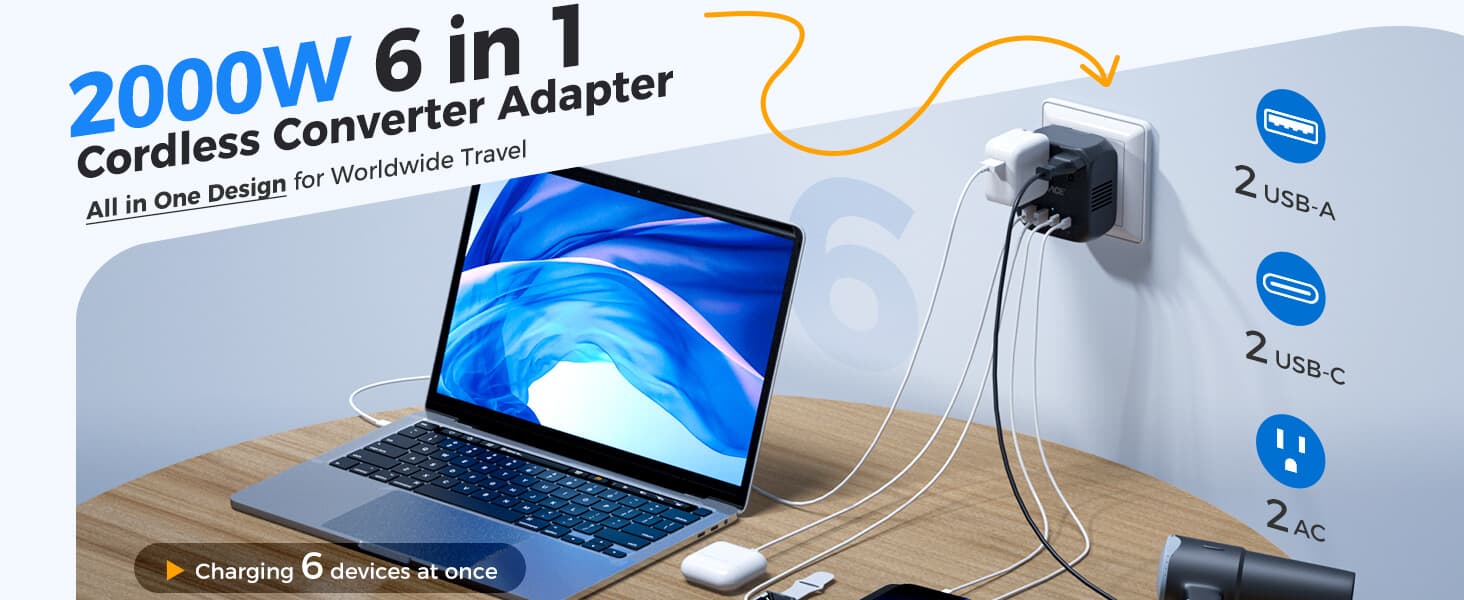
That does not mean a high-watt converter is useless. It means high-watt hair dryers need conservative use, ventilation, one device at a time, and compatibility checking. For many trips, a hotel dryer, a dual-voltage travel dryer, or a destination-voltage dryer is the safer and lighter route. Conair’s travel dryer manuals, such as the Conair 1875W travel dryer manual, show that travel-ready dryer design is a separate concept from forcing a domestic dryer through a converter.
Why the “Low Setting” Is Not a Safe Shortcut
Do not size a converter for the dryer setting you hope to use. Size it for the maximum label rating. A low setting may not have a separate printed wattage, the switch can be bumped, and the motor still runs with the heater. If the converter shuts down, flashes, clicks, or smells hot, stop using the setup.
For a deeper explanation of continuous watts, peak watts, startup surge, and why the largest number on a listing is not always the planning number, use our continuous vs peak wattage guide.
Dyson, Shark, Laifen, and Other Smart Hair Tools
Dyson-style and high-speed smart hair tools are not ordinary curling irons. They may include brushless motors, sensors, power electronics, and intelligent heat control. A converter can step voltage down but still fail the compatibility question. Pure sine wave also does not magically solve wattage, regional voltage design, or manufacturer limits.
Dyson’s own product line shows the difference clearly. The Dyson Supersonic Travel hair dryer is marketed with automatic 100-240V adaptation. That is very different from assuming every regional Dyson hair tool is globally compatible. For standard Dyson Supersonic, Airwrap, or Airstrait questions, use our detailed Dyson voltage converter guide.
Dual-Voltage Tools vs Carrying a Converter
If you travel often, a dual-voltage hair tool can be the cleanest solution. A tool marked 100-240V needs only a plug adapter in most destinations. Conair’s worldwide travel dryer instructions and dual-voltage compact dryer instructions are useful examples of tools designed around travel voltage.
Manual dual-voltage tools require one extra step: set the voltage switch before plugging in. Forgetting to move a 125V/250V switch before using a 230V outlet can damage the tool. Automatic dual-voltage tools remove that switch, but the label still needs to confirm the input range.
DOACE Converter Routing Table
| Your situation | Best route to check | Avoid this mistake |
|---|---|---|
| Hair tool says 100-240V | Plug adapter only | Do not buy a converter you do not need |
| 120V-only curling iron under 100W | LC-C30; LC-X35 if sensitive and within rating | Do not use plug adapter alone in 230V country |
| 120V-only flat iron or heated brush 100-300W | LC-X80 or higher, if compatible | Do not treat digital controls as simple heat without checking |
| Hot air brush around 1000W | Usually high-watt or local-voltage route | Do not size it like a curling iron |
| Traditional 120V dryer 1200-1875W | C15 or HC-X11 only if compatible and used conservatively | Do not rely on low setting or poor ventilation |
| Dyson/Shark/Laifen high-speed tool | Travel-ready or local-voltage version | Do not assume wattage alone proves compatibility |
Converter route by label, wattage tier, and compatibility risk. This chart avoids treating smart motor tools as normal wattage-only loads.
Pre-Trip Checklist
- Take a clear photo of the label on every hair tool.
- Confirm destination voltage and plug type before packing.
- If the label says 100-240V, pack a plug adapter.
- If the label says 120V only, read or calculate wattage.
- Identify the load type: simple heat, heat plus fan, smart motor, or cordless battery.
- Choose by continuous wattage and leave headroom.
- Run only one heat tool at a time.
- Keep the converter on an open surface with airflow.
- Stop immediately if the converter shuts down, flashes, clicks, smells hot, or becomes too hot to touch.
- For expensive smart tools, prefer a travel-ready or destination-voltage version.
Quick Reference: Hair Tool to Converter Match
| Hair tool | Common wattage | If 120V-only in 220-240V country |
|---|---|---|
| Mini curling iron | 15-40W | LC-C30 usually enough after label check |
| Standard curling wand | 25-100W | LC-C30 or LC-X35 depending on controls |
| Flat iron / straightener | 40-150W | LC-C30, LC-X35, or LC-X80 by label wattage |
| Heated brush | 80-250W | LC-X80 if above low tier |
| Hot air brush / dryer brush | 800-1200W+ | High-watt or local-voltage route; not compact converter |
| Standard hair dryer | 1200-1875W | C15/HC-X11 only if compatible; hotel or local dryer often safer |
| Dyson / Shark / Laifen smart tool | Model-specific, often high | Do not rely on generic converter; use travel-ready or local-voltage version |
Frequently Asked Questions
What wattage converter do I need for a 60W straightener?
If the straightener is 120V-only and you are going to a 220-240V country, a 60W tool needs voltage conversion. A 300W converter such as LC-C30 gives plenty of wattage headroom for a simple low-watt straightener. If the straightener is marked 100-240V, you do not need a converter.
Can I use a curling iron in Europe with just a plug adapter?
Only if the label says 100-240V or 110-240V. If it says 120V only, a plug adapter alone can expose it to European 220-240V power. Use a step-down converter or a dual-voltage curling iron.
Can I use an 1875W hair dryer with a 2000W converter?
Be careful. A 1875W dryer leaves only 125W of raw margin on a 2000W converter. That is less than a conservative 20% headroom target. Use a high-watt route only if the dryer is a compatible traditional load, the converter guidance supports it, and you can keep the setup ventilated. A local or hotel dryer is often safer.
Can I use my dryer on low with a smaller converter?
Do not size by the setting you hope to use. Size by the maximum label rating unless the manufacturer gives a separate low-setting wattage and you can prevent accidental high use.
Is a dryer brush the same as a curling iron for converter sizing?
No. If it blows hot air, it usually behaves closer to a hair dryer. Many dryer brushes are far above the wattage of curling irons and flat irons.
Can I use Dyson Airwrap or Supersonic with a voltage converter?
Do not treat Dyson-style smart tools as ordinary converter loads. They can combine high wattage, digital motor control, sensors, and regional voltage design. Use a model designed for the destination voltage or a travel-ready version.
Is a dual-voltage hair tool better than a converter?
For frequent travel, often yes. A confirmed 100-240V curling iron, straightener, or compact dryer is simpler and lighter. A converter makes sense when you already own a compatible single-voltage tool and want to keep using it abroad.
What if my label only lists amps?
Multiply volts by amps. For example, 120V × 15A is about 1800W. That belongs in the high-watt dryer tier, not the small-styler tier.


