

A short trip lets you tolerate compromise. A long-term stay exposes every weak point: warm adapters, loose outlets, daily appliance use, shared apartments, old wiring, and the need to leave devices plugged in safely. That is why expat power planning should be split into three layers: a first-week charger kit, a transformer-based setup for 120V-only devices, and local replacement for high-watt household appliances.
Use the DOACE 4-Check method: Shape, Voltage, Load, and Use Case. Shape is the local outlet. Voltage is the INPUT label. Load is the wattage and duty cycle. Use Case is the real-life pattern: all-day work laptop, overnight medical device, daily converter use, or occasional grooming tool. Review our power label reading guide before you pack anything expensive.
Figure 1: The longer the stay, the more high-watt daily appliances should shift from converter use to local replacement.
Short-Trip Logic Breaks After Six Months
A travel adapter is excellent for getting through airports, hotels, and the first apartment week. It is not meant to turn every US household appliance into a permanent overseas appliance. Long-term use changes the engineering problem: stability, ventilation, copper mass, continuous rating, grounding, and duty cycle matter more than pocket size.
The right expat plan is boring in the best way: bring electronics that are already wide-voltage, use a real transformer plan for 120V-only devices you truly need, buy high-watt daily appliances locally, and treat GaN chargers as convenient charging companions rather than voltage-conversion tools.
For Six Months, Think Transformer First
If you are living abroad for half a year or longer, the question is no longer “What can I fit in a carry-on?” It becomes “What can sit on a desk, stay ventilated, handle repeated use, and keep output stable without being pushed to its limit?” That is where a large copper-wound step-down transformer makes sense. The copper coil and heavier transformer body are not a flaw; they are part of what allows a transformer to handle sustained conversion more comfortably than a tiny travel adapter-style device.
Use this rule: if you have one or two compact 120V-only devices that travel with you, a portable pure sine wave transformer may be enough. If you have several 120V-only devices that will live in one apartment for months, especially devices used repeatedly or for long sessions, plan around a properly rated desktop transformer with headroom, ventilation, and local electrical compliance. Do not daisy-chain power strips into small travel converters.
Why Pure Sine Wave Matters for Long-Term Use
For sensitive electronics, medical devices, game consoles, audio gear, and devices with electronic control boards, the quality of the output waveform matters. A pure sine wave transformer is designed to deliver a smoother waveform closer to normal household AC power. A modified or stepped waveform can be acceptable for some simple loads, but it is not the preferred long-term choice for sensitive devices.

Figure 2: Pure sine wave vs. modified wave — a smooth waveform is the safer default for sensitive long-term electronics.
Bring, Buy, or Convert Matrix
| Item | Best long-term decision | Why | DOACE-style note |
|---|---|---|---|
| Phone, laptop, tablet, camera charger | Bring | Usually 100-240V and easy to power | Use GaN only as a charging companion |
| CPAP or medical device | Verify before bringing | Overnight reliability matters more than convenience | Prefer pure sine wave if conversion is required |
| Hair dryer, kettle, rice cooker, steamer | Buy locally | High-watt daily loads are poor converter habits | Do not build daily life around conversion |
| One or two special 120V-only devices | Convert selectively | Only if hard to replace and matched to wattage | Prioritize pure sine wave transformer models |
| Several 120V-only devices in one apartment | Use a fixed transformer plan | Long daily use needs headroom and ventilation | Large copper-wound step-down transformer is the stable baseline |
| Desktop workstation | Audit carefully | PSU may be wide-voltage, monitor and grounding still matter | Check every power brick, cord, and grounded outlet |
The First-Week Kit
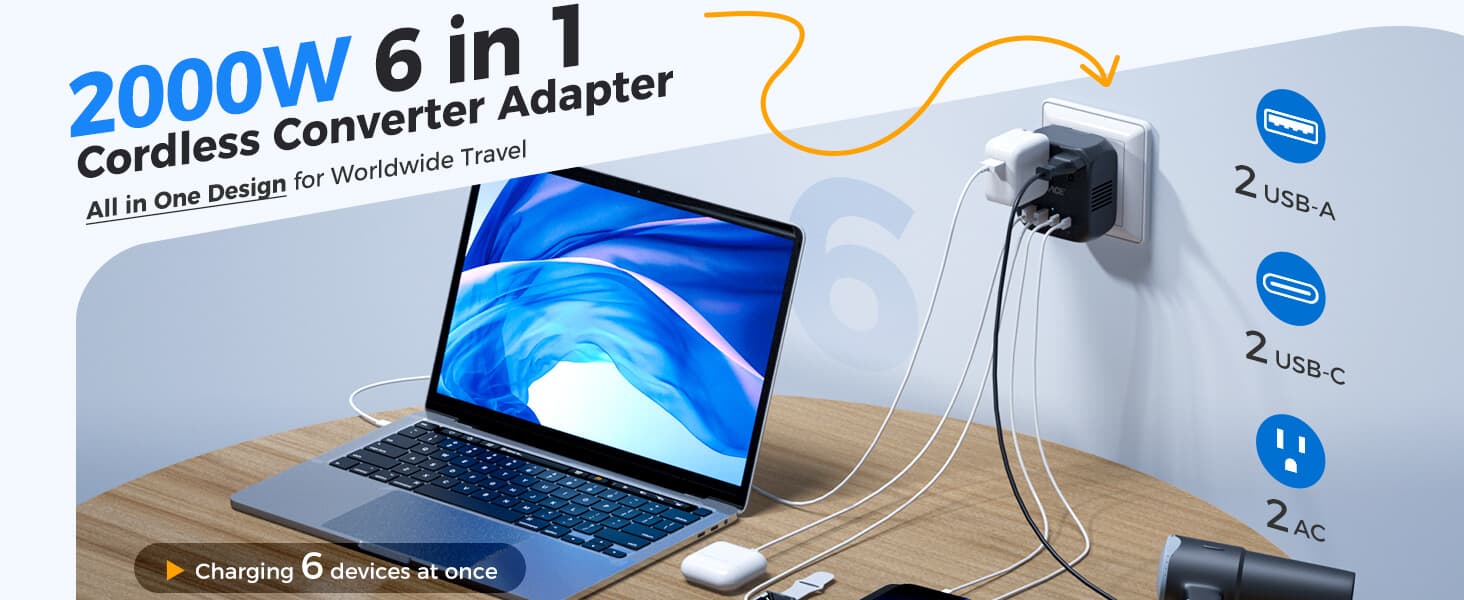
Pack one high-quality travel adapter/charger, one backup plug adapter, rated USB-C cables, original laptop chargers, and any medical device power supplies. That kit keeps work, communication, banking, navigation, and medical essentials running while you learn the apartment's outlets and buy local appliances.
During the first week, inspect outlet firmness, grounding, and location. Ask the landlord which outlets are appropriate for high-power appliances. If an outlet is loose, warm, buzzing, or sparks, do not use it for a converter or a high-load device.
Recommended DOACE Setup: Transformer First, GaN Second
For a long-term stay with 120V-only devices, start with a transformer decision. The DOACE LC-X80 800W Pure Sine Wave Voltage Converter is the stronger DOACE travel-transformer recommendation when the user needs a cleaner waveform, more headroom than compact 300-500W models, and multiple outputs for selected devices under its rating. It is especially relevant for sensitive electronics, work setups, game consoles, small fans, humidifiers, and other devices where waveform quality matters.

If the load is lower but still sensitive, the DOACE LC-X35 Pure Sine Wave Voltage Converter is the compact option to evaluate. It should be chosen by actual wattage and device type, not by destination country alone. For several 120V-only devices used daily in one apartment, step up to a properly rated large copper-wound desktop transformer with enough continuous-rating headroom and local safety compliance.

After the transformer question is solved, add a GaN adapter for wide-voltage charging. The DOACE 100W GaN International Power Adapter is practical for laptops, phones, tablets, headphones, camera batteries, and everyday USB devices during the first month abroad.

When a Converter Still Makes Sense
A converter can make sense for a specific 120V-only device that is moderate wattage, used for limited periods, and hard to replace locally. For sensitive electronics and long sessions, pure sine wave should be the first filter. For simple high-watt heat or mechanical devices, a high-power converter may be considered only if the device type is compatible and the use is controlled.
For a high-watt mechanical appliance that is truly worth bringing, a model such as the DOACE C15 2000W Voltage Converter is the category to evaluate, but only after checking wattage, device type, duty cycle, ventilation, and whether local replacement is smarter. Do not use this type of high-power converter as a shortcut for sensitive electronics that need pure sine wave output.
What Not to Ship Overseas
- US-only kettles, rice cookers, steamers, space heaters, or coffee makers.
- A full box of extension cords and surge strips from home.
- Unlabeled adapters for daily use.
- A converter for every appliance instead of buying local high-watt items.
- Any medical device without checking the original power supply and backup plan.
Common Mistakes
- Mistake 1: treating relocation like a vacation. Daily use demands better planning than a two-week adapter setup.
- Mistake 2: converting heat appliances every day. Local appliances are usually the safer long-term answer.
- Mistake 3: ignoring grounding. Old apartments and mixed outlet types deserve a careful inspection.
- Mistake 4: buying cheap local adapters for daily laptop use. Daily-use gear should be well rated.
- Mistake 5: forgetting the return path. If you later move again, local appliances may be easier to sell than ship.
FAQ
Should expats bring US appliances overseas?
Usually not for high-watt appliances. Bring wide-voltage electronics; buy kitchen and heat appliances locally. If several 120V-only devices are truly necessary, plan a fixed transformer setup instead of relying on small travel adapters.
Can I use one travel adapter for six months?
Yes for wide-voltage electronics if the adapter is well rated, ventilated, and not overloaded. No for a household voltage-conversion system. Long-term 120V-only devices need a transformer decision.
Do I need a converter for my laptop?
Usually no. Most modern laptop chargers say 100-240V, but check the label on your actual charger.
What about a CPAP or medical device?
Check the power brick and manual. Overnight medical devices deserve extra verification, a backup power plan, and sometimes manufacturer guidance.
Is a converter safe for daily use?
Only when matched to one specific device, ventilated, and not overloaded. For months of repeated use, choose a transformer with enough continuous-rating headroom; for sensitive devices, prioritize pure sine wave output.
Why are large copper-wound transformers better for long stays?
They are larger and heavier because the transformer coil and thermal mass are part of the design. For fixed apartment use, that extra size can be an advantage: more stable operation, better headroom, and less dependence on tiny travel hardware.
Should I choose pure sine wave or a regular converter?
Choose pure sine wave first for sensitive electronics, medical devices, audio gear, game consoles, devices with control boards, or any device you expect to use often. Use non-pure-sine high-power converters only for compatible loads and short controlled sessions.
What should I buy after arrival?
Local hair tools, kettles, rice cookers, lamps, heaters, irons, and other daily high-watt items.
What should be in the first-week power kit?
A GaN adapter, backup plug adapter, rated USB-C cables, original laptop charger, phone cable, and any medical device power supplies.
Should I replace US power cords with local cords?
For wide-voltage devices with detachable cords, a proper local cord can be cleaner for long-term use. Match the device connector and rating carefully.
This article is for informational purposes only. Always verify your exact device label, housing rules, local electrical conditions, and DOACE product specifications before using electrical equipment abroad.


