

Trade show power is a three-layer problem. First, the venue controls booth electricity. Second, your demo devices have their own voltage and wattage limits. Third, your team still needs to keep laptops, phones, tablets, scanners, and badge readers charged during long show days. Mixing those three layers is how teams end up with overloaded strips, dead demo screens, and cables running through visitor traffic.
Use the DOACE 4-Check method before anything ships: Shape tells you what plug and socket style you need, Voltage tells you whether the device can run in the country, Load tells you whether the booth circuit can support it, and Use Case tells you whether the device belongs on official booth power or a personal charging station. For basics, review our power label reading guide and adapter vs converter guide.
Figure 1: Booth demo power, staff charging, and backup power should be planned as separate loads instead of one improvised adapter stack.
Trade Show Power Is Not Hotel Power
In a hotel, you decide what goes into the wall outlet. In an exhibition hall, the venue may decide where the outlet is, what voltage is supplied, whether an electrician must install it, what extension cords are allowed, and whether power is switched off after show hours. That changes the planning completely.
The first authority is the exhibitor manual, not your travel adapter. Before packing, find the deadline for electrical orders, the available voltage and amperage options, the connector type, the labor rules, and after-hours power policies. If your demo must stay on overnight, ask for 24-hour power instead of assuming the booth outlet remains active.
Booth Power Matrix
| Power need | Who controls it | Pre-show question | DOACE-style decision |
|---|---|---|---|
| Official booth outlet | Venue / show contractor | What voltage, amperage, connector, location, and install deadline? | Order through the venue; do not improvise |
| Demo monitor or TV | Venue plus your team | Does the power brick say 100-240V? | Adapter only if wide-voltage; otherwise plan conversion or local rental |
| Lead scanner / tablet kiosk | Your team | Can it run all day from USB-C or battery backup? | Keep on staff charging plan, not demo outlet |
| Product demo hardware | Your team and venue electrician | Is it 120V-only, high wattage, or continuous-run? | Confirm venue power or approved converter before shipping |
| Team laptops and phones | Your team | How many USB-C laptops must charge at once? | Use a separate high-output GaN charging station |
The Pre-Show Power Inventory
Create one spreadsheet before the freight deadline. Each row should list the device name, owner, plug type, input voltage, wattage, required runtime, and whether it is mission-critical. Add a column for "venue outlet" or "staff charger." This small inventory prevents a common disaster: a booth laptop, a display monitor, a router, and everyone's phones fighting for the same socket.
For international shows, pay special attention to demo products that were built for the US market. If a label says only 120V, a plug adapter is not enough. You either need the correct venue-supplied voltage, a properly rated converter if allowed, or a local demo unit.
Recommended DOACE Setups
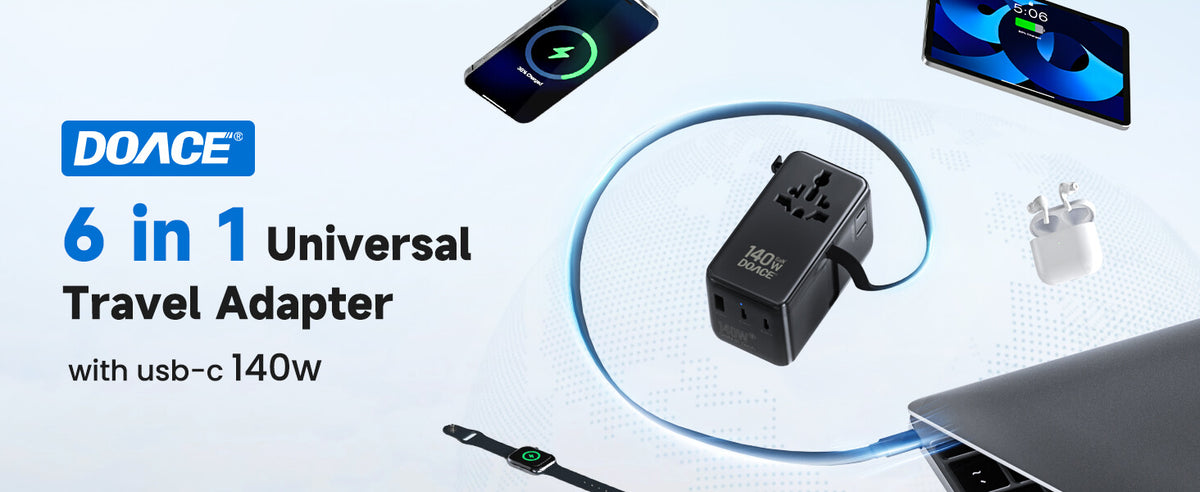
For staff laptops and phones: DOACE 140W GaN Travel Adapter
For the team charging station, the DOACE 140W GaN Travel Adapter is the natural recommendation. It helps consolidate laptops, phones, tablets, and USB-C accessories without taking over the official booth electrical drop. This is the adapter/charger layer of the plan, not the voltage-conversion layer.
For a verified 120V-only demo device: evaluate a converter before shipping
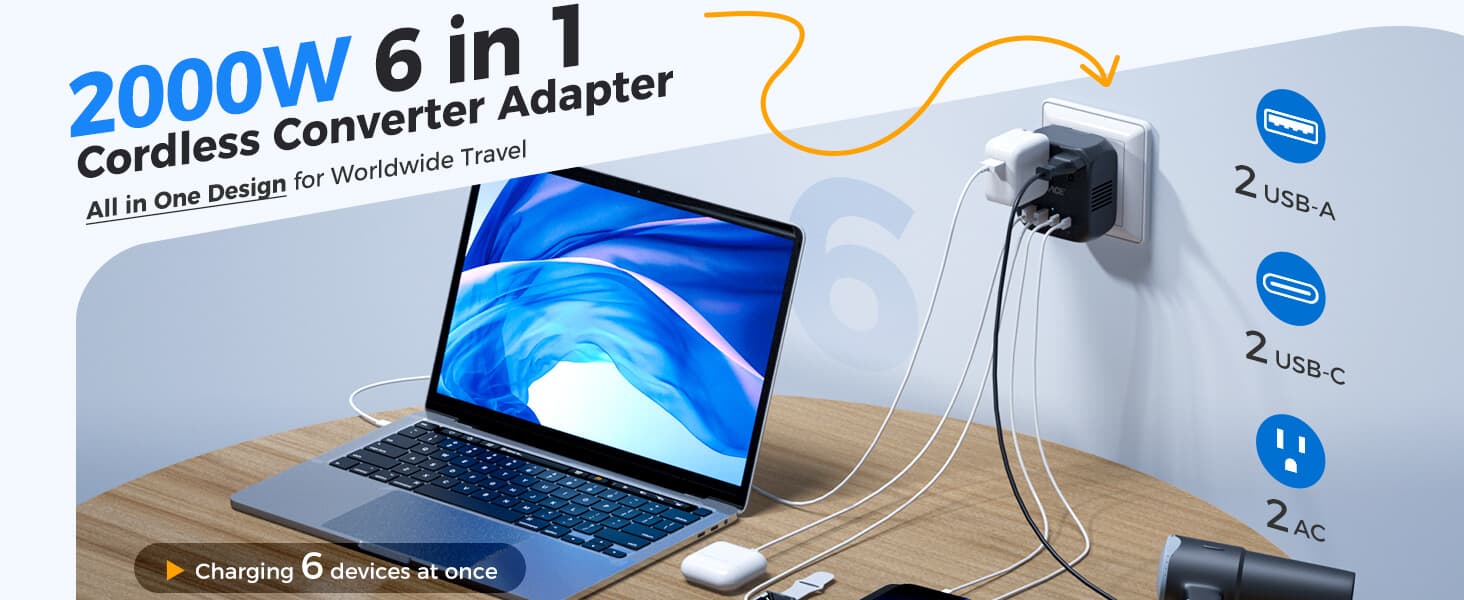
If a demo device is truly 120V-only and the venue supplies 220-240V, ask the organizer whether voltage conversion is allowed and what wattage is available. A product such as the DOACE C15 2000W Voltage Converter belongs in this conversation only after the device wattage, venue rules, duty cycle, and device type are confirmed. Do not use a converter as a shortcut for venue electrical planning.
On-Site Rules That Save the Booth
- Keep demo equipment on the official booth circuit, not on the staff phone charger.
- Label every cable by device, especially laptop USB-C cables and monitor power cords.
- Do not run cables across visitor paths; use venue-approved cable covers or reroute the booth layout.
- Charge staff devices before doors open, then preserve the strongest port for the presentation laptop.
- If power fails, reboot demo devices in order: network/router, display, laptop, then peripherals.
What Not to Bring
- Unapproved extension cords or surge strips.
- A travel adapter as the only plan for booth demo equipment.
- A high-watt converter that has not been approved by the venue or matched to the device.
- Unlabeled chargers that no one can identify during setup.
- A demo device that depends on overnight power unless you ordered 24-hour service.
FAQ
Do trade show booths include power?
Often no. Many shows require exhibitors to order electrical service separately and pay more after the advance deadline.
Can I use a travel adapter for booth equipment?
Only for properly rated wide-voltage devices and only if venue rules allow your setup. A travel adapter does not replace official booth power.
What should I ask the organizer?
Ask about voltage, amperage, connector type, outlet location, 24-hour power, extension-cord rules, labor rules, and whether converters are allowed.
How should a booth team charge phones and laptops?
Use a separate GaN charging station for staff devices so demo equipment does not compete with phones and laptops.
Can I run a US monitor at a European trade show?
Check the monitor power brick. Many monitors are 100-240V, but some devices, cords, and accessories differ. If it is 120V-only, plan with the venue before shipping.
What if my demo device is 120V-only?
Confirm whether the venue can supply the correct voltage or whether an approved, properly rated converter can be used. Do this before freight ships.
Can I bring a power strip to a conference?
Maybe, but do not assume. Some venues restrict extension cords, surge strips, and floor cables. Ask first and follow the exhibitor manual.
What is the safest one-bag conference charging setup?
One high-output GaN travel adapter, rated USB-C cables, a compact backup adapter, and a written separation between staff charging and booth demo power.
This article is for informational purposes only. Always verify your exact device label, exhibitor manual, venue policy, and DOACE product specifications before using electrical equipment at an international event.


