

If you are traveling from the United States to Lithuania, the short answer is this: you definitely need a plug adapter, and you may also need a voltage converter depending on the devices you bring. Lithuania uses 220V / 50Hz electricity and commonly uses Type C and Type F outlets, while the US uses 120V / 60Hz with Type A / Type B plugs.
A lot of travelers assume that buying a Europe plug adapter solves everything. It does not. A plug adapter only changes the physical plug shape so your charger or appliance can fit the socket. It does not convert voltage. A voltage converter is what steps Lithuania's 220V power down for American single-voltage 120V appliances.
Lithuania follows the same general electrical system used across much of continental Europe. That means if you already own a quality adapter for countries such as Germany, France, Spain, or the Netherlands, it will often work in Lithuania too. But if you are coming directly from the US, you still need to sort every device into one of two categories: adapter only or converter required.
This guide explains Lithuania voltage and frequency, what outlet type Lithuania uses, whether US electronics work in Lithuania, which devices need a converter, which only need an adapter, and which DOACE products make the most sense for business trips, vacations, and longer European itineraries.
1. Voltage and Frequency
Lithuania standard: 220V, 50Hz.
US standard: 120V, 60Hz.
- Lithuania uses much higher voltage than the US, which is risky for 120V-only appliances.
- The frequency is different, and while most modern chargers are fine, some motor-based, timer-based, or heat-related devices may behave differently.
- US plug shapes do not match Lithuanian sockets, because the US uses Type A/B while Lithuania commonly uses Type C/F.
Safety warning: if you plug a 120V-only American appliance directly into a Lithuanian outlet, it may overheat, fail, or become unsafe to use.
The correct method is always to check the power label. If it says 100-240V, 50/60Hz, it is usually dual voltage and only needs a plug adapter. If it says 120V only or 110-120V, then it needs a converter.
2. What Plug Type Does Lithuania Use?
Lithuania most commonly uses Type C and Type F outlets.
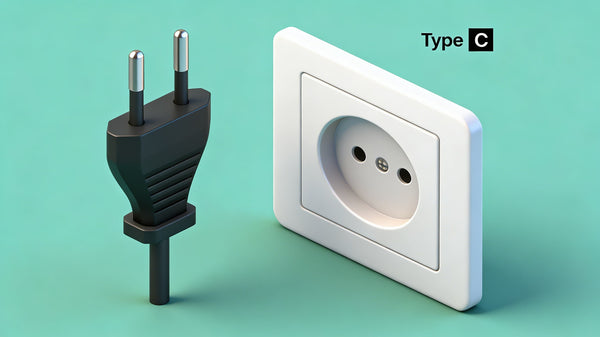

- Type C is the classic two-round-pin European plug used by many small electronics and chargers.
- Type F is the grounded Schuko standard, which usually offers a more secure fit and better stability.
For US travelers, the smarter approach is to choose a high-quality grounded adapter compatible with Type F. In Lithuania, many hotels, apartments, and older buildings use recessed European sockets, and cheap thin adapters may loosen under the weight of larger chargers or power bricks.
3. Can I Use US Electronics in Lithuania?
The answer depends on two separate questions: will the plug fit, and will the device run safely. The first depends on having the right adapter. The second depends on whether the device supports 220V input.
- If the label says 100-240V, 50/60Hz: adapter only.
- If the label says 120V only or 110-120V: converter required.
- If it is a high-wattage heat tool: also check device type and control method.

Devices that usually need only an adapter include phone chargers, laptop chargers, tablet chargers, camera chargers, earbuds, watches, power banks, and most USB-powered electronics. Devices that usually need a converter include US hair dryers, single-voltage curling irons, straighteners, some electric toothbrush bases, and some heating appliances.
One of the most common mistakes is assuming that lower wattage means no converter is needed. That is not true. Input voltage range matters far more than wattage.
4. Choosing the Right Solution by Device Type
Phones, tablets, laptops, and cameras
Most modern consumer electronics already support dual voltage, so in Lithuania they normally need only a quality travel adapter.
Hair dryers, curling irons, and straighteners
This is the category most likely to get damaged abroad. Many US hair tools are still built for 120V only. If you are bringing a traditional mechanical-switch hair dryer or curling iron, you need a converter with enough wattage. If you are bringing a Dyson or another advanced electronically controlled styling tool, do not assume that high wattage automatically means compatibility.
CPAP machines, nebulizers, and sensitive electronics
For these products, voltage conversion alone is not the whole story. Power quality and waveform stability matter too. A pure sine wave option is often a safer choice for devices that are sensitive or medically important.
Kitchen appliances and high-surge devices
Coffee makers, juicers, irons, and steamers are generally poor matches for compact travel converters because their startup surge can be much higher than expected.
5. DOACE Products Worth Considering for Lithuania Travel
DOACE GaN 100W International Power Adapter

- Power: 2500W AC passthrough with up to 100W USB-C charging.
- Best for: phones, tablets, laptops, earbuds, cameras, and power banks.
- Strength: ideal for wide-voltage devices and multi-device charging.
- Note: This is a premium international adapter, not a voltage converter.
DOACE LC-X30

- Power: 350W.
- Best for: shavers, toothbrushes, camera chargers, and selected lower-power US devices.
- Strength: compact and travel-friendly.
- Note: According to the FAQ, it does not include surge protection, which can make it more suitable for some cruise policies.
DOACE LC-X35

- Power: 500W max, 350W continuous.
- Best for: CPAP machines, nebulizers, sensitive electronics, and some low-power hair tools.
- Strength: 100% pure sine wave for better compatibility with sensitive equipment.
- Note: Press and hold for 2-3 seconds to power on. According to the FAQ, its surge protection can make it unsuitable for some cruises.
DOACE HC-X11

- Power: 2200W.
- Best for: traditional mechanical-switch hair dryers, curling irons, and flat irons.
- Strength: built for high-wattage US heating tools in 220-240V countries.
- Note: According to the FAQ, it is not suitable for Dyson and other electronically controlled styling tools.
6. Practical Travel Tips
Check every device label: If you see 100-240V, an adapter is usually enough. If you see 120V only, you need a converter.
Pack fewer single-voltage devices: If possible, travel with dual-voltage devices only.
Choose dual-voltage hair tools when possible: This is usually easier than carrying a heavy high-power converter.
Bring more than one adapter: Outlet availability in hotels and apartments is not always ideal.
Pay attention to outlet depth and contact quality: Avoid weak low-cost adapters, especially for heavier chargers.
Remember the LC-X35 startup method: It requires a 2-3 second press-and-hold, not a quick tap.
Do not use travel converters with high-surge appliances: Coffee makers, juicers, and irons are poor candidates.
Check cruise rules in advance: If your Lithuania trip connects with a Baltic or wider Europe cruise, review the cruise line’s restrictions before packing.
Warranty matters: According to the DOACE FAQ, DOACE products include a 1-year warranty.
7. Frequently Asked Questions
Q1: Can I use my iPhone and MacBook in Lithuania?
A: In most cases, yes. If the charger is marked 100-240V / 50-60Hz, you only need a plug adapter.
Q2: Do I always need a voltage converter for Lithuania?
A: No. You need one only for 120V-only devices. Dual-voltage electronics only need an adapter.
Q3: Are Lithuania outlets the same as in the rest of Europe?
A: In many practical cases, yes. Lithuania commonly uses Type C and Type F, which are also common across much of continental Europe.
Q4: Why is a 2000W converter not suitable for a Dyson hair dryer?
A: According to the DOACE FAQ, high-power converters are better suited to traditional mechanical-switch heat tools. Dyson devices use more advanced electronic controls and cannot be judged by wattage alone.
Q5: How do I choose between LC-X30 and LC-X35?
A: Choose LC-X30 if you want portability and travel-friendliness. Choose LC-X35 if you need pure sine wave output and better support for sensitive equipment.
Q6: Can I use DOACE products on a cruise?
A: Yes, but model choice matters. Devices without surge protection are usually easier to use under cruise rules, while LC-X35 may be restricted.


