

DOACE makes three GaN (gallium nitride) travel adapters: 70W, 100W, and 140W. All three adapt plug shapes for 200+ countries and provide fast USB-C charging. The question is not which one works — they all work everywhere — but which one matches the devices you actually travel with.
This comparison breaks down the real-world differences: how fast each one charges your specific devices, how many devices you can charge simultaneously, and which scenarios justify stepping up to more wattage. If you are not sure whether you need an adapter or a converter, start with our adapter vs. converter guide.
Full Spec Comparison
| Specification | 70W GaN | 100W GaN | 140W GaN |
|---|---|---|---|
| Total Output | 70W | 100W | 140W |
| USB-C Ports | 1 (+ built-in cable) | 2 (+ built-in cable) | 3 (+ built-in cable) |
| USB-A Ports | 1 | 1 | 1 |
| Max Single-Port USB-C | 65W PD | 100W PD | 140W PD |
| AC Outlet | 1 × universal | 1 × universal | 1 × universal |
| Plug Types | US / EU / UK / AU | US / EU / UK / AU | US / EU / UK / AU |
| Built-in USB-C Cable | Yes | Yes | Yes |
| GaN Technology | Yes — GaN 3.0 | Yes — GaN | Yes — GaN |
| Countries Covered | 200+ | 200+ | 200+ |
| Converts Voltage? | No — adapter only | No — adapter only | No — adapter only |
Figure 1: Three GaN adapters compared across key dimensions. The 140W dominates on power and ports; the 70W wins on compactness.
Real-World Charging Speeds
Wattage numbers alone do not tell you how fast your specific device will charge. Here is what each adapter delivers to common travel devices:
| Device | Needs | 70W | 100W | 140W |
|---|---|---|---|---|
| iPhone 15/16 Pro | 27W max | Full speed | Full speed | Full speed |
| Samsung Galaxy S24 Ultra | 45W max | Full speed | Full speed | Full speed |
| iPad Pro M4 | 35W max | Full speed | Full speed | Full speed |
| MacBook Air M3 | 67W max | 65W (near full) | Full speed | Full speed |
| MacBook Pro 14" M3 Pro | 96W max | 65W (slower) | 96W (full speed) | Full speed |
| MacBook Pro 16" M3 Max | 140W max | 65W (much slower) | 100W (slower) | 140W (full speed) |
| Nintendo Switch | 18W max | Full speed | Full speed | Full speed |
| Steam Deck | 45W max | Full speed | Full speed | Full speed |
Multi-Device Charging: Where Wattage Really Matters
The real difference shows when you charge multiple devices at once. Higher total wattage means less speed reduction when ports share power:
| Scenario | Total Draw | 70W | 100W | 140W |
|---|---|---|---|---|
| Phone only | ~27W | Full speed | Full speed | Full speed |
| Phone + tablet | ~60W | OK | Full speed | Full speed |
| MacBook Air + phone | ~90W | Throttled | OK | Full speed |
| MacBook Pro + phone + tablet | ~130W | Heavy throttle | Throttled | OK |
Figure 2: Available wattage per device in common multi-device charging scenarios
Which One Should You Buy?
Choose the 70W if:
- You travel with a phone and tablet only (no laptop)
- You want the smallest, lightest adapter possible
- You carry a separate laptop charger and only need the adapter for phones/tablets
Choose the 100W if:
- You travel with a laptop (MacBook Air, most Windows laptops) + phone
- You want to replace your laptop charger entirely — the 100W adapter can charge most laptops at full speed
- Best balance of power, port count, and size
Choose the 140W if:
- You carry a MacBook Pro 14" or 16" that needs 96W+ charging
- You charge 3+ USB-C devices simultaneously
- You are a power user or digital nomad who wants one charger for everything
Product Details
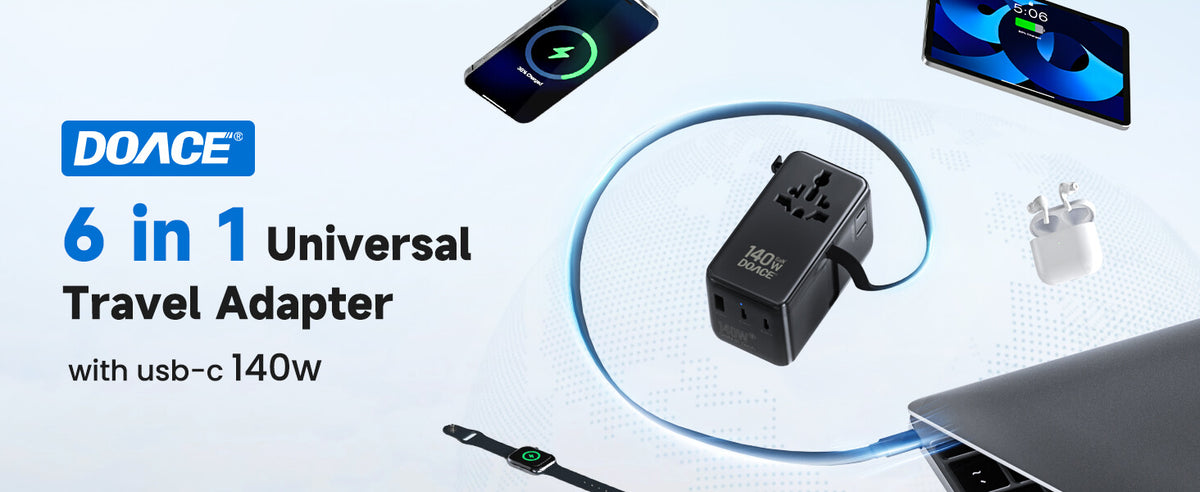
DOACE 70W GaN 3.0 Travel Adapter


Why GaN Matters for Travel Adapters
GaN (gallium nitride) is not just a marketing buzzword — it is a fundamental semiconductor material change that makes these adapters possible. As ZDNET explains: "While silicon transistors have a power efficiency of around 87%, GaN transistors boost this efficiency to over 95%." That 8%+ efficiency gap translates directly into less heat, which means the adapter can pack more power into a smaller body.
GaN transistors also switch about 4× faster than silicon — roughly 40 million times per second — which allows for more precise power regulation. This is why a 140W GaN adapter can be roughly the size of what a 45W silicon charger used to be.
The 140W's Secret Advantage: PD 3.1 EPR
The 140W adapter's built-in cable supports USB PD 3.1 EPR (Extended Power Range), not just standard PD 3.0. This matters because PD 3.0 maxes out at 100W (20V × 5A). PD 3.1 EPR adds higher voltage tiers (28V, 36V, 48V), enabling up to 240W over USB-C.
Apple's MacBook Pro 16" uses 28V × 5A = 140W, and detailed testing confirms you need both an EPR-capable charger AND an EPR-rated cable to get full 140W charging. Regular USB-C cables max out at 100W regardless of the charger. The DOACE 140W's built-in cable solves this — no need to buy a separate $20+ EPR cable.
How DOACE Compares to Other Travel Adapters
The travel adapter market has shifted dramatically. As one r/Ultralight user observed: "I used to use an Epicka universal travel adapter and it could only output at a measly 20W... For my latest trip I picked up a 140W GaN travel adapter." Here is how the current landscape looks:
| Product | Max USB Power | USB-C Ports | Key Trade-off |
|---|---|---|---|
| DOACE 70W GaN | 70W | 2 + cable | Most compact DOACE GaN; good for phones/tablets |
| DOACE 100W GaN | 100W | 2 + cable | Best balance; charges most laptops at full speed |
| DOACE 140W GaN | 140W (PD 3.1) | 2 + cable | Full MacBook Pro 16" charging; largest body |
| Epicka TA-105 Max | 75W | 1 | Wirecutter pick; fewer USB-C ports; no built-in cable |
| Anker Nano (charger only) | 65-140W | varies | Not an adapter — needs separate plug converter |
| TESSAN GaN 65W | 65W | 1-2 | Budget option; lower max power |
Key insight: Anker makes excellent GaN chargers, but they are chargers only — you still need a separate travel plug adapter. DOACE and Epicka combine the adapter and charger into one device. DOACE's advantage over Epicka is significantly higher USB-C wattage (70-140W vs 75W max) and more USB-C ports.
Do You Really Need 140W?
Honest answer: most travelers do not. Here is a quick reality check:
- iPhone 16 Pro Max caps at 27W — any of the three adapters maxes it out
- iPad Pro M4 caps at 35W — same story
- MacBook Air M3 caps at 67W — the 70W adapter handles it
- Most Windows laptops draw 45-65W — the 70W adapter is enough
The 100W or 140W adapters only become essential in two cases:
- Case 1: You have a high-power laptop. MacBook Pro 14" (96W), MacBook Pro 16" (140W), Dell XPS 17, or gaming laptops that draw 100W+.
- Case 2: You charge 3+ devices simultaneously. Even if each device only draws 25-35W, three devices total 75-105W — exceeding the 70W adapter's capacity.
Our recommendation: If you carry a MacBook Air or smaller, the 70W saves you money and bag space. If you carry any MacBook Pro or regularly charge 3+ USB devices at once, the 100W is the pragmatic sweet spot. The 140W is only justified for MacBook Pro 16" owners or true digital nomads running a full mobile office.
Frequently Asked Questions
Can I use any of these to power a hair dryer abroad?
No. These are plug adapters — they change the plug shape but do not convert voltage. A US 120V hair dryer plugged into a 230V European outlet through an adapter will be destroyed. For hair dryers, you need a voltage converter like the DOACE HC-X11 (2200W). See our adapter vs. converter guide.
What is the built-in USB-C cable for?
All three models include a retractable or integrated USB-C cable. This means you do not need to pack a separate cable for your phone — just plug the built-in cable directly into your device. It supports PD fast charging at the adapter's full single-port speed.
Can I charge my MacBook Air with the 70W?
Yes. The MacBook Air M3 accepts up to 67W, and the 70W adapter's USB-C port delivers up to 65W PD. You will get near-full-speed charging. However, if you simultaneously charge a phone from the same adapter, the laptop charging will slow down significantly.
What is GaN technology and why does it matter?
GaN (gallium nitride) is a semiconductor material that is more efficient than traditional silicon. GaN chargers produce less heat for the same power output, allowing them to be significantly smaller. A 140W GaN adapter is roughly the size of what a 45W silicon charger used to be. For travelers, this means more power in less space.
Do these work with the AC outlet and USB ports simultaneously?
Yes. All three adapters have a pass-through AC outlet that works independently of the USB ports. You can plug a dual-voltage device (like a CPAP or laptop charger) into the AC outlet while charging your phone via USB-C at the same time. The AC outlet passes through wall power directly — it does not draw from the adapter's USB wattage budget.


