

If you need to use a hair dryer, curling iron, or flat iron abroad, you need a high-wattage voltage converter — and DOACE makes two: the HC-X11 at 2200W and the C15 at 2000W. They look similar, cost similarly, and target the same use case. So which one should you buy?
This side-by-side comparison breaks down every difference that matters: rated wattage, port layout, protection features, size, and which devices each one handles best. If you are still unsure whether you need a converter at all, start with our adapter vs. converter explainer.
Full Spec Comparison
| Specification | DOACE HC-X11 | DOACE C15 |
|---|---|---|
| Rated Wattage | 2200W | 2000W |
| Input Voltage | 220–240V AC | 220–240V AC |
| Output Voltage | 110V AC | 110V AC |
| Wave Type | Modified sine wave | Modified sine wave |
| Converter Outlets | 1 × converter (2-prong) + 2 × adapter (3-prong, no voltage conversion) | 2 × converter sockets (both step down voltage) |
| USB Ports | 4 × USB-A | 2 × PD USB-C + 2 × QC USB-A |
| Plug Adapters Included | US / EU / UK / AU | US / EU / UK / AU |
| Overload Protection | Yes — auto shut-off | Yes — auto shut-off |
| Overheat Protection | Yes — thermal fuse | Yes — thermal fuse |
| Short Circuit Protection | Yes | Yes |
| Weight | ~380g | ~350g |
| Size | Slightly larger | More compact |
| Best For | 1800W+ hair dryers, sustained high-wattage use | 1500–1875W hair dryers, budget-conscious travelers |
Figure 1: HC-X11 vs C15 comparison across six key dimensions. Both are closely matched; the HC-X11 edges ahead on wattage and thermal headroom.
When the 200W Difference Matters
The HC-X11 is rated at 2200W and the C15 at 2000W. For most US hair dryers (typically 1875W), both converters have enough headroom. But there are scenarios where the extra 200W matters:
- Hair dryers rated 1900–2000W: Some professional-grade US dryers hit 2000W. The C15 is at its absolute limit, while the HC-X11 still has 200W of breathing room. Running any converter at 100% capacity continuously increases heat and reduces lifespan.
- Startup surge: Hair dryers with AC motors draw a brief surge at startup (typically 1.2–1.5× the rated wattage for a fraction of a second). A 1875W dryer might surge to 2200W+ momentarily. The HC-X11 handles this; the C15 may trip its overload protection.
- Extended use sessions: If you dry long hair for 20+ minutes, sustained heat builds up inside the converter. The HC-X11's extra wattage headroom means the internal components run cooler and last longer.
Device Compatibility Matrix
| Device | Typical Wattage | HC-X11 (2200W) | C15 (2000W) |
|---|---|---|---|
| Standard US hair dryer | 1875W | Yes — good headroom | Yes — tight margin |
| Professional salon dryer | 2000W | Yes — at margin | No — at/over limit |
| Flat iron / straightener | 40–100W | Yes | Yes |
| Curling iron / wand | 30–80W | Yes | Yes |
| Garment steamer (handheld) | 800–1500W | Yes | Yes |
| Electric kettle | 1000–1500W | Yes | Yes |
| CPAP machine | 30–100W | Not recommended — use pure sine wave | Not recommended — use pure sine wave |
| Dyson / Shark / Laifen dryer | 1200–1600W | No — brushless motor incompatible | No — brushless motor incompatible |
For CPAP machines, use the DOACE LC-X35 pure sine wave converter instead. For Dyson/Shark/Laifen hair tools, buy the international version — see our brand compatibility guide.
Which One Should You Buy?
Figure 2: Decision tree — choose based on your hair dryer's wattage and travel priorities
Choose the HC-X11 if:
- Your hair dryer is rated 1875W or higher
- You use a hair dryer for extended sessions (20+ minutes)
- You want maximum wattage headroom for peace of mind
- You do not mind slightly more weight and bulk
Choose the C15 if:
- Your hair dryer is rated 1500–1800W
- You value compact size and lighter weight
- You are on a tighter budget
- You use your hair dryer for short sessions (under 15 minutes)
Product Details
DOACE HC-X11 — 2200W Voltage Converter

- 2200W rated — the highest wattage in the DOACE lineup
- 4 USB-A ports for simultaneous phone/tablet charging
- Interchangeable plug adapters for EU, UK, AU, US
- Triple protection: overload, overheat, short circuit
DOACE C15 — 2000W Voltage Converter
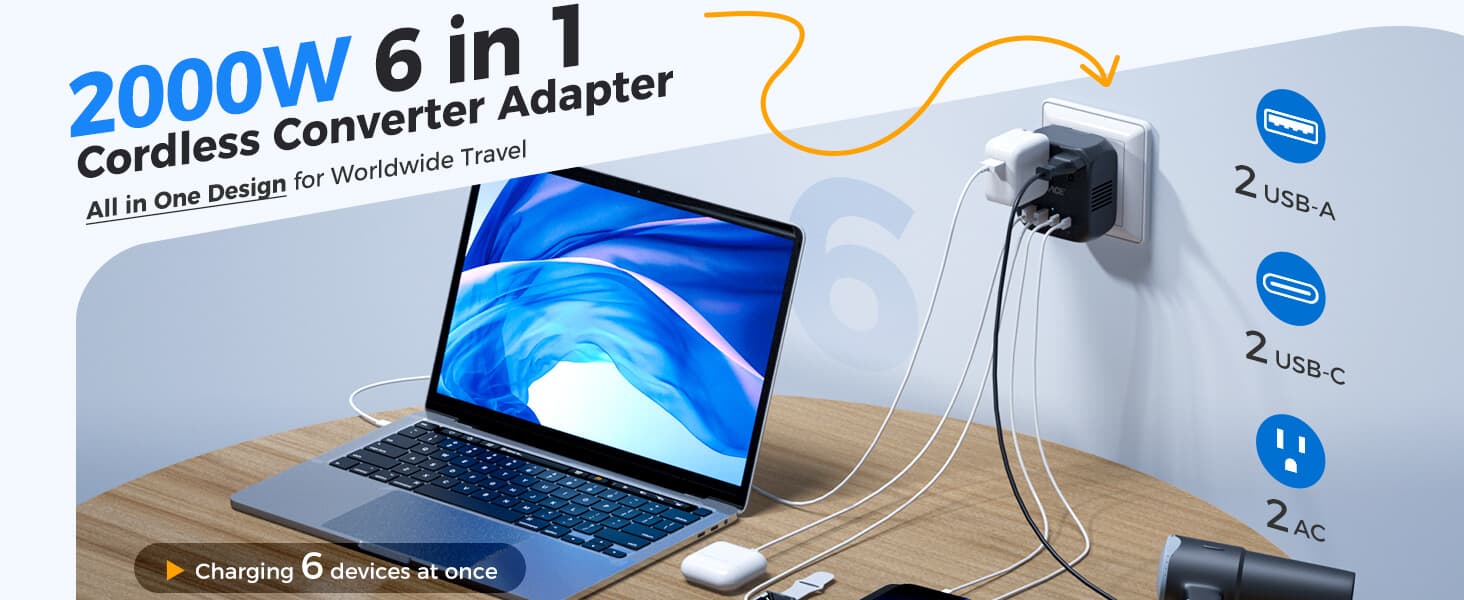
- 2000W rated — handles most standard US hair dryers
- 4 USB-A ports for simultaneous charging
- More compact form factor — lighter for packing
- Same triple protection system as HC-X11
How Both Compare to the Rest of the DOACE Lineup
The HC-X11 and C15 are the top tier of the DOACE converter range. For lower-wattage needs, DOACE offers several other options:
| Model | Wattage | Wave Type | Best For |
|---|---|---|---|
| HC-X11 | 2200W | Modified sine | Hair dryers 1875W+, steamers |
| C15 | 2000W | Modified sine | Hair dryers up to 1800W |
| LC-X80 | 800W | Pure sine wave | Flat irons, curling irons, CPAP + multiple devices |
| LC-X35 | 350W | Pure sine wave | CPAP, electronics, sensitive devices |
| LC-C30 | 300W | Modified sine | Small styling tools under 200W |
For a detailed comparison of the mid-range models, see our LC-C30 vs LC-X35 vs LC-X80 comparison.
Why Dyson, Shark, and Laifen Will NOT Work
This is the single most common mistake travelers make with high-wattage converters, so it deserves its own section. Neither the HC-X11 nor the C15 (nor any modified sine wave converter) is compatible with Dyson Airwrap, Dyson Supersonic, Shark FlexStyle, or Laifen hair dryers.
Dyson's official response on Best Buy is unambiguous: "The Dyson Airwrap™ styler is manufactured and intended for the country in use, and is not multi-voltage. We do not recommend a power converter as this will damage the motor and void the warranty."
The engineering reason, as explained in a detailed r/ElectricalEngineering discussion: These tools use brushless DC motors with electronic speed controllers (ESCs). The ESC needs a clean, stable AC waveform to generate precise PWM signals that control motor speed. Modified sine wave — which is really a stepped square wave — interferes with the ESC's control logic, causing erratic speed, overheating, or total failure.
Traditional hair dryers (Conair, Revlon, BaBylissPRO, Hot Tools) use simple AC motors and resistive heating elements. These are purely resistive/inductive loads that work perfectly fine with modified sine wave. As one r/diySolar user explains: "Resistive heating like a bar heater works fine — it's induction loads with electronics that have problems."
HC-X11 "Converter vs. Adapter Socket" Warning
The HC-X11 uses a dual-track architecture that confuses many travelers:
- The 2-prong "flag" converter socket — Steps down 220V to 110V. This is where your US hair dryer goes.
- The two 3-prong "adapter" sockets — These do NOT convert voltage. They simply provide a plug shape adapter for dual-voltage (100-240V) devices like phone chargers and laptops.
If you plug a 110V-only device into the adapter socket, it receives full 220V and will burn out immediately. This is the most common cause of device damage reported in user reviews.
The C15 eliminates this confusion entirely — both of its AC sockets are converter sockets that step down voltage. There is no "adapter-only" socket to accidentally misuse. This design simplification is one of the strongest reasons to choose the C15 over the HC-X11 if you are not a technical user.
How These Compare to Other Brands
| Product | Power | Waveform | Key Differentiator |
|---|---|---|---|
| DOACE HC-X11 | 2200W | Modified sine | Highest wattage in class; dual-track design |
| DOACE C15 | 2000W | Modified sine | USB-C PD fast charging; simpler 2-socket design |
| Ceptics LX-C2000 | 2000W | Modified sine | Dual mode (200W/2000W); QC 3.0 USB; 6 plug adapters |
| Ceptics VC-S2000 | 2000W | Pure sine wave | Only portable 2000W pure sine; heavier (930g); PD 45W |
| TryAce 2000W | 2000W | Modified sine | Budget option; dual-track similar to HC-X11 |
Key insight: If your only goal is powering a traditional US hair dryer abroad, all of these options work. The HC-X11 wins on raw wattage (2200W vs everyone else at 2000W). The C15 wins on modern USB charging. The Ceptics VC-S2000 is the premium choice if you need pure sine wave at 2000W — but at nearly double the weight.
Do You Need a Converter — or a Dual-Voltage Hair Dryer?
This is a fair question, and travel forums like Rick Steves often recommend: "Just buy an inexpensive dual voltage blow dryer." On Reddit r/TravelHacks, the advice is similar: "Voltage converters tend to not work super well with really high watt things. Get a dual voltage one, or just use the hotel one."
When a dual-voltage dryer makes more sense:
- You travel internationally more than 3-4 times per year
- You only need basic drying (a $25-40 dual-voltage travel dryer is lighter than any converter)
- You want the absolute lightest luggage setup possible
When the HC-X11 or C15 makes more sense:
- You own a specific high-end US dryer (BaBylissPRO, Hot Tools, etc.) with no dual-voltage equivalent
- You also need to power other 110V devices (garment steamer, electric kettle, curling iron)
- You are a hair professional who needs consistent heat and airflow from your own tools
- You already own the converter and just need to decide which trip to bring it on
Frequently Asked Questions
Can I use either converter with a Dyson Airwrap or Supersonic?
No. Dyson, Shark, and Laifen hair tools use brushless DC motors with electronic speed controllers that are incompatible with modified sine wave converters — regardless of wattage. Buy the international version of these tools instead. See our brand compatibility guide for details.
Can I use the HC-X11 or C15 for my CPAP machine?
Not recommended. CPAP machines have precision blower motors that are sensitive to power quality. Both the HC-X11 and C15 output modified sine wave power, which can cause CPAP motors to hum or produce inaccurate pressure. Use the DOACE LC-X35 (pure sine wave, 350W) for CPAP. See our ResMed AirSense travel guide.
My hair dryer is 1875W. Is the C15 (2000W) enough?
It works, but with only 125W of headroom (6.7% margin). This is tighter than the recommended 20% margin. Startup surges may occasionally trip the overload protection, requiring a restart. The HC-X11 (2200W) gives you 325W of headroom (17%) — much more comfortable. If your dryer is your primary travel device, the HC-X11 is worth the small extra cost.
Do both converters work in all countries?
Both include interchangeable plug adapters for EU (Type C/F), UK (Type G), AU (Type I), and US (Type A/B). They convert 220–240V input to 110V output, covering all major international destinations. They do not convert 110V to 220V (step-up), so they are not for using European devices in the US.
How long can I run a hair dryer continuously?
Both converters are designed for intermittent use — typical hair drying sessions of 15–30 minutes. Running any portable converter at near-maximum wattage for extended periods generates significant heat. Allow the converter to cool between sessions. The HC-X11's extra 200W capacity means it runs cooler during the same session, extending its effective continuous use time.


