

Quick Answer: Choose EPICKA if you want a popular all-round universal adapter with a simple finder experience. Choose TESSAN if your priority is high-watt GaN USB-C charging for laptops and multiple devices. Choose SKROSS if safety language, fuse handling, and grounded-adapter education matter most. Choose DOACE if your trip may involve both modern USB-C electronics and 120V-only devices that require real voltage conversion or pure sine wave output.
The video above shows why travel adapter comparisons can feel confusing: every brand claims to be “universal,” but they are not solving the same problem. Some brands are adapter-first. Some are USB-C charging-first. Some are safety-first. Some cover actual voltage conversion. The right choice depends less on the logo and more on what you plug in.
The Short Version: Four Brands, Four Different Jobs
EPICKA
Best known as a mainstream universal adapter choice. Strong for travelers who want a familiar all-round adapter, USB ports, and a simple country/device finder path.
TESSAN
Strongest in the high-output GaN adapter lane, especially for USB-C laptops, tablets, phones, and travelers who want fewer chargers in the bag.
SKROSS
Safety-first positioning. Its FAQ and support content talk more clearly about grounding, fuses, adapter limits, and what to do when USB works but AC does not.
DOACE
Most useful when your travel power problem may go beyond plug shape: USB-C adapters, 800W converters, 2000W converters, and pure sine wave options sit in one ecosystem.
Why These Brands Split Into Different Lanes
Travel power starts with a standards problem. IEC 60038 defines standard voltage values for supply systems and equipment design, but it did not erase the practical divide between 100-120V regions and 220-240V regions. That is why a plug adapter can be enough for a 100-240V laptop charger, while a 120V-only appliance still needs real voltage conversion.
The USB-C era added a second layer. GaN made chargers smaller and more efficient; ZDNET describes modern GaN chargers as smaller, more efficient, safer, and cooler than older silicon designs. USB PD 3.1 then raised the ceiling for high-power laptops; USB-IF says USB PD Revision 3.1 was announced to enable up to 240W over USB Type-C. This is why TESSAN and DOACE now compete in 100W/140W GaN charging, while adapter/converter confusion remains a separate safety problem.
That does not mean everyone needs 140W. For phones, tablets, cameras, earbuds, and many laptop chargers, a lower-watt adapter can be enough. For heavier MacBook Pro or creator setups, 100W/140W becomes more relevant; Apple sells a 140W USB-C Power Adapter, which shows why high-watt travel adapters are useful for some users but unnecessary for others.
Comparison Table: What Each Brand Is Really Best For
| Brand | Best for | Watch out for | Best traveler type |
|---|---|---|---|
| DOACE | Adapter + converter decision-making, GaN charging, high-wattage converters, pure sine wave converter options | You still need to choose the right category; a GaN adapter is not a voltage converter | US travelers carrying both USB-C electronics and possible 120V-only devices |
| EPICKA | Popular all-round universal adapters, country finder, broad plug-shape convenience | Most adapter products do not solve voltage conversion for single-voltage appliances | General vacation traveler with phones, tablets, camera chargers, and laptops |
| TESSAN | High-watt GaN USB-C charging, multi-device setups, laptop travelers | High USB-C wattage does not mean the AC outlet converts voltage | Business traveler, creator, remote worker, family with many USB devices |
| SKROSS | Safety language, fuse education, grounded adapter awareness, support content | Safety education is strong, but product fit still depends on destination and device wattage | Risk-aware traveler, business traveler, anyone using grounded or higher-value devices |
Scorecard: Adapter, USB-C, Safety, and True Conversion
Figure 1: Relative positioning by travel power job — scores reflect brand lane strength, not absolute product quality
This is where DOACE differs from many adapter-only competitors. If all your gear is labeled 100-240V, a high-quality adapter or GaN charger is enough. But if you carry a 120V-only hair tool, CPAP power supply, or appliance, the question changes from “which adapter is best?” to “do I need voltage conversion?”
75W vs 100W vs 140W: What the GaN Numbers Really Mean
| Power lane | Good fit | Brand examples | Important limit |
|---|---|---|---|
| 75W class | Phones, tablets, camera batteries, light laptop charging, mainstream multi-device travel | EPICKA TA-105 Max uses GaN with 3 USB-C and 2 USB-A ports and up to 75W total output | Not the strongest choice for heavy 16-inch laptop workflows |
| 100W class | Many USB-C laptops, remote work setups, family trips with several devices | TESSAN and DOACE both compete in the 100W GaN travel adapter lane | Still does not convert AC voltage for 120V-only appliances |
| 140W class | Heavier MacBook Pro or creator setups where high USB-C power matters | TESSAN and DOACE both offer 140W-style GaN travel adapter options | Overkill for many phone/tablet-only travelers |
EPICKA: Best for Simple All-Round Adapter Shopping
EPICKA's strongest advantage is ease. The brand is visible in media lists, marketplaces, and “which adapter should I buy?” conversations. Its Travel Adapter Finder matches how people actually shop: choose destination, check device type, buy something that fits. EPICKA's own comparison page also makes the key limitation explicit: its travel adapters do not convert voltage.
Where EPICKA makes sense:
- You mostly charge phones, tablets, camera batteries, and laptop chargers.
- Your devices already say 100-240V on the label.
- You want a familiar adapter brand with a broad travel footprint.
- You do not need a true step-down voltage converter.
TESSAN: Best for High-Watt USB-C and Multi-Device Charging
TESSAN's current strength is the GaN charging lane. Its 100W and 140W-style positioning speaks to a modern traveler: laptop, phone, tablet, headphones, watch, and maybe a partner's devices too. The limit is equally important: TESSAN's 140W adapter page lists 100-250V input and excludes non-dual-voltage appliances, so it is a charger-first adapter, not a voltage converter.
Where TESSAN makes sense:
- You care about USB-C PD wattage more than AC voltage conversion.
- You charge one or two laptops plus phones and tablets.
- You want a compact charging hub for airport lounges and hotels.
- You understand that USB-C wattage and AC voltage conversion are separate issues.
If your main search is “best travel adapter with USB-C,” compare the wattage logic in our USB-C travel adapter guide before choosing purely by headline output.
SKROSS: Best for Safety-Focused Buyers
SKROSS is not always the loudest SEO competitor, but its support content is unusually useful. Its FAQ ecosystem discusses fuse replacement, grounding limitations, and the common issue where USB charging still works while the AC adapter outlet stops working because the fuse is blown. SKROSS even provides a dedicated fuse replacement guide, which is exactly the kind of practical safety content many adapter brands bury or skip.
Where SKROSS makes sense:
- You care about grounding and fuse behavior.
- You use higher-value devices and want clear safety documentation.
- You prefer country-specific safety logic over vague “universal” claims.
- You want better support content when something stops working abroad.
This is also the safety gap DOACE is now closing with deeper guides like travel adapter grounding, fuse, and overheating safety and adapter troubleshooting abroad.
DOACE: Best When You Need a Complete Travel Power Decision Path
DOACE's advantage is not that one adapter magically solves every trip. It is that the product range maps to the actual decision tree:
- 100-240V USB-C electronics? Use a GaN travel adapter.
- 120V-only mid-wattage device? Check a voltage converter.
- Sensitive or overnight device? Consider pure sine wave output.
- High-watt mechanical hair tool? Use a properly rated converter or leave it at home.

DOACE 100W GaN International Power Adapter
Best fit when your devices are already wide-voltage: laptop, phone, tablet, camera, and other USB-C gear. It replaces several chargers but does not convert AC voltage for 120V-only appliances.

DOACE LC-X35 Pure Sine Wave Converter
Best fit for sensitive single-voltage devices under its wattage boundary, especially where clean output matters more than headline wattage.
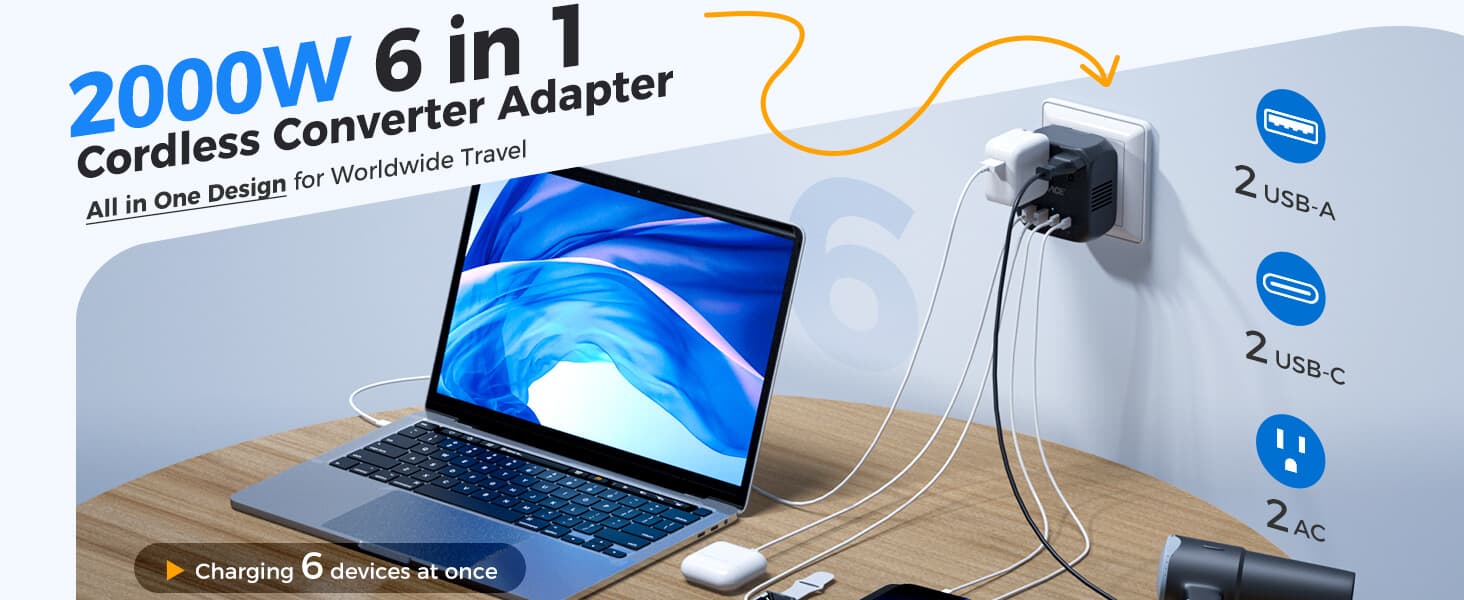
DOACE C15 2000W Voltage Converter
Best fit for compatible high-wattage mechanical appliances where a plug adapter alone would be unsafe. Always check the device label and appliance type before use.
Which Brand Should You Choose?
| Your situation | Best direction | Reason |
|---|---|---|
| Phone, tablet, camera, laptop only | EPICKA, TESSAN, DOACE GaN | Devices are usually 100-240V; you need plug shape and USB-C output. |
| High-power USB-C laptop setup | TESSAN or DOACE 100W/140W GaN | USB-C PD wattage and port-split behavior matter most. |
| Safety-first buyer concerned about fuse/grounding | SKROSS or safety-documented DOACE setup | Look for clear fuse, grounding, and overheating guidance. |
| 120V-only device in Europe/Asia | DOACE converter path | Adapter-only brands do not solve voltage mismatch. |
| CPAP or sensitive device | Check label first; pure sine wave if conversion is required | Clean output and overnight reliability matter more than compactness. |
| You don't know what you need | Use the DOACE Travel Power Finder | It starts from destination voltage, device label, wattage, and use case. |
If you want a guided route instead of comparing brands manually, use the DOACE Travel Power Finder. It starts from the device label, not the country list, which helps prevent the most common mistake: buying an adapter when you actually needed conversion.
Do You Really Need a Premium Adapter Brand?
Not always. If every device you bring says 100-240V, and you only need to charge a phone, tablet, camera battery, and laptop brick, a basic certified plug adapter can be enough. Brand differences matter less when the electrical job is simple.
The brand choice starts to matter when the job gets more specific: high-watt USB-C charging, replaceable fuses, grounding clarity, adapter troubleshooting, 120V-only appliances, or sensitive devices that may need pure sine wave conversion. In those cases, choosing by the cheapest price or highest country count can create the wrong kind of confidence.
FAQ
Is DOACE better than EPICKA?
DOACE is better if you need both adapter options and actual voltage-converter options. EPICKA is a strong all-round adapter brand if your devices are already 100-240V and you only need plug-shape compatibility plus USB charging.
Is TESSAN better than DOACE for USB-C charging?
TESSAN is very competitive in high-watt GaN charging. DOACE is the better fit if your buying decision also includes voltage conversion, pure sine wave output, or high-wattage 120V-only appliances.
Is SKROSS safer than other travel adapters?
SKROSS has some of the clearest public safety education around fuses, grounding, and adapter limitations. That does not mean every SKROSS product fits every trip; it means the brand communicates safety boundaries better than many competitors.
Do any of these universal adapters convert voltage?
Most universal travel adapters do not convert voltage. They change plug shape and may add USB charging. If your device is 120V-only and the destination is 220-240V, you need a voltage converter, not just an adapter.
Which brand is best for a CPAP machine?
First check the CPAP power supply label. Many modern CPAP machines accept 100-240V and need only a plug adapter. If conversion is required, prioritize pure sine wave output and enough wattage headroom rather than brand popularity.
Which brand is best for a MacBook Pro?
For a MacBook Pro, focus on USB-C PD wattage. A 100W adapter works for many models; 140W is better for heavier 16-inch or creator setups. TESSAN and DOACE both fit this category depending on the exact model.
Should I buy a converter just in case?
Usually no. Converters are heavier and should be matched to device wattage and type. If every device you bring says 100-240V, a converter adds weight without solving a real problem.
What is the safest way to choose?
Read the device label first, then choose by shape, voltage, load, and use case. That is the DOACE 4-Check method. It is safer than choosing only by country count or USB-C wattage.


