

The video above explains the difference between grounded and ungrounded adapters — a distinction most travelers never think about until something goes wrong. Below, I'll go deeper into all five real safety risks and show you exactly how to check your own setup.
Why "It Fits the Outlet" Does Not Mean "It's Safe"
Here's the core problem most travelers never hear about: a plug adapter is a mechanical shape tool. It makes your plug physically fit into a foreign socket. That's all it does. It doesn't regulate voltage. It doesn't limit current. And in most cases, it doesn't even pass through the safety ground from the wall outlet to your device.
So when your US three-prong laptop charger plugs into a European Schuko outlet through a $9 universal adapter, the laptop gets power — but the ground pin on your charger might be floating. The metal casing of your device is no longer connected to earth. If a wire comes loose inside, the casing becomes live, and you become the path to ground.
That's the scenario nobody mentions in "10 Best Travel Adapters" lists.
The 5 Real Safety Risks With Travel Adapters
I've broken adapter safety into five distinct failure modes. Most travelers only know about one (overheating). The other four are invisible until they aren't.
Figure 1: Five adapter safety risk dimensions — higher score means higher risk for typical universal adapters
1. Overheating (Thermal Risk)
Every electrical connection has resistance. Cheap adapters use thin contact pins and low-grade alloys that create more resistance, which means more heat. The physics: heat generated = I² × R_contact × time. Because heat scales with the square of current, a 1500W hair dryer (pulling ~6.5A at 230V) generates over 5,000 times more contact-point heat per second than a 20W phone charger (pulling ~0.09A).
Run that hair dryer through a universal adapter rated for 10A at 250V (2500W theoretical max) and the contacts might handle it — but only briefly. The real issue: continuous load. A hair dryer at 1500W for 15 minutes produces far more cumulative heat at the contact point than a phone charger at 20W overnight — even though the phone draws power 40× longer, the current difference (72×) squared makes the hair dryer's thermal impact dramatically higher.
Temperature thresholds to know:
- Normal (30-40°C): Slight warmth — any current flow produces some heat
- Caution (40-55°C): Noticeably warm but holdable — acceptable for high-power devices during active use, but don't leave unattended
- Danger (>60°C): Too hot to hold comfortably — unplug immediately, contact resistance is too high or you're overloading
- Critical: Discoloration, chemical smell, or smoke — internal damage has already occurred
2. Loss of Grounding (Earth Continuity Risk)
Most universal travel adapters — the ones with sliding prongs for every country — physically cannot pass the ground pin through. The sliding mechanism doesn't have a fixed grounding path. Only adapters specifically designed as "grounded" or "earthed" (usually country-specific, bulkier, and more expensive) maintain earth continuity.
Devices with two-prong plugs (phones, laptops with figure-8 cables, most chargers) don't need grounding — they're double-insulated. But anything with a three-prong plug was designed to be grounded: desktop computers, some monitors, medical devices like CPAP machines, and many power strips.
3. No Internal Fuse or Wrong Fuse Rating
A fuse is the last line of defense. If you overload a circuit, the fuse blows before the wiring melts. Many cheap universal adapters have no fuse at all. Some have a fuse but rate it at 13A — meaning it won't blow until you're pulling far more current than most devices should, offering almost no protection for a 5A appliance.
Why this matters — the 13A vs 3A problem: UK BS 1363 plugs come with either a 3A fuse (for devices up to 700W) or a 13A fuse (for 700-3000W devices). If your 100W laptop charger has a 13A fuse, and it develops an internal short pulling 10A, the fuse won't blow — it needs 13A+ to trip. Your device is already overheating at 10A while the fuse sits there doing nothing. The correct fuse for a 100W device is 3A.
Why the UK requires plug fuses and no other country does: The UK uses a unique "ring circuit" wiring system — a single 32A circuit loops through every outlet in a room. Because the main breaker is 32A, it can't protect individual low-power devices. The solution: put a fuse inside every plug to protect devices at the endpoint. This is why UK Type G plugs are physically larger than any other country's plugs — they contain a fuse holder. Other countries use "radial circuits" with individual 15-20A breakers per outlet group, making plug-level fuses unnecessary.
Quality adapters (including UK Type G plugs, which are required by law to contain a fuse) have appropriately rated, replaceable fuses. If your adapter has a fuse compartment you can open, that's a good sign. If it's a sealed plastic block, there's likely nothing protecting you inside. Based on product teardowns and user reports, roughly 90%+ of $5-15 sliding universal adapters have no internal fuse whatsoever.
4. Voltage Mismatch (Hidden Behind the Adapter)
This isn't the adapter's fault, but the adapter enables the mistake. A US traveler plugs a 120V-only flat iron into a European 230V outlet using an adapter. The adapter happily passes 230V through because that's its job — shape change only. The device gets double its rated voltage and can overheat, spark, or catch fire within seconds.
The adapter doesn't warn you. It doesn't regulate. It doesn't convert. If the device label says "120V" or "120V 60Hz" only, you need a voltage converter, not just an adapter.

5. Mechanical Overloading (Too Many Devices, One Adapter)
Stacking a power strip into a travel adapter into a wall outlet multiplies the load through a single connection point. That single adapter becomes the bottleneck. If the adapter is rated 10A but you're drawing 12A across four devices, the weakest point overheats first — usually the adapter's contact pins against the outlet's socket contacts.
This is especially common in hotel rooms where outlets are scarce. Two phones, a laptop, a camera battery charger, and a tablet — all through one adapter and one power strip — can quietly exceed safe limits.
How Grounding Works — and Why Most Travel Adapters Skip It
Electrical grounding connects exposed metal parts of a device to the earth through the building's wiring. If a live wire touches the metal case, current flows to ground through the wire — not through you. The circuit breaker trips. You stay safe.
Different countries ground in different ways:
| Plug Type | Grounding Method | Countries |
|---|---|---|
| Type B (US grounded) | Round pin below two flat blades | US, Canada, Mexico, Japan |
| Type F (Schuko) | Side clips on the socket grip the plug | Germany, France, most of Europe |
| Type G (UK) | Top rectangular pin (longer, opens shutter) | UK, Ireland, Singapore, Malaysia |
| Type I (AU/CN) | Angled third pin | Australia, China, New Zealand |
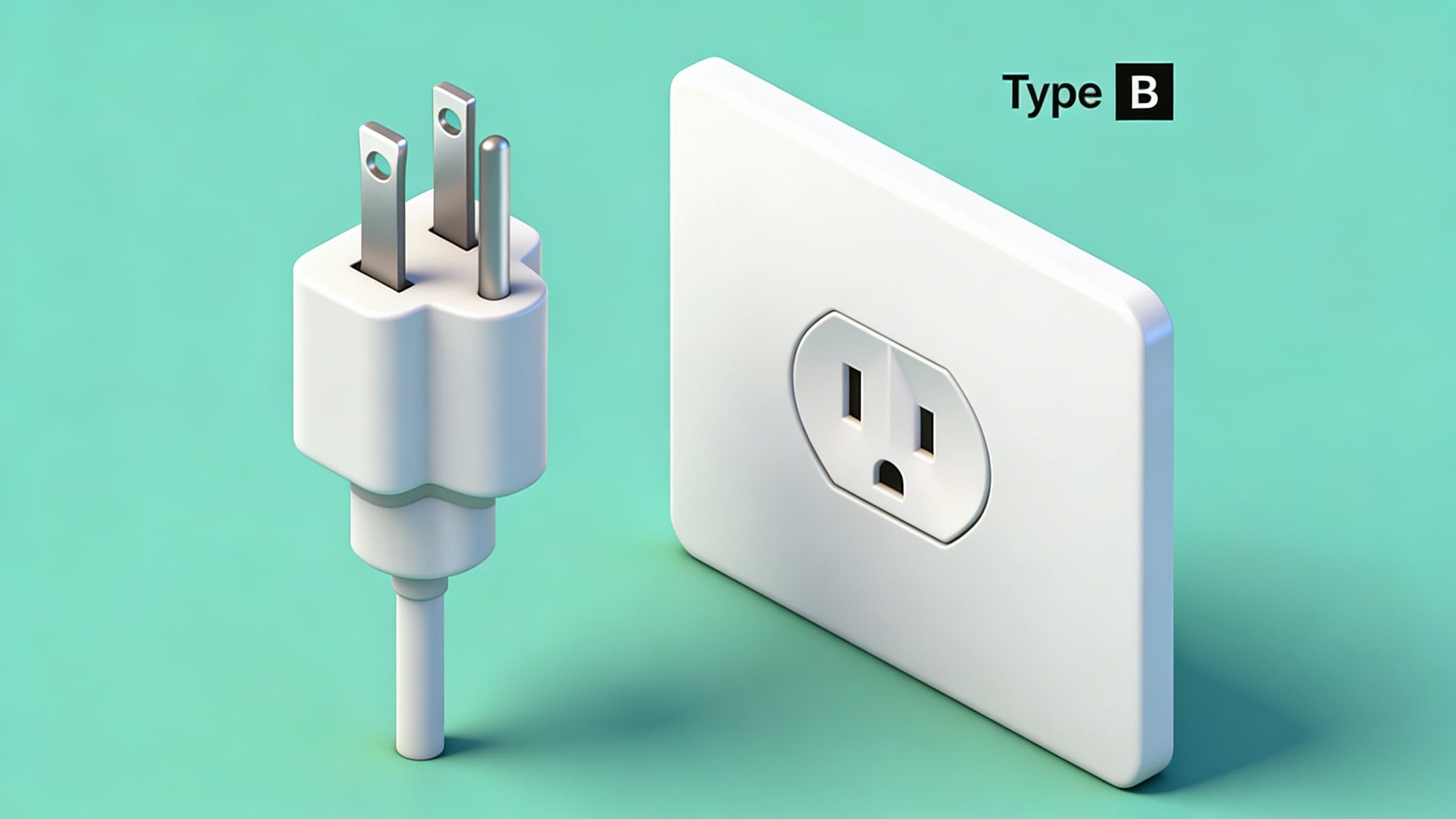
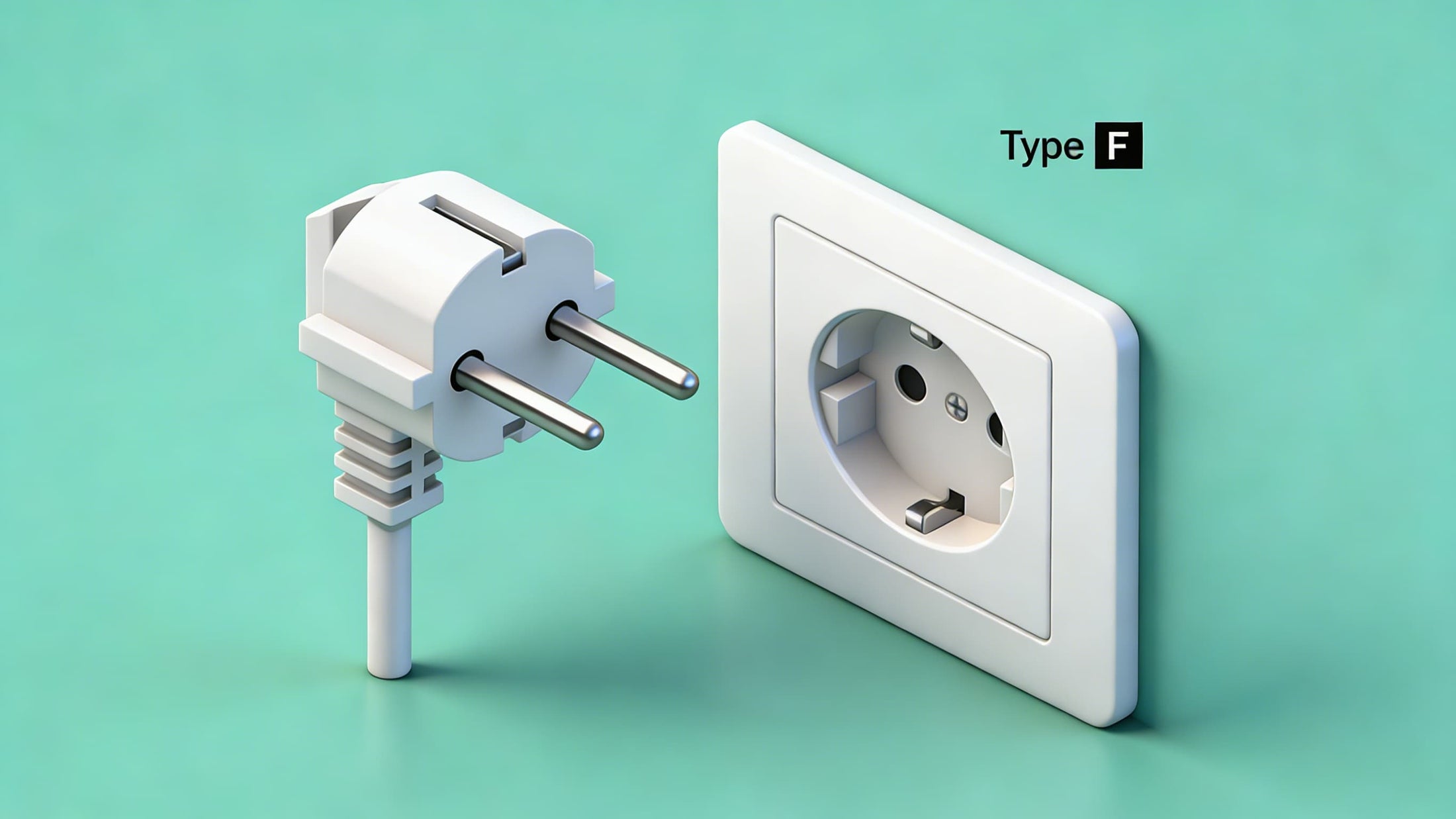
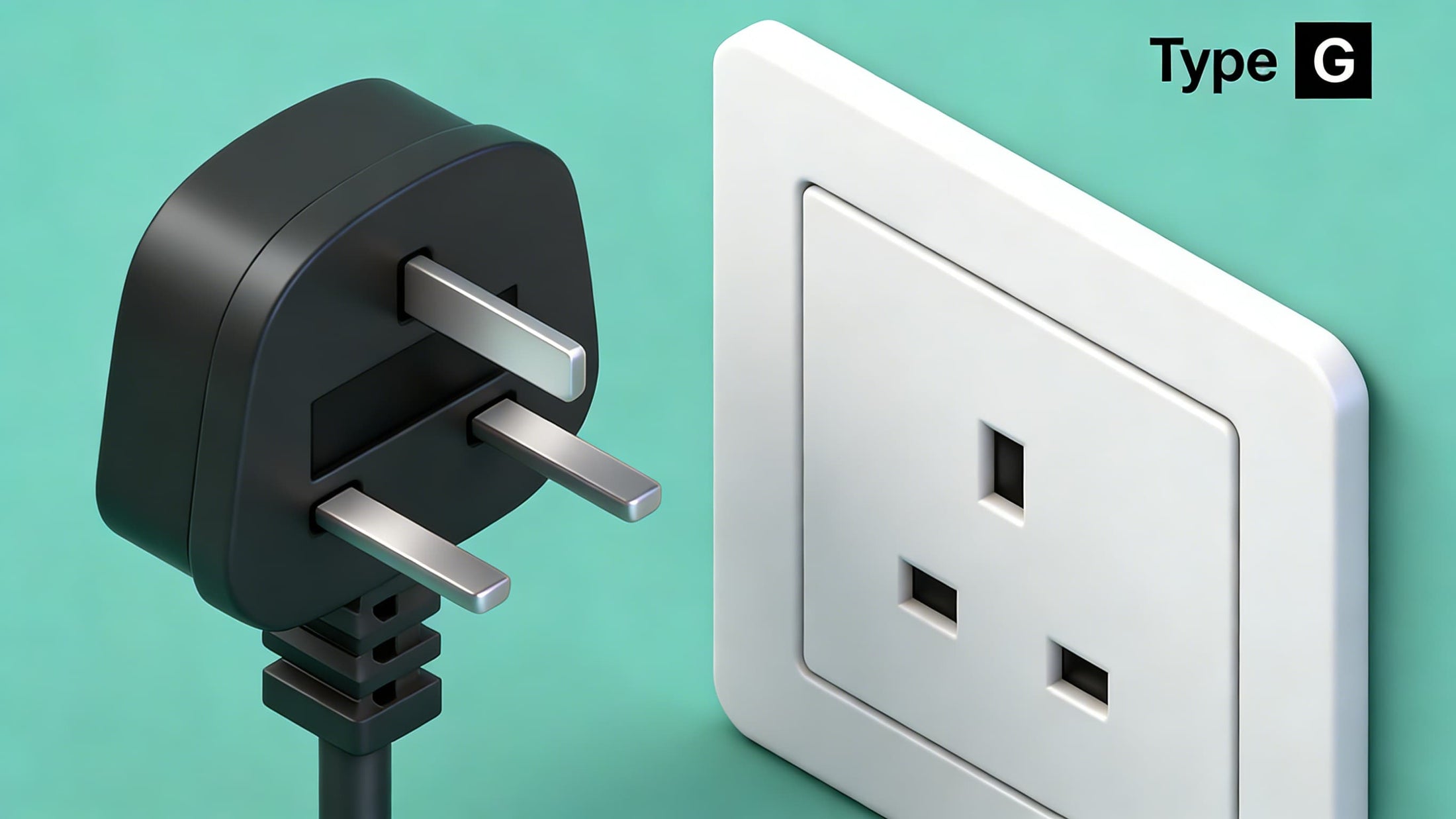
Universal travel adapters with sliding multi-prong mechanisms can't physically replicate all these grounding methods with one moving part. So they compromise: they pass live and neutral through, and drop the ground. For double-insulated devices (most consumer electronics with two-prong plugs), this is fine. For three-prong devices, it's a real safety gap.
Why this isn't laziness — it's physics: The grounding mechanisms across countries are fundamentally incompatible. US Type B uses a round pin at the bottom. UK Type G uses a rectangular pin at the top (deliberately longer, so it connects first and disconnects last). Schuko Type F uses metal clips on the socket's inner walls that grip the plug's outer rim. To replicate all of these in one sliding mechanism, an adapter would need a ground conductor path that simultaneously presents as a round pin, a rectangular pin, and a full-circumference metal contact surface — while maintaining reliable spring pressure in each configuration. No sliding mechanism can do this. That's why adapters that actually pass ground through are always country-specific: a dedicated US-to-Schuko adapter, or a dedicated US-to-UK adapter.
The Schuko problem: Type F (Schuko) is the hardest grounding system to replicate in any adapter. The ground connection happens through metal clips inside the recessed socket that press against the plug's outer cylindrical surface. A universal adapter's plastic housing physically cannot make this contact. Even some "grounded" adapters designed for European use have poorly aligned contact surfaces that barely touch the Schuko clips — providing unreliable or no grounding despite their marketing claims.
"False grounding" — when the outlet has a ground hole but no ground wire
Even a perfect grounded adapter can't protect you if the building's outlet isn't actually wired to ground. This is more common than you'd think:
- Old European hotels (pre-1970s construction): Schuko outlets may have the grounding clips physically present but not connected to any ground wire — the renovation only ran live and neutral
- Older US buildings (pre-1971): Some have been retrofitted with three-prong outlets but the ground terminal is unconnected (illegal but common in DIY renovations)
- Southeast Asian guesthouses: Electrical codes may not be strictly enforced; ground wires may not reach all rooms
You cannot tell by looking at an outlet whether it's properly grounded. The only reliable method: a socket tester (also called an outlet tester) — a small plug-in device (~$10-15) with indicator LEDs that shows whether ground is connected, wiring is correct, and polarity is right. If you travel with medical devices or expensive equipment that requires grounding, a socket tester is worth the weight in your bag.
When does missing ground actually matter?
Honestly? For most travelers charging phones and laptops, it doesn't. Those devices are double-insulated or use isolated switching power supplies. The risk surfaces with:
- Metal-cased desktop or gaming equipment
- CPAP machines with three-prong cords
- Power strips plugged into adapters (the strip's surge protection needs ground to work)
- Older appliances with metal casings and no double-insulation marking
What's Inside Your Adapter: Fuses, Ratings, and What Actually Protects You
Let me break down what different adapters actually contain — because the $12 universal adapter and the $45 dedicated adapter are not the same product class.
| Feature | Cheap Universal Adapter | Quality Dedicated Adapter | Voltage Converter |
|---|---|---|---|
| Internal fuse | Usually none | Yes (replaceable) | Yes (rated to load) |
| Grounding pass-through | No | Yes (country-specific) | Varies by model |
| Surge protection | No | Some models | Some models |
| Fire-retardant housing | Unknown/unmarked | PC or ABS (marked) | PC or ABS (marked) |
| Certification | Often unlisted | CE, UL, FCC, or BS | CE, FCC, UL |
| Continuous rating honest? | Headline watts only | Usually accurate | Check spec sheet |
The big takeaway: if your adapter doesn't have a CE, UL, or FCC marking — or if those markings look like they were printed on a home inkjet — you're gambling. Legitimate certification means the product passed safety testing for insulation, flame resistance, and current handling.
How to spot a fake CE mark
There are two "CE" marks that look almost identical but mean completely different things:
- Conformité Européenne (real): The two letters have specific spacing — you could draw a circle the same diameter as the C, and the vertical stroke of the E should align with the right edge of that circle. This means the product passed EU safety testing.
- "China Export" (fake): The two letters are squished together with almost no gap. This is not a legal marking — it's an attempt to look like CE certification without actually having it.
If the letters on your adapter look cramped together with barely any spacing, or if the mark is blurry/unevenly printed, treat the certification as unverified.
What CE and UL actually certify — and what they don't
A common misconception: "CE/UL certified = completely safe." In reality, these certifications test whether the adapter itself won't catch fire or electrocute you. They do not require the adapter to pass ground through to your connected device. An adapter can be legitimately CE-certified while providing zero grounding protection to anything plugged into it. The certifications confirm insulation quality, material flame resistance, and thermal behavior under rated load — nothing about ground continuity for connected devices.
Real-world safety incidents with travel adapters
These aren't hypothetical risks:
- Apple 2016 global recall: Apple recalled approximately 12 million AC wall plug adapters worldwide after reports that the plug prongs could detach and remain in the outlet, creating an electrical shock risk. This affected their own adapters for UK, EU, AU, and other regions.
- Target 2019 "Travel Smart" recall: A batch of universal adapters was recalled by CPSC because adapter pins could break off inside outlets, exposing live metal.
- EU Safety Gate warnings: The EU Safety Gate (formerly RAPEX) system regularly flags imported travel adapters for "accessible live parts" and "inadequate insulation" — meaning the adapter lets you touch electrified metal while it's plugged in.
The pattern: the most common failure modes are broken/detaching pins (creating shock hazard), inadequate insulation (letting electricity reach the outer surface), and overheating contacts (fire risk). A properly certified adapter from a reputable brand eliminates all three.
DOACE 4-Check Applied to Safety
The DOACE 4-Check method (Shape, Voltage, Load, Use Case) applies directly to safety decisions. Here's how to think about each check specifically through a safety lens:
✓ Shape
Does the adapter sit firm and flush in the outlet? A loose fit creates arcing — tiny sparks between the contact surfaces that generate heat and degrade the connection over time. If you can wobble the adapter in the socket, find a better-fitting one or use a country-specific adapter.
✓ Voltage
Check every device label. If it says 100-240V, you only need shape adaptation. If it says 120V only, you need voltage conversion — not just an adapter. Plugging 120V-only devices into 230V through an adapter is the single most dangerous common mistake.
✓ Load
Add up all device wattages sharing one adapter. Stay well below the adapter's rated maximum — ideally at 70-80% for continuous use. A "2500W" adapter at 10A/250V should not run anything over 2000W continuously. Heating elements draw their full wattage nonstop.
✓ Use Case
Overnight, unattended, or medical-critical devices need higher safety margins. Don't leave a high-wattage device running through an adapter while you sleep. For CPAP or medical equipment, use grounded, fused connections or a dedicated converter with certified safety features.
Warning Signs Your Adapter Is Unsafe Right Now
Here's a practical checklist. If any of these are true, unplug and reassess:
- Hot to touch after 5+ minutes — warm is acceptable for high-draw devices; "can't hold it" is not
- Burning or chemical smell — plastic housing degrading; stop immediately
- Visible discoloration or melting — the adapter has already been damaged internally
- Loose fit / wobbles in the outlet — arcing risk; use a country-specific adapter instead
- Sparking when inserting or removing — normal for high-inductive loads (motors) but not for phone chargers or laptops
- Intermittent power / flickering — poor contact; the connection is degraded
- Tripped breaker at the outlet — you've exceeded the circuit's capacity or there's a short
Device Safety Matrix — Adapter Only vs. Converter Needed
Not every device needs the same level of protection. Here's a realistic breakdown by device type and the safety level required:
Figure 2: Device wattage ranges and safety thresholds — green zone is adapter-safe (100-240V devices), red zone requires voltage conversion or should not travel
| Device | Typical Wattage | Usually 100-240V? | Safety Verdict |
|---|---|---|---|
| Phone charger | 5-45W | Yes | Adapter only. Safe on any adapter. |
| Laptop charger | 45-140W | Yes (check label) | Adapter only. Grounding preferred but not critical. |
| Camera battery charger | 10-30W | Yes | Adapter only. Safe anywhere. |
| Electric toothbrush charger | 1-5W | Yes | Adapter only. Negligible risk. |
| CPAP machine | 30-90W | Most modern CPAPs yes | Adapter safe if 100-240V. Use grounded adapter. Consider pure sine wave converter if humidifier attached. |
| Hair dryer (US 120V) | 1500-1875W | No (120V only) | Needs high-wattage converter or don't bring it. |
| Curling iron / straightener | 25-200W | Many are dual-voltage | Check label. If dual-voltage, adapter only. If 120V only, converter required. |
| Electric kettle | 1000-1500W | No (region-specific) | Don't bring. Buy locally or use hotel kettle. |
| Gaming console (PS5/Xbox) | 100-350W | Yes (internal PSU) | Adapter only. Grounded adapter recommended. |
Hotel and Airbnb Reality — Old Wiring, Loose Outlets, Missing Ground
Even a perfect adapter can't fix bad wiring behind the wall. Here's what travelers actually encounter:
- Old European hotels (pre-1990 renovation) — outlets may be recessed Schuko without proper earth connection; the grounding clips exist but aren't wired
- Airbnb apartments — renovated rooms might have modern outlets in one room and ancient two-pin sockets in another; no guarantee of consistency
- Southeast Asian guesthouses — multiple outlet types on one wall (Type A, Type C, Type G mixed); wiring quality varies wildly
- UK bathroom shaver sockets — limited to 1A; will not power anything beyond an electric shaver or toothbrush charger
- Cruise ship cabins — typically US-style 110V outlets plus one European 220V outlet; each limited to specific amperage
What to do: when you arrive, test one low-draw device first (phone charger). Check if the outlet feels firm. If the adapter wobbles, try a different outlet. For critical devices (CPAP, work laptop), ask the front desk:
Common Safety Mistakes — and What Actually Happens
These aren't hypothetical. They're the mistakes that lead to fried devices, tripped breakers, and — in worst cases — small electrical fires in hotel rooms.
- Mistake 1: Assuming "universal adapter" means "universal safety" — Universal adapters adapt shape. They don't adapt voltage, don't carry ground, and often lack fuses. You still need to check voltage compatibility separately.
- Mistake 2: Running a 120V-only device through an adapter into 230V — The adapter doesn't stop this. The device receives 230V and can burn out in seconds. Always read the device label first.
- Mistake 3: Daisy-chaining power strips through a single adapter — All current flows through one connection point. The adapter becomes the thermal bottleneck.
- Mistake 4: Leaving high-wattage devices plugged in unattended — Hair dryers, irons, heaters should never run unattended through any adapter.
- Mistake 5: Ignoring a warm adapter because "it still works" — Excess heat is the warning. Each overheat episode degrades the internal contacts, making the next session hotter.
- Mistake 6: Trusting a surge protector strip in an ungrounded outlet — Most surge protectors need the ground reference to shunt excess voltage. Without ground, the MOV (metal oxide varistor) inside can't protect anything.
Every one of these mistakes is avoidable with the 4-Check method. Read the full breakdown of common travel power mistakes for more real-world examples.
Recommended Setup for Safe Travel Power
Based on the safety principles above, here's how I'd structure a travel power kit depending on what devices you're bringing:
If you only carry USB-powered devices (phones, tablets, cameras, earbuds)
You need a quality multi-port GaN travel adapter — not a voltage converter. GaN adapters with built-in USB-C and USB-A ports handle 100-240V internally, so they work everywhere without conversion. They're also compact and eliminate the need for multiple chargers.
Why GaN chargers don't need grounding: A GaN USB charger has complete electrical isolation between the AC input side and the USB output side — provided by an internal transformer barrier. Even if the AC side had a fault, the USB output cannot exceed 20V (USB PD maximum). Since 20V DC is well below the human-safety threshold (~50V DC), there is no shock risk from the output side. The charger also includes internal OVP (over-voltage), OCP (over-current), OTP (over-temperature), and SCP (short-circuit) protection. Additionally, GaN semiconductors operate at 95%+ efficiency versus 88-92% for traditional silicon — meaning less wasted energy as heat, and a cooler-running device in a smaller package.

DOACE 100W GaN International Power Adapter
Built-in USB-C cable + 4 USB charging ports. Handles 100-240V input automatically. Replaces multiple chargers with one certified adapter for phones, laptops, tablets, and cameras. No voltage conversion needed — it's a universal power supply.
If you carry a 120V-only sensitive device (CPAP with humidifier, small electronics)
For devices that need clean, stable 110V output — especially sensitive electronics or CPAP machines with heated humidifiers — a pure sine wave converter is the safe choice. Modified wave converters can cause buzzing, overheating, or malfunction in devices with motors or sensitive circuits.

DOACE LC-X35 Pure Sine Wave Converter (350W)
Outputs clean sine wave 110V for sensitive devices. Use this for CPAP machines with humidifiers, audio equipment, or small medical devices. Not for hair dryers or heating elements — the 350W continuous limit is real and not a suggestion.
If you must bring a high-wattage 120V appliance (hair dryer, flat iron)
I'll be direct: the safest option is usually to not bring US 120V hair dryers abroad. Buy a dual-voltage travel hair dryer or use one at your hotel. But if you must, you need a high-wattage converter rated well above your device's actual draw, with thermal protection and automatic shutoff.
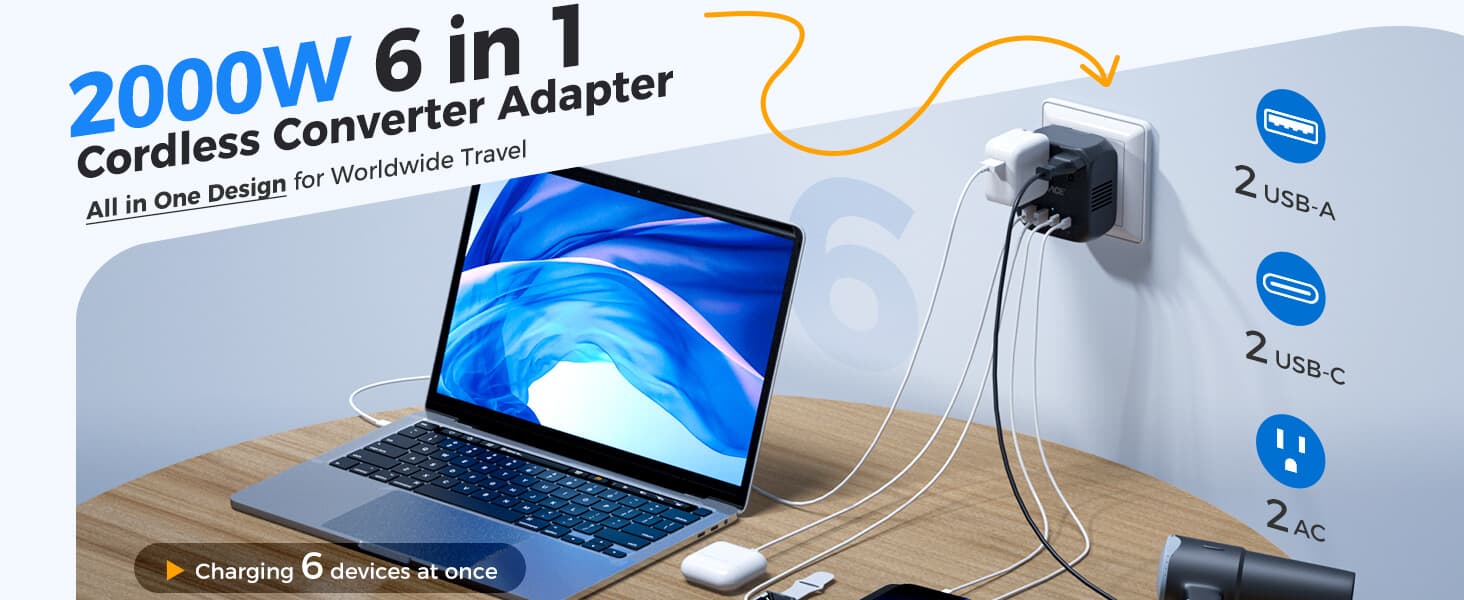
DOACE C15 2000W Voltage Converter
For mechanical hair dryers up to 2000W, flat irons, and simple heating tools. Includes worldwide plug adapters and USB-C fast charging. Not for Dyson Airwrap, smart curling irons with digital temp control, or devices with microprocessors — those need pure sine wave or should stay home.
You can compare DOACE converter models side by side in the DOACE LC-C30 vs LC-X35 vs LC-X80 comparison guide to find which model matches your device wattage and use case.
The $8 Adapter vs. $50 Converter Question
A common pushback: "I've been using a $8 universal adapter for years and nothing's happened. Why would I spend $50 on a converter or a certified adapter?"
When $8 is genuinely enough:
- You only charge phones, tablets, earbuds, and cameras — all under 50W and all 100-240V
- You use the adapter for short periods (1-2 week trips) and unplug when not actively charging
- You never plug anything with a three-prong plug into it
- You check the outlet fit before use and the adapter doesn't wobble
For this traveler — and it's the majority of travelers — a cheap adapter works fine. The thermal load is negligible, grounding is irrelevant for double-insulated devices, and a fuse wouldn't have anything to protect against at 20W.
When $8 becomes dangerous:
- High-power devices (>500W): The I² relationship means contact-point heat rises dramatically. A $8 adapter's thin pins and poor alloy contacts can overheat under sustained high current.
- Unattended overnight use with high loads: Even moderate loads through poor contacts accumulate heat over hours. No fuse means no circuit break if something shorts.
- Medical devices (CPAP): If your CPAP has a three-prong plug, you want grounding and reliable contacts. A device you depend on to breathe overnight should not run through the cheapest possible connection.
- Unknown certification: The issue isn't price per se — it's whether the product passed real safety testing. A $8 adapter with no verifiable CE/UL marking may have substandard insulation, non-flame-retardant plastic, or contacts that degrade after a few uses.
The honest answer: don't throw away your cheap adapter if you only charge phones. But if you're bringing a converter, a CPAP, or high-power devices, invest in a product with real certifications and protection circuits. The price difference is $15-40. The risk difference is real.
How to Tell If Your Device Needs Grounding
Before you worry about grounded adapters, check whether any of your devices actually need grounding:
- Count the prongs on the plug. Two prongs = no grounding needed (the device is double-insulated or uses an isolated power supply). Three prongs = designed to be grounded.
- Look for the double-insulation symbol: A small square inside a larger square (⧈) printed on the device or its power brick. This symbol means the device has two independent layers of insulation and does not rely on grounding for safety. Most phone chargers, laptop power bricks, and tablet chargers have this marking.
- Check the power label. If it says "Class II" or shows the ⧈ symbol, grounding is not required regardless of the plug type.
The practical reality: Over 90% of devices a typical traveler carries — phones, laptops, tablets, cameras, earbuds, electric toothbrushes — are Class II double-insulated. They are designed to be safe without grounding. The travelers who genuinely need grounded adapters are a small but important group: CPAP users with three-prong machines, digital nomads with desktop monitors, and professionals with specialized equipment.
FAQ
Is it safe to leave my travel adapter plugged in overnight?
For low-draw devices like phone chargers (5-20W) through a quality adapter: yes, that's fine. For anything above 100W or any heating device: no. Unplug high-wattage devices when not actively using them.
How do I know if my travel adapter is grounded?
Check the product listing or packaging for "grounded" or "earthed." Physically, a grounded adapter will have a visible earth pin or grounding contact specific to the destination country — not just a sliding multi-prong mechanism. If it has sliding prongs for "200+ countries," it's almost certainly not grounded.
Can a travel adapter cause a fire?
Yes, if overloaded beyond its rating, if the connection is loose (causing arcing), or if used with a 120V device in a 230V outlet without voltage conversion. The adapter itself won't ignite under normal rated use, but the connection point and the device can.
Why does my travel adapter get hot when I use my hair dryer?
Hair dryers draw 1500-1875W continuously. That's a massive current through a small adapter contact. Even a properly rated adapter will warm up. If it's hot enough to be uncomfortable to touch, your adapter's contacts are likely undersized for that load — switch to a dedicated high-wattage converter or use the hotel's hair dryer.
Do I need a grounded adapter for my laptop charger?
Most laptop chargers use a two-prong (figure-8 or Mickey Mouse) cable that doesn't require grounding. Some larger gaming laptop power bricks use three-prong cables — for those, a grounded adapter is recommended but not dangerous without one. The laptop's power supply is internally isolated.
Is a universal travel adapter with USB ports safer than a plain adapter?
The USB ports themselves are safe — they output regulated 5V/9V/20V regardless of wall voltage. But the AC pass-through part of the same adapter has the same limitations as any universal adapter: no grounding, possibly no fuse. The USB section and the AC section are separate safety questions.
What does the fuse inside a travel adapter actually protect against?
A fuse protects against overcurrent — drawing more amps than the circuit is designed for. If something shorts or you overload the adapter, the fuse wire melts and breaks the circuit before the wiring melts. Without a fuse, the weakest point in the circuit fails first, which could be inside your device or at the wall outlet's wiring.
Can I use a surge protector power strip through a travel adapter?
You can physically do it, but the surge protection likely won't work. Most surge protectors need a grounding connection to divert excess voltage. Through an ungrounded travel adapter, the MOV (metal oxide varistor) inside the strip has no path to earth. You get the power strip's outlets but not its protection. For real surge protection abroad, use a dedicated adapter with built-in surge rated for the destination's grid.


