

The 6-Step Converter Sizing Formula
A safe converter choice is not just “device watts plus a little margin.” Use this sequence instead:
| Step | Question | Why it changes the answer |
|---|---|---|
| 1 | Does the label say 100-240V? | If yes, you normally need a plug adapter or GaN charger, not a voltage converter. |
| 2 | What are the real watts? | Use printed watts or calculate volts × amps. |
| 3 | How long will it run? | Overnight and continuous loads need more margin than 5-minute heat tools. |
| 4 | Does it have motor startup surge? | Motors can briefly draw several times their running wattage. |
| 5 | Does it need pure sine wave? | CPAP, medical, audio, and sensitive electronics may fail on modified wave. |
| 6 | Does the manufacturer exclude converters? | Dyson-style smart heat tools can fail even with enough watts. |
Figure 1: Device wattage vs practical converter size after headroom and use-case adjustment.
Step 1: Check Whether You Need a Converter at All
Before sizing, find the word INPUT on the device, charger, or power brick. If it says 100-240V, 50/60Hz, the device is already wide-voltage. For that device, a voltage converter is unnecessary. You need the right plug shape or a USB-C/GaN charging path.

| Label says | Meaning | What you need |
|---|---|---|
| 100-240V, 50/60Hz | Wide-voltage worldwide input | Plug adapter or GaN charger |
| 100-240V~ | Wide-voltage AC input | Plug adapter or GaN charger |
| 120V, 60Hz | North America single-voltage | Step-down converter in 220-240V regions |
| 110-120V, 60Hz | North America single-voltage range | Step-down converter in 220-240V regions |
| 220-240V, 50Hz | High-voltage region single-voltage | Step-up solution in 120V regions, or local device |
| No readable label | Unknown | Do not guess; check exact model specs |
Most phone chargers, laptop power bricks, tablets, camera chargers, USB accessories, and modern gaming devices are already wide-voltage. The USB Power Delivery ecosystem also explains why many travel charging problems now belong in the USB-C/GaN adapter category instead of the voltage converter category.
How Converter Sizing Changed Over Time
Older advice often said “match the converter wattage to the appliance wattage.” That advice came from the heavy transformer era, when a voltage transformer was large, iron-core, and often overbuilt. Modern travel converters are lighter and more convenient, but the label number can hide continuous limits, waveform type, thermal behavior, and load restrictions.
| Era | What changed | What it means for your trip |
|---|---|---|
| Heavy transformer era | Large iron-core transformers handled voltage conversion with simple sizing and high weight. | Reliable but too heavy for most casual travel. |
| Electronic converter era | Lightweight converters reduced size but introduced peak-vs-continuous confusion and modified wave output. | The biggest printed wattage is not always the safe planning wattage. |
| USB-C and GaN era | Phones, laptops, and many electronics moved to 100-240V input and USB-C charging. | Many devices should bypass the converter entirely. |
| Smart heat tool era | Dyson-style BLDC motors and digital heat control made wattage-only sizing unsafe. | Some devices should be replaced locally, not converted. |
| Current best practice | Size by watts, duration, waveform, startup surge, device type, and manufacturer rules. | A multi-factor check prevents both undersizing and wrong-device purchases. |
Step 2: Find the Device Wattage Correctly
If a label says 120V and 1.5A, calculate 120 × 1.5 = 180W.
Use the highest printed wattage, not the setting you expect to use. If a hair dryer says 1875W, choose by 1875W even if you plan to use low heat. If a device lists VA instead of W, use the VA number for conservative converter sizing because some motor and power-supply loads have a power factor below 1.0.
| Label example | Calculation | Sizing category |
|---|---|---|
| 120V 0.75A | 90W | Low-watt device; waveform and duration decide product route |
| 120V 1.5A | 180W | Small appliance or styling tool; add headroom |
| 120V 6A | 720W | Mid-watt load; LC-X80 class if compatible |
| 125V 15A | 1875W | High-watt dryer class; high-watt converter or local device |
| 100-240V 65W charger | No converter sizing needed | Plug adapter or USB-C/GaN path |
Step 3: Add Headroom Because Equal Is Not Enough
A converter running at 100% capacity has no margin for voltage fluctuation, startup transients, heat buildup, or warm hotel-room conditions. For continuous loads, electrical practice often uses an 80% planning idea: do not run a load at the full rating for extended periods. For travel use, use these practical targets:
| Device type | Headroom rule | Example |
|---|---|---|
| Short-use simple device | At least 25% | 150W curling iron → 200W+ converter |
| Continuous or overnight device | At least 50% | 90W CPAP → 150W+ pure sine wave converter |
| Motor startup load | 2× running watts or more | 100W fan motor may need 200W+ startup capacity |
| High-watt heat tool | 25-30% target when practical | 1500W dryer → 2000W class converter |
| Smart heat tool | Do not size by wattage alone | Dyson-style tools can be excluded regardless of watts |
Continuous Load, Peak Load, and Startup Surge
A converter sees different stress patterns depending on how the device runs. A CPAP at 60W for eight hours can be harder on thermal design than a higher-watt heat tool used for a few minutes. A motor can draw several times its running current during startup. The Engineering Toolbox motor-starting reference explains why motor starting current can be many times the normal running value.
| Load pattern | Examples | Converter impact |
|---|---|---|
| Continuous load | CPAP overnight, medical equipment, some electronics | Needs conservative headroom and ventilation |
| Peak or burst load | Hair dryer for 5-10 minutes, curling iron warm-up | Needs enough watts but less total thermal duration |
| Startup surge | Fan, compressor, older motorized tools | May trip a converter even when running watts look low |
| Thermostat cycling | Heating tools that switch on/off | Can create repeated short surges and heat cycling |
For more detail, use the DOACE explanation of continuous vs peak wattage.
When Pure Sine Wave Changes the Size Answer
Pure sine wave is not about having more watts. It is about cleaner AC output. Eaton explains that pure sine wave output is important for sensitive equipment and can reduce problems associated with simulated or modified waveforms. That matters for CPAP, medical devices, audio equipment, and some electronics.

Figure 2: Pure sine wave compared with a stepped modified wave.
| Device | Pure sine wave need | Reason |
|---|---|---|
| CPAP machine | Strongly recommended | Overnight medical-adjacent reliability and possible humidifier/control sensitivity |
| Audio equipment | Often yes | Harmonic distortion may be audible |
| Sensitive medical devices | Follow manual first | Manufacturer requirements override converter marketing |
| Simple heating element | Usually no | Resistive load cares more about correct voltage and watts |
| Mechanical hair dryer | Usually no | High wattage is the larger issue, not waveform |
| Smart heat tool | Pure sine is not enough | Digital motor and control-board compatibility still matter |
DOACE Product Tier Map
Figure 3: Product route by voltage need, wattage, waveform, and device compatibility.

LC-X35 — 350W Pure Sine Wave
Best for compatible 120V-only sensitive devices under 350W: CPAP setups that truly need conversion, small medical devices, audio gear, and sensitive electronics. Not for hair dryers, kettles, or high-watt heat tools.
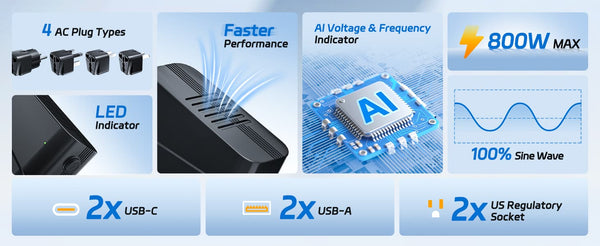
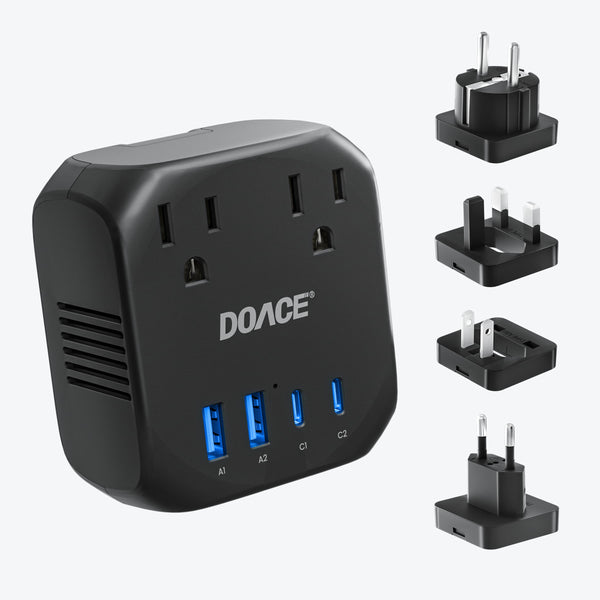
LC-X80 — 800W Mid-Range Converter
Best for compatible mid-watt travel appliances, curling irons, flat irons, and multiple lower-watt devices when waveform sensitivity is not the main concern. Not for full-size hair dryers or CPAP setups that require pure sine wave.
C15 — 2000W High-Watt Converter
Best for compatible mechanical high-watt heat tools under 2000W. A 1875W dryer leaves only about 7% raw headroom, so use conservatively and do not treat it as a smart-tool solution.

HC-X11 — 2200W Maximum Headroom
Best when a compatible high-watt tool is too close to a 2000W limit. It gives more margin than C15 for 1875W mechanical dryers, but it still does not approve Dyson, smart heat tools, or devices over the product rating.
Devices You Should Not Solve with a Travel Converter
- Dyson Airwrap, Supersonic, Airstrait, and similar smart heat tools: BLDC motors, sensors, digital temperature control, and manufacturer restrictions make wattage-only sizing unsafe. Use the destination-voltage version. See the DOACE Dyson converter guide.
- High-watt kitchen appliances: Kettles, rice cookers, and blenders are heavy, high-load, and often cheaper to buy locally.
- Devices over 2200W: No portable DOACE travel converter route covers them.
- Frequency-sensitive equipment: Some clocks, turntables, synchronous motors, and 60Hz-only devices need frequency conversion, not just voltage conversion. KCC Scientific’s 50Hz/60Hz guide explains this category.
- Any device whose manual excludes converters: The manual wins over the wattage calculation.
Multiple Devices Through One Converter
Only count the devices that actually need conversion. A laptop charger marked 100-240V should not be routed through the converter just because the converter has an outlet. It can use wall power through a plug adapter or GaN adapter directly.
- Never run two high-watt heat tools through one converter at the same time.
- Do not add wide-voltage chargers to converter load for no benefit.
- If devices have very different needs, one converter may not be ideal. A CPAP and a hair dryer belong to different power categories.
Worked Sizing Examples for Common Travel Devices
The easiest way to avoid the wrong converter is to run the same logic against real device categories. The examples below are not approvals for every model. They show how the calculation changes when the device label, waveform need, use duration, and manufacturer guidance change.
| Device on the label | Typical rating | Planning result | Likely route |
|---|---|---|---|
| Phone charger | 100-240V, USB-C | No voltage conversion. Choose plug shape and USB-C wattage. | GaN travel adapter |
| MacBook or Dell laptop brick | 100-240V, 50/60Hz | No converter. Apple and Dell support pages describe worldwide-capable power adapters for many laptop supplies. | Plug adapter or GaN charger |
| Camera battery charger | Often 100-240V | Check the charger, not the camera body. Most modern chargers only need plug adaptation. | Adapter-only path |
| Travel CPAP with 120V-only supply | 30-90W depending on humidifier | Add 50% margin and prioritize pure sine wave if the manufacturer allows converter use. | LC-X35 if within 350W |
| Simple curling iron | 120V, 100-200W | Add at least 25%. Check whether it is basic heat or digitally controlled. | LC-C30, LC-X35, or LC-X80 depending on watts and waveform need |
| Flat iron with electronic temperature control | 120V, 40-200W | Wattage may look small, but the control board may be the risk. Manual guidance matters. | Confirm before converting |
| Mechanical hair dryer | 120V, 1500-1875W | High wattage and heat are the main constraints. Use only if the dryer is compatible and sessions are short. | C15 or HC-X11 class |
| Dyson, Shark, Laifen, or similar smart dryer | Often 120V and high wattage | Do not solve by wattage. BLDC motor and smart controls create a converter boundary. | Destination-voltage version or leave it home |
| Electric kettle or rice cooker | 900-1500W+ | Possible in theory for some simple loads, poor travel choice in practice because heat duration is high and local replacements are easy. | Buy local |
| Clock, turntable, or synchronous motor | May be 60Hz-sensitive | Voltage conversion does not necessarily correct frequency. A 50Hz country can change speed or timing. | Specialized solution or do not bring |
Notice the pattern: the highest-watt device is not always the most complicated one. A basic hair dryer is mostly a wattage and heat problem. A CPAP can be a low-watt device with a high reliability requirement. A smart styling tool can be a no-converter item even when a large converter appears to have enough capacity.
How to Read Manufacturer Guidance Without Over-Trusting Marketing
A product page may say “for travel,” “worldwide,” or “international,” but those phrases can refer to very different things. Sometimes they mean plug adapters are included. Sometimes they mean the USB ports accept global input. Sometimes they mean the AC converter section handles 220-240V input for a specific set of 120V appliances. Treat the printed electrical label and manual as the controlling information.
For medical and sleep equipment, start with the manufacturer’s travel page or power-supply label. ResMed, Philips Respironics, and other CPAP brands often sell or specify power supplies that already accept 100-240V. If your CPAP power brick is already worldwide input, a travel voltage converter may add complexity without improving safety. If the power supply is older or single-voltage, the correct question becomes: total watts with humidifier, overnight use, clean waveform, grounding needs, and manufacturer permission.
For hair tools, do the opposite kind of check. Do not assume “salon quality” means converter compatible. Some premium devices use sensors, microcontrollers, or high-speed motors. Dyson support guidance is especially important because Dyson tools are commonly searched by US travelers but are not a simple high-wattage converter match. If a manual says not to use a converter, the converter size does not matter.
Short Trip, Long Stay, Hotel, and Cruise Scenarios
The same device can deserve a different answer depending on the travel setting. A portable converter is designed for travel convenience. That does not mean it is the best answer for months of daily use, high-heat sessions, or restricted environments.
| Scenario | Main question | Practical recommendation |
|---|---|---|
| One-week hotel trip | Will I use one compatible device for short sessions? | A travel converter can make sense if the device passes label, wattage, waveform, and manufacturer checks. |
| Business travel with laptop, phone, tablet, camera | Are all chargers 100-240V? | Usually choose a GaN travel adapter instead of a voltage converter. |
| CPAP overnight in a hotel | Is the CPAP power supply worldwide input? If not, what waveform does it require? | Prefer manufacturer-approved wide-voltage supply. If truly 120V-only and compatible, evaluate LC-X35 pure sine wave within rating. |
| Semester abroad or relocation | Will this be daily use for months? | Use local-voltage devices or a heavier stationary transformer. Travel converters are not the ideal long-stay foundation. |
| Cruise cabin | Does the cruise line restrict extension cords, surge protectors, or high-heat items? | Check the line’s current policy before packing. A converter that is electrically correct can still be disallowed onboard. |
| Airbnb or older building | Are outlets worn, ungrounded, or limited? | Use lower loads, avoid daisy chaining, and do not force high-watt appliances through uncertain outlets. |
Cruise and hotel rules are worth checking close to travel because policies can change and staff can enforce them differently. Carnival, Royal Caribbean, Norwegian, and other cruise lines publish their own prohibited-item rules. Even outside cruising, some hotels discourage personal kettles, irons, or high-heat appliances. Electrical compatibility is only one gate; property rules are another.
Why Frequency Can Break a Correct Wattage Choice
Most travel voltage converters step voltage up or down. They usually do not convert frequency. That means a 120V 60Hz device used in a 230V 50Hz country may receive the corrected voltage but still see 50Hz power. For many modern switching power supplies, this is fine because the label says 50/60Hz. For synchronous motors, timing devices, turntables, some fans, and older appliances, frequency can affect speed, heat, noise, or timing accuracy.
This is why the label check must include both voltage and Hz. “120V 60Hz only” is a more restrictive label than “100-240V 50/60Hz.” A voltage converter may make the voltage safe while leaving the frequency unchanged. KCC Scientific’s frequency-conversion guidance is useful for understanding why true frequency conversion is a specialized category, not something every pocket travel converter does.
What the Converter Rating Does Not Tell You
A headline rating such as 350W, 800W, 2000W, or 2200W is useful, but it is not the whole specification. It may not tell you how the converter behaves after ten minutes of heat, whether the output waveform is pure sine wave, how much startup surge it can tolerate, or whether a specific appliance’s electronics will accept the converted output.
| Missing dimension | Why it matters | How to check |
|---|---|---|
| Waveform | A modified or stepped waveform can make sensitive equipment hum, run hotter, or show errors. | Look for pure sine wave output when the device requires clean AC. |
| Continuous duration | A converter may handle a short burst better than hours of load. | Apply extra margin for overnight or repeated use. |
| Startup surge | Motors and compressors can briefly draw far above running watts. | Use motor surge guidance and avoid marginal sizing. |
| Ambient heat | Warm rooms reduce practical thermal headroom. | Use open-air placement and avoid running near the top rating. |
| Device electronics | Smart controls can object to converted power even at the correct voltage. | Read the manual and check known exclusions. |
| Grounding and outlet quality | Some devices require a grounded path, and adapters vary by destination. | Check plug type, grounding need, and local outlet condition. |
This is also why every converter recommendation needs both “best fit” and “not for.” Without both sides, a product card can accidentally imply universal compatibility. DOACE converter routing works best when the device has already passed the label and device-type filters.
The Headroom Math in Plain English
Headroom is the unused capacity between your device load and the converter rating. If a device uses 150W and your converter is rated 300W, the converter has 150W of spare capacity, or 100% headroom relative to the device. If a device uses 1875W and the converter is rated 2000W, the spare capacity is only 125W, which is about 7% headroom. Both examples are “under the rating,” but they are not equally comfortable.
For a simple 150W curling iron, a 300W converter gives room for voltage variation and brief heat cycling. For a 1875W hair dryer, a 2000W converter is working much closer to its limit, so the session should be short, the converter should be fully ventilated, and any thermal shutdown should be treated as a stop sign. Moving from 2000W to 2200W gives more room, but it still does not make an incompatible smart tool safe.
| Device load | Converter rating | Raw headroom | Interpretation |
|---|---|---|---|
| 60W CPAP | 350W | About 483% | Plenty of wattage; waveform and overnight reliability are the real checks. |
| 180W curling iron | 300W | About 67% | Comfortable for many compatible simple tools. |
| 700W appliance | 800W | About 14% | Thin for long sessions; verify device type and duration. |
| 1500W dryer | 2000W | About 33% | Reasonable only for compatible mechanical high-watt tools and short use. |
| 1875W dryer | 2000W | About 7% | Very narrow margin; HC-X11 gives more room if the tool is compatible. |
| 1875W dryer | 2200W | About 17% | Better than 2000W, still not a smart-tool approval. |
How to Pack a Two-Path Travel Power Kit
Many travelers do best with two separate power paths instead of trying to send everything through one converter. The first path is for wide-voltage electronics: phone, laptop, tablet, camera charger, power bank, watch charger, and earbuds. The second path, if needed at all, is for one or two single-voltage devices that genuinely require conversion.
A clean packing layout might look like this: one GaN travel adapter for all 100-240V electronics, one converter sized only for the 120V-only device, the original device labels photographed on your phone, and a destination plug plan based on the countries you will visit. This reduces converter load, keeps sensitive electronics away from unnecessary converted output, and makes troubleshooting much easier if something stops working.
This two-path approach also prevents a common packing mistake: buying one large high-watt converter because it feels simpler. It may be simpler in the suitcase, but electrically it can be less precise. A CPAP and a hair dryer do not have the same needs. A laptop and phone often do not need conversion at all. A high-watt converter is useful only for a compatible high-watt appliance; it is not the universal hub for every device on the trip.
Quick Decision Matrix: Which Path Fits Your Device?
| Your device situation | Best next step | DOACE route to evaluate |
|---|---|---|
| Every device label says 100-240V, 50/60Hz | Do not buy a voltage converter. Choose plug shape and USB-C capacity. | GaN travel adapter |
| One 120V-only low-watt sensitive device under 350W | Check manual approval, total watts, duration, and waveform need. | LC-X35 pure sine wave |
| One 120V-only simple heat tool around 100-250W | Add at least 25% headroom and check whether controls are basic. | LC-C30, LC-X35, or LC-X80 depending on final watts |
| Compatible mid-watt appliance above 350W and below 800W | Check startup surge and duration; avoid sensitive or smart devices. | LC-X80 |
| Compatible mechanical hair dryer around 1500W | Use short sessions, ventilation, and high-watt converter capacity. | C15 or HC-X11 |
| Mechanical hair dryer close to 1875W | A 2000W converter is close to the edge. More margin is better, but use remains short-session only. | HC-X11 if compatible |
| Dyson, Shark, Laifen, smart dryer, or digitally controlled styling tool | Do not solve with wattage. Use destination-voltage version or leave it home. | No portable converter route |
| Unknown label or no manual | Do not guess. Identify the exact model first. | No recommendation until confirmed |
Converter, Transformer, Local Device, or GaN Adapter?
| Path | Best when | Not ideal when |
|---|---|---|
| Travel voltage converter | Single-voltage device, compatible load type, within wattage plus headroom | Long-term high-load use or excluded smart devices |
| Heavy transformer | Long stay, stationary setup, continuous use where weight is acceptable | Short trip or carry-on travel |
| Local-voltage replacement | Kettles, rice cookers, smart hair tools, daily-use appliances abroad | Expensive specialized tool you only need briefly |
| GaN travel adapter | All devices are 100-240V and you need USB-C/USB-A charging | Any 120V-only appliance in a 220-240V country |
Common Mistakes That Lead to the Wrong Size
Buying the biggest converter
A 2200W converter will not make a Dyson compatible and will not give a CPAP pure sine wave. Bigger watts are useful only after waveform and device type pass.
Matching exactly
A 300W device on a 300W converter leaves no room for heat, startup, or voltage fluctuation. Add headroom.
Treating all heat tools alike
A simple heating coil is not the same as a BLDC smart heat tool with digital temperature control.
Using a travel converter for months
For relocation or daily long-term use, a local device or heavier transformer is usually safer.
Real-World Failure Scenarios
CPAP on a high-watt modified-wave converter
A traveler buys a 2000W converter for a 60W CPAP. The wattage margin is enormous, but the machine hums or the humidifier behaves incorrectly. The problem was waveform, not wattage.
1875W dryer on a 2000W converter
A 1875W mechanical hair dryer is technically below 2000W, but the margin is only about 7%. In a warm hotel room, after several minutes, the converter may trigger thermal protection.
Dyson Airwrap on a 2200W converter
The wattage may look covered, but the tool uses digital control and a high-speed motor. Wrong waveform or unsupported conversion can cause errors or damage.
Wide-voltage devices stacked through a converter
A laptop charger and phone charger marked 100-240V do not need to consume converter capacity. Plug them into an adapter or GaN charger instead.
Thermal Safety and Ventilation
Converters are not 100% efficient. The lost energy becomes heat. At high load, this can be substantial. A 2000W converter running a 1800W load can generate enough internal heat that ventilation and short use sessions become critical.
| Converter | Load scenario | Thermal concern |
|---|---|---|
| LC-X35 | 60W CPAP | Low heat, but overnight ventilation still matters |
| LC-X35 | 300W device | Watch warm rooms and long duration |
| LC-X80 | 700W compatible appliance | Allow cooling between sessions |
| C15 | 1500W dryer | Short-use only, open-air placement |
| C15 | 1875W dryer | Very close to high-watt stress boundary |
| HC-X11 | 1875W dryer | More headroom than C15, still short-use and compatible-tool only |
Thermal shutdown is not a minor inconvenience. It is a protection event. If the converter turns itself off, wait for a full cool-down and reduce the load before trying again. Do not cover the converter with clothes, put it under bedding, run it in a packed suitcase, or place it directly beside another heat source. High-watt conversion should happen in open air on a hard surface.
For overnight loads, the thermal rule is stricter because you are not watching the device every minute. A CPAP setup that truly needs conversion should have much more wattage margin than a short-use tool, and the converter should be positioned where air can move around it. If the device has medical importance, confirm the power plan before the trip rather than testing it for the first time at midnight in a hotel room.
A Practical Pre-Purchase Checklist
If you are comparing converter options before a trip, use this checklist with the exact device in your hand:
- “The device label says ___V and ___Hz.” If it says 100-240V and 50/60Hz, stop converter shopping for that device.
- “The device draws ___W or ___A.” If amps are listed, calculate watts with volts × amps.
- “I will use it for ___ minutes or ___ hours.” Longer use means more headroom.
- “It is a simple heater, motor, power supply, medical device, audio device, or smart controlled device.” This decides waveform and risk category.
- “The manual says converters are allowed, prohibited, or not mentioned.” Prohibited means stop.
- “The destination voltage is ___V.” Use IEC World Plugs, WorldStandards, or your destination’s official travel guidance to confirm.
- “The destination plug type is ___.” Voltage conversion and plug shape are separate decisions.
When any blank cannot be filled, do not buy by guesswork. The most expensive converter in the product list is still the wrong purchase if the missing blank is “manufacturer prohibits converters” or “device is 100-240V already.”
How This Guide Uses External Power References
For destination voltage and plug differences, use sources that publish country-level electrical data such as IEC World Plugs and WorldStandards. For waveform differences, Eaton’s explanation of pure sine wave versus modified sine wave gives useful background. For startup surge and motor behavior, engineering references such as Engineering Toolbox and NEMA standards explain why motors may need more than their running watts. For frequency issues, specialist resources such as KCC Scientific explain why 50Hz/60Hz is separate from voltage.
For product selection, use the current DOACE product pages and the exact model pages linked in the product cards. Product names, wattage classes, USB port layouts, and accessories can change, so the product page should be treated as the live specification before purchase. The logic in this guide is intentionally conservative: it is better to avoid a converter purchase than to imply support for a device category that should not be converted.
When the Safer Answer Is “Do Not Buy a Converter”
Voltage conversion does not need to push every shopper toward a product. The safest answer is often not to buy anything until the device is better identified. That is especially true when the label is missing, the device is expensive, the device runs hot, or the appliance includes a motor and electronic control board. In those cases, a converter can appear to be the solution because the plug fits and the wattage number looks large enough, while the real risk sits in waveform, frequency, heat, or manufacturer restrictions.
This is why the adapter-only exit is just as important as the product route. A traveler with only a phone, laptop, tablet, camera, and power bank usually needs better charging organization, not voltage conversion. A traveler with a Dyson-style hair tool may need a local-voltage version, not a larger converter. A traveler with an older CPAP may need a manufacturer-approved power supply or a carefully checked pure sine wave converter, not a high-watt heat-tool converter. The correct answer can be smaller, larger, cleaner, or no converter at all.
If you are unsure, the most useful pre-trip action is to take clear photos of each device label and separate your gear into three groups: already worldwide input, single-voltage but simple and compatible, and uncertain or excluded. The first group goes to a plug adapter or GaN charger. The second group can be sized against a converter. The third group needs manufacturer confirmation, a local replacement, or a decision to leave it home.
This conservative sorting step is especially useful for family trips, study-abroad packing, and long itineraries where several people bring chargers and appliances together. It keeps the converter reserved for the one or two devices that actually require converted AC power, while the rest of the travel kit stays on normal wide-voltage charging. That separation reduces heat, reduces troubleshooting, and makes it easier to explain the power plan to another person using the same hotel room or cabin outlet. It also prevents a tired traveler from plugging a 100-240V charger into the converter simply because the outlet is available.
Pre-Trip Sizing Checklist
- Photograph the INPUT label on every device.
- Separate 100-240V devices from 120V-only devices.
- For each 120V-only device, record watts or calculate volts × amps.
- Add headroom: 25% for short-use, 50% for continuous, and more for motor startup.
- Check whether the device needs pure sine wave.
- Check whether the device is a smart heat tool, BLDC motor, compressor, or excluded product.
- Check whether frequency matters: 50Hz vs 60Hz is not fixed by most voltage converters.
- Choose the converter tier only after all checks pass.
- If multiple devices use one converter, sum only the devices that need conversion.
- Use the converter on a hard, open surface with ventilation.
FAQ
Is a 2000W converter enough for an 1875W hair dryer?
Only if it is a compatible mechanical dryer and you accept the thin margin. A 1875W dryer on a 2000W converter has about 7% raw headroom. HC-X11 gives more margin, but it still does not approve smart/Dyson-style tools.
Do I need a voltage converter for my laptop?
Almost certainly no. Most laptop chargers are marked 100-240V. Check the brick. Use a plug adapter or USB-C/GaN charger.
What size converter for a CPAP?
First check whether the CPAP power supply is already 100-240V. If it is, use a plug adapter. If it is truly 120V-only, size by machine plus humidifier draw, add about 50% headroom, and prioritize pure sine wave. LC-X35 is the DOACE route to check when the total load is within 350W and manufacturer guidance allows it.
Can I use a larger converter than I need?
Yes, oversizing usually does not harm the device. The tradeoffs are weight, size, cost, and sometimes baseline heat. Do not oversize to bypass waveform or device-type restrictions.
Can I plug multiple devices into one converter?
Yes, if the combined load of devices that actually need conversion plus headroom stays within rating. Do not run two high-watt tools at once. Do not route wide-voltage chargers through the converter.
When is pure sine wave worth it?
For CPAP, medical devices, sensitive electronics, audio gear, or anything running overnight. It is not needed for every simple heating element, and it does not replace wattage limits.
Converter or transformer for long stays?
For short travel, a portable converter is convenient. For relocation, months-long daily use, or stationary continuous loads, a transformer or local-voltage device is usually safer.
What if the label says 100-127V?
That may cover Japan and North America, but it does not cover 220-240V countries. Treat it as needing step-down conversion in Europe, the UK, Australia, and many other destinations.
Should I buy one large converter or multiple smaller ones?
One converter is simpler, but devices with different needs may justify separate paths. A CPAP may need pure sine wave overnight, while a hair dryer is a short high-watt load. Those are different categories.
What if my device label is worn off?
Do not guess. Search the exact model number, contact the manufacturer, or buy a local replacement. Wrong voltage can destroy the device or create a safety risk.


