

The awkward truth: “I need more outlets” is a real travel problem, but a normal U.S. household power strip is often the wrong solution. A travel adapter may let the plug fit, yet the strip can still be rated only for 125V. Hotels, cruise cabins, international outlets, grounding systems, and connected devices all add separate compatibility checks.
The most important rule is that every link in the power chain must be compatible: the wall outlet, travel adapter, power strip, surge components, connected chargers, grounding path, and total load. A 250V travel adapter does not upgrade a 125V strip behind it.
Power Strip vs Outlet Extender vs USB Charger: The Difference
| Item | What it does | Travel safety concern | Best use |
|---|---|---|---|
| Power strip | Adds multiple AC outlets through one cord | Can overload one outlet; may not be rated for 220-240V; surge versions often banned on cruises | Domestic use or verified hotel use with low loads |
| Outlet extender | Adds extra outlet faces directly at the wall | Still shares one wall outlet's load; bulky units can loosen sockets | Phones, cameras, tablets, low-power electronics |
| USB-C GaN charger | Converts wall power to USB-C/USB-A output | Does not provide AC outlets or voltage conversion for appliances | Phones, tablets, laptops, cameras |
| Voltage converter | Steps voltage down/up for single-voltage devices | Must match wattage, waveform, and device type | 120V-only devices in 220-240V countries |
The Cruise Rule: Surge Protectors Are the Problem
Cruise cabins have limited outlets, so travelers love power strips. But many cruise lines ban surge-protected strips. The issue is not simply “too many plugs.” It is the surge-protection circuit inside many household strips. Shipboard electrical systems can interact with surge protector components differently than a grounded home circuit.
Figure 1: Relative travel risk by power expansion method
Hotels: The Main Risk Is Overload and Voltage Mismatch
Hotels usually will not confiscate your power strip. But that does not make it safe. The biggest problems are:
- One wall outlet becomes the bottleneck. Four devices may look harmless, but all current passes through one connection.
- Voltage mismatch can multiply damage. A US power strip rated only for 125V should not be treated as a 230V travel accessory.
- Grounding may not pass through. A power strip's surge protection often needs ground to work; many travel adapters do not pass ground.
- Loose hotel outlets overheat faster. A heavy strip hanging from a worn socket can create poor contact.
If your adapter already feels warm or loose, read the travel adapter safety guide before adding more devices to it.
Device-by-Device Decision
The answer changes depending on what you are trying to power. Low-power wide-voltage electronics can often be consolidated into USB charging. High-watt or single-voltage appliances need separate treatment.
| Device category | Typical input | Use U.S. strip abroad? | Better path |
|---|---|---|---|
| Phone, tablet, earbuds | USB charger, usually 100-240V | Unnecessary | Multi-port GaN charger |
| USB-C laptop | 45-140W, usually 100-240V | Usually unnecessary | 100W/140W GaN charger |
| Grounded laptop brick | Often 100-240V, three-prong cord | Only with verified voltage and ground | Destination-country grounded cord |
| Camera/drone battery hubs | Often wide-voltage | Use local 250V strip if many chargers are needed | Local strip or separate firm outlets |
| CPAP | Check the external power supply | Avoid unknown strips for overnight use | Reliable direct outlet; adapter only if wide-voltage |
| Toothbrush/shaver base | Varies; some are 120V-only | Strip does not solve voltage | Read label; use correct charger/converter |
| Hair dryer/curling iron | High watt, often single-voltage | No | Dual-voltage/local tool or compatible converter |
| Kettle/iron/steamer/heater | High watt | No | Use local appliance |
Why USB-C changes the decision
The original reason for packing a strip was to hold several AC charger bricks. USB-C Power Delivery has removed much of that need. A 100W or 140W GaN charger can often charge a laptop, phone, tablet, camera accessories, watch, earbuds, and handheld console through low-voltage USB outputs. One wide-voltage AC input replaces several wall plugs.
You do not need to replace every proprietary charger. The practical strategy is to consolidate what you can, then handle the remaining one or two wide-voltage AC chargers directly. Reducing AC outlets also reduces adapter weight, contact points, and the chance that someone connects a high-watt appliance to the same strip.
CPAP and overnight equipment
Many CPAP power supplies support 100-240V, but overnight use deserves a reliable connection. A questionable strip adds failure points without solving voltage. Use the original power supply in a firm outlet with the correct adapter. Charge phones through a separate USB charger. If the CPAP supply is single-voltage, follow the device manufacturer and a carefully matched converter plan rather than powering an entire strip.
Photography and drone charging
A photographer may have several battery chargers that cannot all move to USB-C. For a short trip, charge in batches across firm outlets. For a long stay, buy a locally rated strip. Drone charging hubs can draw more power than a camera battery charger, so check each input label and do not assume every small black power brick is interchangeable.
Destination Examples: One Trip Does Not Prove Global Compatibility
Europe, the UK, Australia, and New Zealand
These are generally 220-240V destinations. A U.S. strip labeled only 125V should not be connected through an adapter. In continental Europe, recessed Type E/F outlets can also make a heavy adapter-plus-strip setup mechanically unstable. In the UK, a native Type G plug includes a fuse; a U.S. strip behind an adapter is not equivalent to a locally designed fused strip.
Japan
Japan uses approximately 100V and Type A-style outlets, so a U.S. strip may physically fit and is not exposed to higher voltage. You still need to check grounding, total load, frequency-sensitive devices, and the strip label. Success in Japan does not prove the same strip is safe in France, Germany, or Australia.
Brazil
Brazil is a strong example of why country names are not enough. Voltage can be 127V or 220V depending on city, building, and circuit. A strip that appears acceptable on one 127V circuit may be unsuitable on a 220V circuit. Read the outlet information and device labels rather than relying on a previous hotel.
Long stays and study abroad
For weeks or months abroad, buy a locally certified grounded strip and use wide-voltage chargers or destination-country power cords. A travel adapter is useful during arrival, but it should not become a permanent wall installation carrying a desk full of equipment every day.
Four Real-World Setups
A 125V surge strip in France
The French outlet supplies about 230V. The plug adapter is rated 250V. The laptop and phone chargers both say 100-240V. The strip says 125V and has a protected indicator. The setup is not compatible because the strip remains a 125V surge product. Use a GaN charger or a locally rated strip.
A 250V non-surge strip in Germany
The strip clearly says 250V, the switch and cord carry recognized certification, every connected charger is wide-voltage, and the total load is 250W. This may be compatible if grounding is preserved and the adapter sits firmly in the recessed Schuko outlet. For a long stay, a local Schuko strip is still easier and mechanically better.
A 250V Label Is Permission to Check, Not Automatic Approval
Finding a 250V label removes the most obvious 125V mismatch, but it does not finish the decision. A marketplace listing may advertise “250V” based on one component or a generic cord while the complete product lacks clear certification. Read the rating plate on the actual strip, not only the online title.
Next, check amperage. A strip rated 10A at 250V has a theoretical maximum that is much higher than a laptop-charging kit needs, but the travel adapter may have a lower limit. The wall outlet, adapter, strip, and connected devices must all stay below the lowest current or wattage limit. For continuous use, do not operate near the maximum.
Then check the plug fit. A heavy strip hanging from a universal adapter can pull out of a recessed European outlet. A loose connection can arc and heat even when every printed voltage rating is correct. A short cord can reduce the pull on the wall outlet, but a locally designed strip remains the cleaner option for long use.
Finally, check grounding. A 250V rating says nothing about whether earth continuity survives the adapter. If the strip has three-prong outlets or powers grounded equipment, confirm that the destination plug module actually connects to the local earth system.
A U.S. strip in Japan
Japan supplies about 100V, so a 125V strip is not exposed to overvoltage. It may be usable for compatible devices, but grounding, frequency-sensitive loads, outlet condition, and total watts still matter. A successful Japan trip does not prove the same strip is safe in Italy or Australia.
A strip after a 500W converter
The traveler connects a 300W appliance, 100W laptop charger, 30W phone charger, and another device. The load approaches the converter limit, startup demand may be higher, and the laptop and phone chargers did not need conversion. The safer setup is the single-voltage appliance directly on the compatible converter, with electronics on a separate GaN charger.
Family, Business, and Creator Travel
Family travel
A family may bring four phones, two tablets, watches, a laptop, game consoles, a toothbrush base, and hair tools. The solution is not a larger U.S. strip. Put the low-voltage electronics on one or two multi-port USB chargers. Check the toothbrush base separately. Leave high-watt single-voltage hair tools home or replace them with a safe destination-compatible option.
Business travel
Most business kits are ideal for GaN charging: laptop, phone, tablet, earbuds, and a battery bank. A grounded proprietary laptop brick may need a destination AC cord, but the rest can stay on USB. This reduces the chance of arriving at a meeting with a confiscated cruise strip or a 125V office strip that cannot be used.
Photographers and videographers
Creator kits have more proprietary chargers. Build a charging schedule instead of running everything simultaneously. Use USB-C for devices that support it, place the remaining wide-voltage chargers on a locally rated strip, and keep drone fast chargers within the strip and outlet load. Do not connect lighting, kettles, or other high-watt equipment to the same travel chain.
Remote workers and long-term travelers
For a permanent desk, buy destination hardware: a local strip, local grounded laptop cord, and wide-voltage chargers. Keep the travel adapter for transit days and short hotel stays. Permanent daily use magnifies heat, mechanical looseness, and grounding problems that may never appear during one overnight charge.
Can You Put a Power Strip After a Voltage Converter?
The default answer is no unless the converter manual explicitly allows it. Portable converters are normally sized for one defined device or a limited set of outputs. A power strip hides the total load and makes it easy to connect incompatible device types.
For example, a traveler might connect a 120V hair tool, laptop charger, phone charger, and CPAP to one converted strip. Those loads have different wattage, startup, waveform, and usage-time needs. The laptop and phone chargers may already be wide-voltage and do not need conversion. The hair tool may be too powerful or manufacturer-prohibited. The CPAP may require a carefully matched overnight solution. Combining them does not make the setup simpler; it removes the safety boundaries.
If a converter manual specifically permits multiple devices, add all running watts, consider startup surge, keep meaningful headroom, and use only compatible loads. Do not add a surge-protected U.S. strip to the converter output unless the manufacturer explicitly approves that exact use.
Cruise Ships: “Cruise Approved” Is Not a Universal Standard
Cruise policies change by company and can change over time. Always check the official prohibited-items page shortly before departure. A product listing that says “cruise approved” is not an industry certification and does not override a cruise line's current rule.
| Cruise line | Current planning assumption | Safer packing choice |
|---|---|---|
| Carnival | Surge protectors are prohibited; simple non-surge devices may be treated differently | Check Carnival's official page; prefer one-plug USB charging |
| Royal Caribbean | Rules are stricter and may prohibit multi-outlet AC strips even without surge | Check Royal Caribbean's official page; use a single-plug GaN charger |
| Norwegian | Surge/extension rules should be verified for the current sailing | Check Norwegian's official page before packing |
For CPAP or other medical equipment, contact the cruise line in advance. The ship may provide an approved extension cord or distilled water. Do not solve a medical-device outlet problem by packing a household surge strip.
Why the 125V Label Is the Main Problem
Many U.S. household strips are labeled 125V, 15A, 1875W. That rating is built around a North American 120V system. In Europe, the UK, Australia, New Zealand, and many parts of Asia and Africa, the wall supply is approximately 220V to 240V. A passive travel adapter passes that higher voltage straight through.
The problem is not only the copper wire. A power strip may contain a switch, indicator lamp, outlet shutters, internal bus bars, insulation, thermal parts, filters, or surge-protection components designed and certified for 125V. A higher destination voltage can stress those parts even when the connected chargers draw very little power.
This is why simple wattage math is not enough. You cannot take a 15A strip and conclude that it should handle 3450W at 230V. Product voltage ratings include insulation, spacing, switches, indicators, fault behavior, and certification, not just current capacity.
What Can Fail Inside a 125V Strip?
A strip looks simple, but its voltage rating applies to the whole product. The cord enters a strain relief, connects to internal conductors or bus bars, passes through a switch or breaker, and feeds several receptacles. A lighted switch adds an indicator circuit. A surge model adds MOVs, filters, and thermal parts. Any one of those parts can be the limiting component.
Switches and indicator lights
The rocker switch and red “on” light in a U.S. strip may be designed for a 120V nominal circuit. The switch must safely interrupt voltage, and the indicator must tolerate it continuously. Low current from phone chargers does not make a 120V indicator safe at 230V.
Surge parts and filters
MOVs are selected to remain inactive at normal system voltage and conduct during a surge. A part selected for a 120V circuit can be stressed by normal 230V supply. EMI filters and capacitors also have voltage ratings. A strip can have thick conductors and still be incompatible because its protection circuit was built for another system.
Insulation and spacing
Certification includes insulation, air gaps, creepage distance, outlet construction, fault behavior, and temperature limits. These are not details a traveler can recalculate from “15A” printed on the case. If the label says 125V, treat 125V as the limit.
Cord, plug, and earth conductor
A three-wire strip may depend on an intact earth conductor. A two-pin adapter can leave that conductor disconnected while the strip's three-slot outlets still accept grounded plugs. The interface looks complete even though the safety path is missing.
| Strip label | 220-240V destination | Recommended decision |
|---|---|---|
| 125V or 120V only | Not compatible | Do not use through a plug adapter |
| 125V surge protector, joule rating | Surge components may be incompatible | Do not use |
| 250V, non-surge, clear certification | Potentially compatible | Still check grounding, amps, load, fit, and policy |
| No readable rating | Unknown | Treat as incompatible |
Why a U.S. Surge Protector Is Riskier Than a Simple Strip
A surge protector is not merely a power strip with better marketing. It may contain metal-oxide varistors (MOVs), filtering parts, protected/grounded indicator lights, and thermal protection. Those components are selected for a particular nominal voltage and grounding system.
A surge protector designed for a 120V circuit may behave incorrectly on 230V. Its MOVs can be exposed to excessive continuous voltage, indicator circuits can be overdriven, and protection behavior may no longer match the system. The strip can appear normal until it heats or fails. Turning the strip off does not convert its internal parts into 230V-rated components.
Grounding adds another complication. A U.S. surge strip may expect a Type B protective-earth connection. If you put it through a two-pin adapter, the outlets on the strip still look grounded, but the earth path may be absent. A glowing “protected” or “grounded” light is not reliable proof that the overseas adapter and outlet preserve the intended ground connection.
Safety references: ESFI surge protection, UL relocatable power taps, and Electrical Safety First extension-lead guidance.
The Six-Part Rating Chain
Before connecting any strip abroad, check all six parts below. The lowest rating or missing safety function controls the entire setup.
| Part | What to verify | Common mistake |
|---|---|---|
| Destination outlet | Voltage, frequency, plug type, grounding | Checking only the plug shape |
| Travel adapter | Voltage/current rating and real ground continuity | Assuming its 250V rating transfers downstream |
| Power strip | Voltage, amps, watts, certification | Ignoring a 125V-only label |
| Internal strip features | Surge, filter, switch, indicator compatibility | Assuming “non-surge” from appearance |
| Connected devices | Every INPUT label supports local voltage | Checking only the laptop charger |
| Total load | Sum running watts and startup surge | Treating more outlets as more capacity |

A charger labeled 100-240V, 50/60Hz can usually accept overseas voltage. That does not certify the power strip in front of it. Conversely, a 250V-rated strip cannot protect a 120V-only appliance connected behind it.
The Eight-Check Test Before Packing
- Read the strip label. Find an explicit voltage rating. “15A, 1875W” usually identifies a 125V strip.
- Look for surge language. Surge, joules, suppression, MOV, protected, or a protected light means the strip has more than passive wiring.
- Inspect the cord. Leave it home if the insulation is cracked, the blades are bent, the ground pin is loose, or the case is discolored.
- Check destination voltage. Europe and Australia are not Japan; Brazil may have 127V and 220V circuits.
- Read every device label. One 120V-only base or hair tool can make an otherwise wide-voltage kit unsafe.
- Add the watts. Include everything that could run at the same time and account for startup demand.
- Verify grounding. Make sure the adapter actually connects the destination earth system, not merely accepts a three-prong plug.
- Check venue rules. Cruise security can reject a strip even if the electrical labels look acceptable.
Relative risk of common multi-device travel setups
Grounding: Three Holes Do Not Guarantee an Earth Path
A U.S. power strip normally has three-slot outlets, and its cord may have a Type B ground pin. If that cord is connected through an ungrounded two-pin travel adapter, the strip can still accept three-prong plugs while providing no protective earth. The physical hole remains; the safety path does not.
Grounding methods also differ by country. Type F Schuko uses side contacts, Type E uses a socket earth pin, Type G uses a rectangular earth pin, and Type I uses an angled earth blade. A universal adapter must deliberately connect the correct ground geometry. Do not assume a universal input socket with three holes means grounding is preserved in every output mode.
This matters for metal-cased equipment, grounded laptop power bricks, audio equipment, and surge-protected strips. For a deeper explanation, see our grounded vs ungrounded travel adapter guide.
More Outlets Do Not Create More Capacity
All connected devices still draw through one wall outlet, one adapter connection, one strip plug, and one cord. A strip can organize low-power electronics, but it cannot safely multiply a weak or loose outlet.
| Example load | Approximate total | Better solution |
|---|---|---|
| Laptop 100W + phone 30W + tablet 30W + camera 20W | 180W | One 100W/140W GaN charger where possible |
| CPAP + phone charger | Depends on CPAP supply | Reliable direct outlet; USB charger separately |
| Hair dryer 1600W + laptop 100W | 1700W plus startup/heat | Do not use a travel strip; separate correct-voltage paths |
| Kettle 1200W + iron 1200W | 2400W | Use local appliances one at a time |
Safe vs Unsafe Travel Setups
Avoid
- US 125V surge protector plugged into a 230V outlet through an adapter
- Hair dryer + laptop + phone chargers through one universal adapter
- Heavy wall tap hanging from a loose hotel outlet
- Cruise power strip with surge protection
- Power strip used as a “voltage converter”
Safer
- USB-C GaN charger for phones, tablets, laptops
- Non-surge cruise-approved USB hub if allowed
- Country-correct adapter for low-power electronics
- Voltage converter only for single-voltage devices
- Two separate outlets instead of one overloaded outlet
DOACE 4-Check Before You Use Any Outlet Extender
| Check | Question | Why it matters |
|---|---|---|
| Shape | Does it fit firmly without wobble? | Loose contact creates heat and arcing. |
| Voltage | Is the strip/extender rated for the local voltage? | A 125V-only strip is not automatically safe on 230V. |
| Load | What is the total wattage across all devices? | More outlets do not increase the wall outlet's capacity. |
| Use Case | Hotel, cruise, Airbnb, or medical device? | Rules and risk tolerance differ by setting. |
Choose the Simplest Safe Alternative
Short hotel trip: use a GaN charger
If your bag contains a laptop, phone, tablet, camera, watch, and earbuds, the cleanest solution is usually one high-output USB-C charger. It accepts 100-240V, uses one wall connection, and avoids the voltage rating of a household strip. Pick 70W, 100W, or 140W according to the laptop and simultaneous charging needs.
Long stay: buy a local strip
A local strip matches the destination plug, voltage, switch design, socket geometry, and certification environment. It also avoids a heavy adapter hanging between the wall and the strip. Use it only with devices whose own power supplies support local voltage.
One single-voltage device: use a dedicated converter path
Do not convert an entire strip because one device is 120V-only. Put that one compatible device on the correct converter. Keep the wide-voltage phone and laptop chargers on direct local voltage through an adapter or GaN charger.
High-watt appliance: use local or dual-voltage equipment
For kettles, steamers, irons, and many hair tools, using the hotel's appliance or a local version is often safer than carrying a converter and strip. If you use a converter, verify device type and wattage and connect the appliance directly as instructed.
When the Correct Answer Is “Do Not Use It”
No additional adapter can fix a strip that is rated only 125V, has an unknown surge circuit, has a damaged cord, feels hot, smells burned, or loses ground through the chosen plug adapter. Do not modify the strip, remove an MOV, cut off a ground pin, or cover warning lights.
The same no-use answer applies when venue rules prohibit the product. A cruise security policy is not an electrical engineering debate at the terminal. If the line bans multi-outlet strips, leave it home and pack an allowed single-plug USB charger.
This boundary keeps the product recommendation honest. DOACE products can reduce AC outlet demand or provide appropriate conversion for a compatible device. They cannot certify a third-party 125V strip for 230V or override hotel, ship, or building rules.
Stop-Use Signs During the Trip
Even a setup that passed the label checks should be monitored when first used. Unplug it if the strip, adapter, or wall plug becomes hot; if you smell heated plastic; if a protected light flickers; if the outlet buzzes; if the plug droops; or if devices repeatedly lose power. These signs point to poor contact, overload, internal incompatibility, or damaged hardware.
Do not solve looseness by taping the strip to the wall or bending prongs. Do not leave a new setup charging unattended overnight on the first use. If only one hotel outlet behaves badly, stop using it and tell staff. If the strip behaves badly in multiple outlets, retire the strip.
A circuit breaker or converter shutdown is not an invitation to reset repeatedly. It may be protecting the system from overload or an incompatible load. Disconnect devices, recalculate watts, and rebuild the setup with fewer components.
What DOACE Product Fits This Use Case?
For travel, the safer direction is usually to reduce AC outlet demand, not multiply it. A GaN adapter charges multiple electronics without turning one outlet into a high-load AC cluster.

DOACE 100W GaN International Power Adapter
Best fit: hotel, airport, and business travel with wide-voltage laptop, phone, tablet, camera, and earbuds.
Not for: AC voltage conversion, grounded-strip replacement, hair dryers, kettles, or 120V-only appliances.

DOACE LC-X35 Travel Converter
Best fit: one clearly compatible lower-to-mid watt single-voltage device after checking its label, wattage, and manufacturer guidance.
Not for: powering an entire U.S. power strip, wide-voltage chargers, cruise-prohibited setups, or unknown devices.
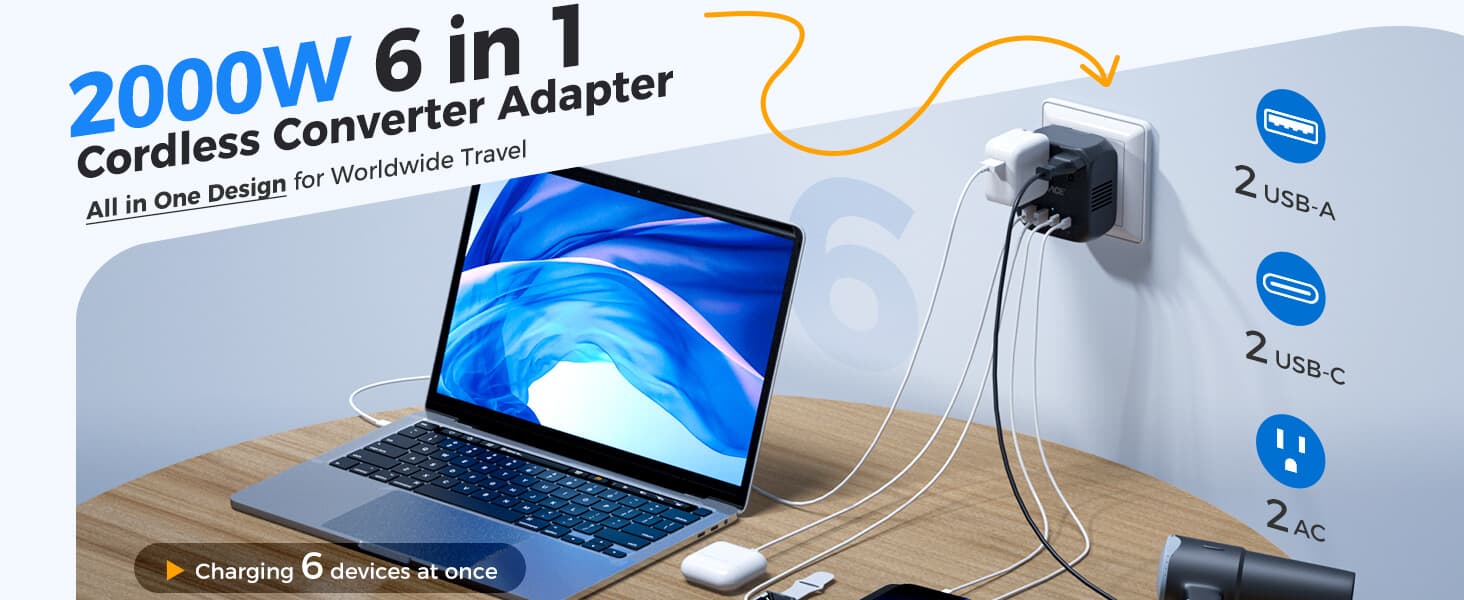
DOACE C15 High-Watt Converter
Best fit: a compatible traditional high-watt 120V load used directly according to the product instructions.
Not for: multiplying outlets with a strip, Dyson/Shark/Laifen-style smart tools, unknown labels, or multiple mixed loads.
One more boundary matters: home and furniture power strips are not travel voltage converters. Do not treat a desk power strip, recessed furniture outlet, or household outlet extender as a solution for international voltage mismatch or cruise-line power rules. For travel power decisions, start with the device label and destination voltage.
If your device is single-voltage, use the voltage converter sizing guide instead of trying to solve the problem with more outlets.
Five Common Myths
“Every connected charger is 100-240V, so the strip is safe.”
Wide-voltage chargers solve their own input compatibility. They do not change the voltage rating of the strip's switch, indicator, surge components, cord, or insulation.
“The travel adapter says 250V, so everything after it is 250V-rated.”
Ratings do not transfer downstream. A 250V adapter can still feed 230V into a 125V strip. The strip remains the weak link.
“Non-surge means internationally safe.”
Removing surge protection eliminates one risk, but the strip still needs a 220-240V rating, suitable switch and insulation, correct grounding, and safe load.
“Cruise approved means every cruise line accepts it.”
There is no universal cruise-approved certification. Policies differ and change. Royal Caribbean may reject multi-outlet strips that another line permits.
“Putting the strip after a converter makes every device 120V-safe.”
It also hides the combined load and mixes incompatible device types. Follow the converter manual and connect only defined compatible loads.
FAQ
Can I bring a power strip on a cruise?
Sometimes, but rules vary. Many cruise lines ban surge-protected power strips and may confiscate them. Check your cruise line's current prohibited-items policy before packing.
Why are surge protectors banned on cruise ships?
Surge protector components can behave differently on ship electrical systems than in a grounded home circuit. Cruise lines restrict them to reduce electrical risk and operational problems.
Is a non-surge power strip safe for hotels?
It can be safe for low-power electronics if it is rated for the local voltage and not overloaded. It is not safe for high-watt appliances or voltage mismatch.
Can I plug a US power strip into a European adapter?
Only if the strip is rated for 220-240V and every connected device is compatible with that voltage. Many US household strips are 125V-only, so do not assume.
What if every charger says 100-240V?
The chargers may be compatible, but the strip itself still needs to support the destination voltage. Check its label, switch, surge features, grounding, and certification.
Can I use a U.S. power strip in Japan?
Japan's approximately 100V supply is closer to U.S. voltage, so many 125V strips are not exposed to overvoltage. You still need to check grounding, frequency-sensitive devices, total load, and local rules. This does not mean the strip is safe in 230V countries.
Is a non-surge strip safe abroad?
Only when the strip clearly supports the local voltage and its cord, switch, outlets, grounding, and certification are appropriate. “Non-surge” alone is not enough.
Can a power strip convert voltage?
No. A power strip only distributes power. It does not step 230V down to 110V. For single-voltage devices, you need a voltage converter matched to the wattage and device type.
Can I connect a power strip after a voltage converter?
Not unless the converter manual explicitly allows it. The strip makes it easy to overload the converter or mix device types. Directly connect one compatible device whenever possible.
Is an outlet extender better than a power strip?
For travel, often yes, because it is smaller and has no cord. But it still shares one outlet's capacity and must be rated for the voltage. It is not automatically safe for high-watt loads.
What is the safest way to charge many devices in a hotel?
Use a GaN USB-C travel adapter for electronics and avoid AC power strips unless necessary. Spread devices across separate outlets if possible and keep high-watt appliances separate.
Can I use a power strip for CPAP travel?
For CPAP, prioritize a reliable outlet and correct voltage. Many CPAP power supplies are 100-240V. If yours is single-voltage, use an appropriate converter; do not rely on a power strip to solve voltage or waveform requirements.
Does a grounded travel adapter make a U.S. surge strip safe?
Not by itself. Ground continuity is only one check. The surge strip must also be rated for the destination voltage and its protection components must be designed for that system.
How many devices can I connect?
Use total watts and the lowest rating in the chain, not the number of outlets. Avoid high-watt appliances and keep meaningful headroom below the strip, adapter, outlet, and converter limits.
Bottom Line
For a normal U.S. 125V household power strip, the answer is no: do not connect it to a 220-240V destination through a travel adapter. The adapter changes the plug shape but passes the local voltage through. A surge protector is an even clearer no unless the complete product is specifically rated for that system.
A clearly labeled 250V non-surge strip can be considered only after checking its switch, cord, certification, grounding, total load, connected devices, mechanical fit, and venue policy. That is a long checklist for something most travelers only need to charge electronics.
The simpler rule is better: use a multi-port GaN charger for wide-voltage USB devices, buy a local strip for long stays, and give each compatible single-voltage appliance its own correctly sized converter path. Do not use a power strip to hide voltage differences or multiply a converter's outlets.
If the label is faded, hidden, contradictory, or available only in an online marketplace description, treat the strip as unknown and do not use it overseas. A replacement charger or locally rated strip costs less than damaged equipment, a tripped hotel circuit, or losing the strip at cruise security.
When in doubt, reduce the number of AC connections and choose equipment designed for the destination voltage.
That approach is lighter, easier to verify, and safer for repeated daily use.


