

Short answer: a wall outlet, a travel adapter, a power strip, and a voltage converter are four different parts of the power chain. The wall outlet gives you the local country power. A travel adapter changes plug shape. A power strip divides one outlet into several outlets. A voltage converter changes voltage only when the device is compatible with that converter. If you remember one rule before packing, make it this: plug shape and voltage are separate problems.
For most U.S. travelers with phones, tablets, camera chargers, and USB-C laptops, the safest normal path is simple: check the INPUT label, confirm it says 100-240V 50/60Hz, then use the right plug adapter or a multi-port GaN travel adapter. For a 120V-only appliance, a travel adapter is not enough. For several devices, a U.S. power strip is usually not the right shortcut overseas. Use a compact USB charging setup, a locally rated power strip when appropriate, or a properly matched converter for one confirmed device.
Quick Answer: What Should You Use Abroad?
Start with the device, not the outlet. A destination can have the right-looking plug but the wrong voltage. A travel adapter can make a U.S. plug fit a European socket, but it cannot make a 120V-only hair tool safe on a 230V system. A power strip can make more holes available, but it cannot turn one limited travel adapter into a higher-capacity power station. A converter can step voltage down, but only for devices that fit its instructions, wattage limit, runtime limit, and exclusions.
- Use the wall outlet directly only when your device already has the correct plug for that country and the label accepts the local voltage.
- Use a travel adapter when your device or charger is already wide-voltage and only needs a different plug shape.
- Use a power strip only as a locally rated outlet splitter, not as a voltage solution. A U.S. strip is usually the wrong item to pack for 220-240V countries.
- Use a voltage converter only for a clearly compatible 110-120V device, used directly and within the converter's rated limits.
That order matters. If the device label fails the voltage check, no plug adapter or power strip fixes the problem. If the device passes the voltage check, a converter usually adds cost, weight, heat, and confusion you do not need. If you simply need to charge five small electronics, a multi-port USB-C travel adapter is usually cleaner than packing six wall bricks plus a U.S. power strip.
What Each One Can and Cannot Do
The easiest way to avoid a bad setup is to separate the jobs. The wall outlet is the local power source. The adapter is a plug-shape bridge. The power strip is an outlet multiplier. The converter is a voltage tool. These jobs can sit in the same travel bag, but they are not interchangeable.
| Item | What it does | What it does not do | Best travel use |
|---|---|---|---|
| Wall outlet | Provides local voltage, frequency, and current through the country's socket type. | Does not adapt U.S. plugs or change its local voltage for your device. | Local appliances, hotel devices, and chargers that already fit and match local voltage. |
| Travel adapter | Changes plug shape so a U.S. plug can physically connect abroad. | Does not step 230V down to 120V and does not increase outlet capacity. | Wide-voltage chargers labeled 100-240V. |
| GaN travel adapter | Combines plug adaptation with USB-C/USB charging in one compact device. | Does not convert AC voltage for 120V-only appliances. | Phones, tablets, laptops, cameras, earbuds, watches, and other wide-voltage electronics. |
| Power strip | Splits one upstream outlet into multiple outlets. | Does not change voltage, fix frequency, add capacity, or make mixed devices compatible. | Locally rated devices on a locally rated strip, used within its rating. |
| Voltage converter | Steps voltage up or down for a compatible device. | Does not override manufacturer limits, unknown labels, high startup loads, or unsafe mixed loads. | One confirmed 110-120V device that fits the converter instructions. |
For country voltage and plug shape, the IEC World Plugs database is a useful starting point because it lists plug type, voltage, and frequency together. That combination is exactly what a traveler needs. A country page that only tells you “Type C plug” or “Type G plug” is incomplete unless you also know the local voltage and your device input range.
Check the INPUT Label Before Buying Anything
The device label is the whole game. Do not guess from the brand, the price, or the shape of the plug. Look for the word INPUT on the charger brick, power supply, appliance handle, or device body. The label may be tiny, but it tells you whether the device can accept the voltage at your destination.

If the label says 100-240V 50/60Hz, 100-250V, or similar, the device power supply is wide-voltage. Most modern phone chargers, tablet chargers, laptop power bricks, camera chargers, and USB-C charging bricks fall into this group. For these, use a plug adapter or a GaN travel adapter with enough USB-C output. Do not buy a converter just because the country uses 230V.
If the label says 120V 60Hz, 110V only, 125V, or only lists U.S. voltage, stop. A travel adapter only makes the plug fit. It does not protect the appliance from the higher voltage in many countries. A 120V-only device in a 230V wall outlet can overheat, fail, trip protection, or become unsafe. The next question is not “which adapter fits?” It is “is this device allowed to run through a voltage converter, and which converter rating fits it?”

Small wattage does not automatically mean safe. An electric toothbrush base may draw far less power than a hair dryer, but if it is marked 120V only, the voltage question still matters. Large wattage does not automatically mean impossible either, but it raises the bar: high-watt appliances need more headroom, create more heat, and often have manufacturer restrictions. The label is the first filter, not the final approval.
Why a U.S. Power Strip Is Not the Shortcut Abroad
A U.S. power strip feels convenient because it solves a familiar problem at home: too many plugs and not enough outlets. Abroad, that same strip adds new questions. Is the strip rated only for 125V? Does it contain surge-protection parts designed around U.S. mains? Is the switch, light, or internal wiring appropriate for the local voltage? How much total load is being pulled through one travel adapter? Are you mixing safe wide-voltage chargers with one unsafe 120V-only appliance?
The main issue is that a power strip only distributes. It does not inspect each device. It does not lower voltage. It does not know that your laptop charger is wide-voltage but your curling iron is not. It does not raise the current limit of the hotel outlet or the adapter feeding it. If you plug a strip into an adapter and then fill the strip, the entire chain still depends on the weakest part: the wall outlet, the adapter, the strip, the plug contact, or the device itself.
U.S. safety organizations regularly warn against overloading extension cords and power distribution devices. The Electrical Safety Foundation International advises using extension cords properly and avoiding misuse such as overloading or running cords where they can be damaged. The National Fire Protection Association treats electrical safety as a major home-fire topic. The U.S. Consumer Product Safety Commission also keeps a consumer electrical safety center. Travel makes the same habits harder because the outlet may be loose, hidden behind furniture, or shared with a bulky adapter.
| Bad path | Why it is a problem | Better path |
|---|---|---|
| 230V wall outlet → adapter → U.S. surge protector → hair dryer | The strip may not be rated for the voltage, and the appliance may be 120V only. | Use the hotel/local appliance or a clearly compatible converter path. |
| Adapter → U.S. strip → laptop + phone + curling iron | Two devices may be wide-voltage while one may not be. The strip hides the difference. | Charge wide-voltage electronics through USB-C; evaluate the hair tool separately. |
| Converter → U.S. power strip → several mixed devices | Mixed loads make wattage, startup draw, and device limits harder to control. | Connect one confirmed compatible device directly to the converter. |
| Cruise cabin outlet → extension cord → strip under a bed | Policy, heat buildup, cord damage, and inspection issues stack together. | Use a cruise-allowed compact charging setup and follow the line's current rules. |
A locally rated power strip can be useful when you are living abroad, renting a flat for a month, or using local-voltage devices. It is still not a converter. It simply means the strip is built for the local plug system and local mains voltage. If you plug a 120V-only U.S. appliance into a local strip through a tiny adapter, the appliance still sees the local voltage.
Decision Matrix by Device
Use this matrix as a first pass. It does not replace the label, but it shows where most travel devices usually land. The pattern is simple: modern charging electronics often need plug adaptation and USB power, while appliances that produce heat or use motors often need much more caution.
| Device | First check | Likely path | Do not do this |
|---|---|---|---|
| Phone, tablet, earbuds, watch | USB charger INPUT label | GaN travel adapter or plug adapter if label says 100-240V | Buy a voltage converter for normal USB charging |
| USB-C laptop | Power brick input and USB-C wattage need | 100W or 140W GaN path if wide-voltage and wattage fits | Assume a low-output adapter can run a high-performance laptop |
| Camera or drone battery charger | Charger input label, not the camera body | Plug adapter or GaN path if the charger is wide-voltage | Plug an unmarked charging dock into 230V |
| Electric toothbrush or shaver | Base or charger label | Adapter if wide-voltage; converter only if confirmed compatible | Assume low wattage makes 120V-only safe on 230V |
| CPAP power supply | Power brick input range and medical-device instructions | Adapter if wide-voltage; specialist converter planning if not | Use an unknown converter for overnight medical equipment |
| Hair dryer, curling iron, hot brush | Voltage, wattage, dual-voltage switch, brand restrictions | Travel dual-voltage tool, local tool, or compatible high-watt converter path | Use a plug adapter only on a 120V-only heat tool |
| Kettle, iron, steamer | Wattage and voltage label | Local appliance is usually the cleaner travel choice | Pack a high-watt U.S. heating appliance for casual hotel use |
| Game console, monitor, audio gear | Power supply or device label | Adapter if wide-voltage; converter planning if single-voltage | Hide a single-voltage device inside a U.S. power strip setup |
For laptops, the key is not just voltage. It is also output wattage. A tiny travel adapter with a low USB-C output may charge a phone beautifully but struggle with a 16-inch laptop under load. A 100W or 140W GaN adapter can make sense when the laptop supports USB-C PD and the adapter's output profile fits the computer. That is still an adapter-only path: the laptop's power supply must accept the local voltage.
For hair tools, do not use the matrix as permission to force a converter solution. A simple dual-voltage curling iron with a manual voltage switch is different from a high-end tool with electronics, sensors, or a motor the manufacturer does not approve for converter use. When the manual says not to use a converter, follow the manual. High wattage on the converter label is not a permission slip.
Hotel, Airbnb, Cruise, and Conference Rules
A hotel room is the most common travel-power setting, but it is not always the easiest. The outlet may be behind the bed, under a desk, shared with a lamp, or loose from years of use. A heavy power strip hanging from a small adapter can pull on the socket and create a poor contact. Poor contact can mean heat. A compact adapter plugged firmly into the wall, with USB cables running to devices on the desk, is often a better physical setup than a dangling chain of adapter plus strip plus wall bricks.
An Airbnb adds uncertainty. Older apartments may have fewer outlets, different grounding quality, or furniture blocking the safest outlet. If you stay for weeks and need several local-voltage devices, buying a local power strip can be reasonable. It matches the local plug and local voltage rating. It still does not change voltage for U.S. appliances. It also should not be overloaded, covered, or used as a permanent fix for damaged sockets.
Cruise cabins are their own category. Cruise lines often restrict power strips, surge protectors, and extension cords. Royal Caribbean lists extension cords, power strips, and surge protectors among prohibited items. Carnival also publishes prohibited item guidance that travelers should check before boarding. Norwegian Cruise Line provides a guest conduct and prohibited items FAQ. Policies change, and ship staff make the final call, so do not pack a questionable strip and hope the wording works in your favor.
A trade show or conference booth creates a different problem: venue rules. You may have access to one floor box or a rented power drop. The organizer may require approved distribution equipment and may not allow personal cords across walkways. If you are charging laptops, tablets, demo phones, cameras, and payment devices, build the setup around wide-voltage chargers and a small number of high-output adapters. Do not arrive with a U.S. household strip and assume the venue electrician will accept it.
How to Build a Travel Power Setup Step by Step
A good travel power setup is usually smaller than people expect. The mistake is starting with outlet count. “I have six things, so I need six AC sockets” sounds logical, but it often creates a bulky, fragile chain. Start with charging function instead. Many of those six things may charge from USB-C or USB-A. If the actual need is five USB devices and one laptop, one high-output travel adapter plus good cables may replace a row of wall bricks and a U.S. power strip.
Step 1: Sort devices by input type. Put phone, tablet, watch, earbuds, camera battery charger, laptop, shaver, toothbrush, hair tool, and any medical device into separate piles. Anything powered by USB should be considered a charging-output problem first. Anything with a fixed U.S. plug and a heating element should be considered a voltage and wattage problem first. Anything used overnight or for health should be treated more conservatively than a casual phone charger.
Step 2: Read labels before thinking about products. A MacBook charger marked 100-240V belongs in the adapter-only group. A camera charging hub marked 100-240V belongs there too. A curling iron marked 120V belongs in the caution group. An electric toothbrush base that does not clearly show worldwide input should not be guessed into the safe group. If you cannot read the label, check the manual before travel or leave that device out of the overseas kit.
Step 3: Count real USB needs. A family trip might include four phones, two tablets, one laptop, two watches, and a camera. That sounds like nine devices, but they do not all need AC outlets at the same time. Phones and tablets can rotate overnight. Watches need very little power. A camera battery charger may only run for an hour. A laptop may need the highest USB-C output, so it should get the strongest port while smaller items share lower-output ports. This is where a GaN adapter is useful: it reduces the number of wall bricks and keeps the setup physically stable.
Next: identify the one or two devices that may need special handling. Usually these are hair tools, grooming bases, older electronics, medical equipment, or high-watt appliances. Do not let them ride along inside the same mental bucket as phones. A 120V-only curling iron and a wide-voltage laptop charger may have the same U.S. plug shape, but electrically they are different. The adapter-only path is correct for one and dangerous for the other.
Step 5: Choose the smallest safe chain. Shorter chains are easier to keep cool and stable. Wall outlet → travel adapter → USB-C cable is cleaner than wall outlet → adapter → U.S. strip → three wall bricks → USB cables. Wall outlet → converter → one compatible appliance is cleaner than wall outlet → converter → U.S. strip → mixed devices. The fewer contact points you add, the easier it is to see what is happening if something feels warm or loose.
Destination Examples: Same Device Bag, Different Outlet Reality
The same U.S. packing list can behave very differently depending on the country. A trip to Canada or Mexico may feel familiar because the voltage and plug shape often overlap with U.S. expectations. A trip to France, Germany, Italy, Spain, the Netherlands, the U.K., Australia, Singapore, Thailand, or the UAE often puts U.S. travelers into 220-240V territory with different plug shapes. Japan has a lower nominal voltage than the U.S. and regional frequency differences. Brazil can involve Type N outlets and mixed local voltage situations. The country matters, but the label still comes first.
For Western Europe, most phone and laptop chargers marked 100-240V only need a plug adapter. A U.S. hair dryer marked 120V only should not be used with a plug adapter. A U.S. power strip should not be treated as a normal European accessory. If you are staying long enough to need more outlets for local-voltage devices, buy a locally rated strip after arrival and use it within its rating. If your only need is electronics charging, a multi-port adapter is usually enough.
For the U.K., the wall plug shape changes to Type G, and sockets are often switched. The voltage is still in the 230V class. A Type G adapter solves plug shape for a wide-voltage charger. It does not make a 120V-only appliance safe. Do not let the large, sturdy look of a U.K. plug create false confidence. The voltage question is unchanged.
For Australia and New Zealand, the Type I plug shape is different again, with 230V-class power. A U.S. laptop charger marked 100-240V can use the correct adapter. A U.S. 120V-only grooming appliance needs a different decision. A power strip from home does not become suitable because the trip is familiar, English-speaking, or hotel-based.
For Japan, the plug shape may look close to U.S. Type A in many places, but the voltage is lower and frequency varies by region. Many U.S. devices will work, but performance can differ for some motor or heating devices. A wide-voltage charger is still the easiest case. A device that depends on a precise U.S. voltage or frequency deserves a manual check. Japan is a good example of why “same-looking plug” does not replace the label check.
For multi-country trips, do not build the kit around the first country. A U.S. traveler going from London to Paris to Rome may need different plug shapes and the same voltage caution. A traveler going through Japan, Thailand, and Singapore may see different outlets and different hotel quality. In a multi-country kit, a compact universal adapter for wide-voltage electronics is valuable, while bringing a heavy U.S. strip usually creates more problems than it solves.
The Multi-Device Load Problem
Power strips make it easy to forget that all connected devices share one upstream path. If a strip is plugged into a travel adapter, every device on the strip is pulling through that adapter. If the strip is plugged into a converter, every device is pulling through that converter. The wall outlet, adapter, strip, cable, converter, fuse, and device plugs all have limits. You do not get a fresh wall outlet for each socket on the strip.
For small chargers, the issue is usually physical stability and clutter more than raw wattage. Five phone chargers may not draw much compared with a kettle, but they can create a bulky block of weight hanging from a loose adapter. They can also trap heat if buried behind a bed or inside luggage. A multi-port USB adapter reduces the number of AC plugs, which reduces mechanical stress on the wall outlet.
For mixed loads, the issue is confusion. A laptop charger drawing 65W, a phone charger drawing 20W, and a curling iron drawing 900W do not belong in the same mental category. Two of them may be wide-voltage electronics. One may be a 120V-only heating device. A power strip makes the setup look uniform, but the devices are not uniform. The right decision may be adapter-only for the electronics and no-use or converter evaluation for the hair tool.
For high-watt loads, the issue is heat and headroom. Heating appliances and motors can pull large current, run hot by design, and create startup or cycling loads. Even when a converter is rated for a high number, you still need the device type to be compatible, the runtime to be appropriate, and the manufacturer's restrictions to be respected. Do not use a converter's wattage number as a reason to add a strip and plug in several appliances.
A practical packing test is to ask: “Would I still feel confident if this exact setup ran while I was asleep?” If the answer is no, simplify it. Overnight charging should be boring: stable wall connection, known wide-voltage devices, good cables, nothing covered by blankets, no hot appliance, no unknown strip, no converter feeding mixed loads. For a CPAP or another health-related device, the standard is even higher. Use the manufacturer's travel guidance and test the setup before the trip.
When a Converter Actually Makes Sense
A converter makes sense when four things are true at the same time. First, the device is single-voltage and needs a different voltage than the destination provides. Second, the device type is appropriate for converter use. Third, the wattage and startup behavior fit the converter's rating with room to spare. Fourth, the manufacturer instructions do not prohibit converter use. Miss one of those four checks and the converter path becomes uncertain or wrong.
This is why a converter is not the first recommendation for most phones and laptops. Their power supplies usually already handle worldwide input. Adding a converter to a wide-voltage charger is like hiring a translator for two people already speaking the same language. It adds another device in the chain without solving a real problem. In some cases it can even create noise, heat, or inconvenience.
A converter can be relevant for a clearly marked 120V device that you truly need abroad and cannot replace with a local or travel version. Examples might include a specific low-watt specialty device, a compatible grooming item, or a device whose manual allows step-down conversion. Even then, connect the device directly. Do not turn the converter into a little U.S. island by attaching a power strip full of mixed appliances.
A converter is often the wrong answer for modern smart hair tools, some high-end motor appliances, and devices with explicit manufacturer warnings. Brands may design internal electronics, motors, heating control, or safety systems around a specific supply environment. If the manual says not to use converters, believe it. The fact that another traveler says their device worked once is not a reliable safety standard.
What Not to Buy for This Problem
Do not buy the cheapest universal adapter just because it has a long list of countries. Country coverage is useful, but it only tells you plug-shape reach. It does not tell you your appliance can accept the voltage. Look for clear AC rating, USB output, safety design, and honest wording about voltage conversion. A product that hides the adapter-versus-converter difference creates more risk than it removes.
Do not buy a bigger converter just to keep using a U.S. power strip. The problem is not only wattage. The problem is mixed loads, rating context, surge parts, contact heat, and user confusion. A larger converter may be appropriate for one compatible appliance. It is not a general permission to recreate a U.S. wall outlet cluster in a 230V hotel room.
Do not buy a travel power strip unless you understand what it is rated to do. Some travel strips are designed for worldwide input and USB charging. Some are simple outlet splitters. Some have surge protection that may be banned on cruises. Some are meant for domestic travel only. Read the rating and the policy environment. The smaller and clearer the job, the better.
Do not buy based on the word “grounded” alone. A three-prong socket on a device is not enough to prove a complete ground path. Grounding depends on the destination wall outlet, the plug system, the adapter construction, and the device plug. If a device truly requires earth continuity, use products designed for that path and confirm the building outlet supports it.
Common Assumptions That Cause Trouble
“Universal” means it works everywhere. Usually it means the adapter has several plug shapes. It may also mean the USB charging circuit accepts worldwide voltage. It does not mean the AC outlet on the adapter converts voltage for anything you plug into it. If your device is 120V only, the word universal on the adapter package does not save it.
“It has a fuse, so it converts voltage.” A fuse is a protection part. It can open under certain fault or overload conditions. It does not step 230V down to 120V. A fused adapter can still pass the local voltage through to the device.
“My power strip says 15A, so it is strong enough.” The rating has a context. A U.S. strip may be designed around U.S. voltage and plug standards. Even if the total wattage seems low, the internal indicator light, switch, surge parts, and insulation assumptions may not be meant for your destination. The adapter feeding it also has its own rating.
“A local power strip solves everything.” A local strip solves plug shape and local voltage rating for the strip itself. It does not make your 120V-only appliance compatible with 230V. It is a distribution tool, not a converter.
“Three holes means grounded.” A grounded-looking outlet, adapter, or strip does not guarantee a complete earth path for your device. The building wiring, destination plug system, adapter design, and device plug all matter. If a device requires grounding, use a properly grounded path and do not assume a travel adapter or GaN charger adds ground protection.
A Visual Way to Think About the Tools
The chart below compares the jobs each item is designed to handle. The important part is not the exact score. It is the shape of the comparison: an adapter is strong at plug-shape matching, a GaN adapter is strong at USB charging, a power strip is strong at outlet distribution, and a converter is the only item in this set intended for voltage conversion.
Which DOACE Path Fits Your Setup?
The right DOACE product depends on the device label and the job you are trying to solve. Do not choose by maximum wattage first. Choose by device type, input voltage, runtime, charging need, and what you are trying to avoid. If all your important devices are wide-voltage electronics, a GaN travel adapter may be the entire answer. If you have one confirmed 120V-only device, a converter may be relevant. If you want to multiply outlets with a U.S. power strip, step back and redesign the setup.

DOACE 100W GaN International Power Adapter
Best fit: phones, tablets, cameras, earbuds, and many USB-C laptops whose chargers or devices are marked 100-240V.
Not for: 120V-only appliances, voltage conversion, grounded-strip replacement, or powering a U.S. power strip abroad.
DOACE LC-X35 Travel Converter
Best fit: one clearly compatible lower-to-mid watt single-voltage device after you check voltage, wattage, runtime, and manufacturer instructions.
Not for: a U.S. power strip, unknown labels, high-watt heat appliances, or devices whose maker says not to use a converter.
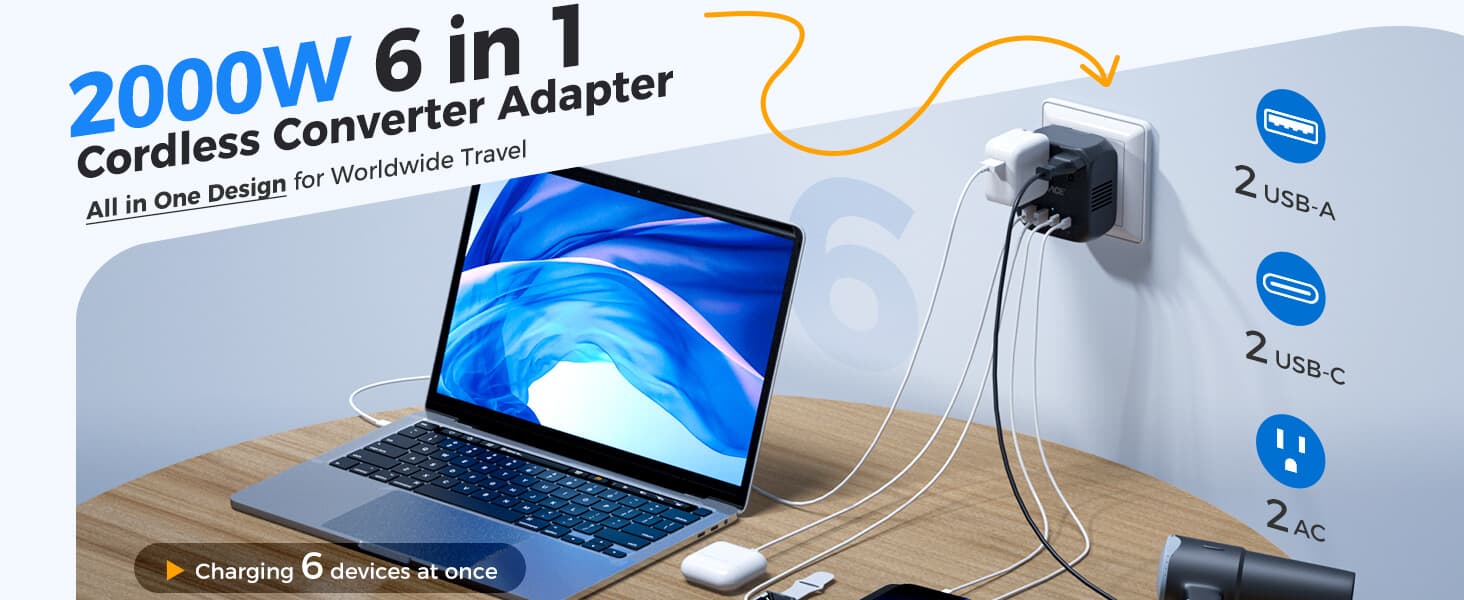
DOACE C15 High-Watt Converter
Best fit: a compatible traditional high-watt 120V load used directly according to the product instructions.
Not for: multiplying outlets with a strip, Dyson/Shark/Laifen-style smart tools, unknown labels, mixed loads, or devices with manufacturer converter warnings.
If you need a broader explanation of the product categories, compare this with DOACE's guide to travel adapters, converters, and transformers. If your exact question is whether a U.S. strip can go into a travel adapter, the deeper companion guide is Can I Plug a U.S. Power Strip into a Travel Adapter Abroad?. For voltage basics, use the 110V, 220V, 50Hz, and 60Hz explainer.
Stop-Use Signals
Even a planned setup should be watched the first time you use it. Stop using the setup and unplug it if the adapter, plug, strip, or converter becomes too hot to touch comfortably, if you smell a burning odor, if the outlet is loose, if a plug arcs repeatedly, if a device runs at the wrong speed, if a charger buzzes or deforms, if a fuse trips, or if hotel or cruise staff ask you to remove the item.
A brief tiny spark when inserting a charger can happen because many power supplies have input capacitors, but continued sparking, heat, odor, crackling, or discoloration is different. For that specific symptom, see DOACE's guide to why a travel adapter may spark when plugged in. Do not keep testing a setup that is already giving physical warning signs.
Final Packing Check Before You Leave
Before you close the suitcase, lay the whole setup on a table and test the logic without plugging anything in. For every device, say the voltage label out loud: wide-voltage adapter path, single-voltage converter review, or leave-at-home. Then count how many AC sockets you truly need at the same time. Many trips that look like six-outlet trips become one-adapter trips once phone, tablet, watch, headphones, and laptop are moved to USB-C charging. Keep the highest-power device separate from the small electronics group so it does not disappear inside a strip.
Also check the physical chain. A compact adapter that sits firmly in the wall is better than a heavy strip pulling downward from a tiny plug adapter. A converter on an open desk is better than a converter under bedding or inside a bag. USB cables should reach the desk or nightstand without putting tension on the wall outlet. If the hotel outlet is loose, choose a different outlet or ask the front desk. Travel power is not only about electrical ratings; it is also about heat, weight, contact quality, and whether the setup stays stable when someone bumps the luggage or moves a chair.
Frequently Asked Questions
Can I plug a U.S. power strip into a travel adapter abroad?
Usually, you should avoid it in 220-240V countries. The adapter only changes plug shape. It does not change the strip's voltage rating, the surge-protection design, or the total load pulled through one outlet. For USB charging, use a multi-port travel adapter. For multiple local-voltage devices, use a locally rated strip. For one 120V-only device, evaluate a converter path directly.
Is a wall adapter the same thing as a voltage converter?
No. In travel language, a wall adapter or plug adapter usually changes the physical plug shape. A voltage converter changes voltage. Some products combine several functions, but you must read the product description and your device label carefully. Do not assume an AC outlet on a universal adapter is converted output.
Do I need a converter for my laptop?
Most modern laptop power supplies are wide-voltage, but check the label. If it says 100-240V 50/60Hz, you normally need the right plug shape and enough USB-C or AC charging capacity, not a converter. If the power brick has a narrow input range, use the manufacturer's travel guidance before buying any converter.
Can I use a local power strip abroad?
A local power strip can be useful for local-voltage devices or wide-voltage chargers because it is built for the local plug and mains voltage. It still does not convert voltage. A 120V-only U.S. appliance remains 120V-only even if you plug it into a local strip through an adapter.
Can I plug a power strip into a voltage converter?
Do not use a converter as a general hub for a U.S. power strip unless the converter manual specifically allows that exact use and every connected load is known, compatible, and within rating. The safer normal rule is one confirmed compatible device directly into the converter.
Are surge protectors safe overseas?
Be careful. A surge protector designed for a U.S. 120V system may not be appropriate on a 230V system, and many cruise lines restrict surge protectors. If you need more outlets abroad, a local non-surge strip for local-voltage use or a compact USB travel charging setup is usually a cleaner choice.
Can I bring an extension cord on a plane?
Airline security is a different question from electrical compatibility. The TSA has an extension cord entry, but getting an item through screening does not mean it is appropriate for a 230V hotel room, cruise cabin, or venue power system.
What should I pack for most international trips?
For a normal electronics-heavy trip, pack one good travel adapter or GaN travel adapter matched to your destinations, the USB-C cables you actually need, and only the device-specific chargers that cannot be replaced by USB-C. Leave U.S. power strips and high-watt 120V appliances at home unless you have a specific, checked, compatible converter plan.
Bottom Line
A wall outlet, travel adapter, power strip, and voltage converter are not four names for the same thing. The wall outlet gives local power. The adapter changes shape. The strip divides outlets. The converter changes voltage for a compatible device. Before you pack, read the INPUT label, check your destination voltage, decide whether you really need multiple AC outlets, and keep converter use limited to devices that clearly fit the converter's instructions. That one habit prevents most travel power mistakes before anything gets warm, noisy, or expensive.


