

A curling iron looks simple, but travel power decisions are not just plug shape. You need four checks: destination voltage, the INPUT label, wattage, and control type. A small dual-voltage travel curling iron and a 120V salon-style curling wand can require completely different power setups.
Read the INPUT Label Before the Plug Shape
Find the label near the handle, cord tag, plug, or manual. The key line starts with INPUT. If it says 100-240V or 110-240V, the curling iron accepts most international voltage. If it says 110V, 120V, or 125V only, it is a single-voltage US tool.

A 100-240V label means the tool accepts the destination voltage; you still need the correct plug shape.

A 120V-only curling iron needs voltage step-down in 220-240V countries. A plug adapter alone does not do that.
| Label says | Meaning | What to pack |
|---|---|---|
| 100-240V 50/60Hz | Wide voltage | Plug adapter or GaN travel adapter |
| 110-240V | Usually travel-ready voltage range | Plug adapter; check wattage and plug type |
| 120V 60Hz only | US single-voltage tool | Compatible voltage converter or leave it home |
| No readable label | Unknown voltage and wattage | Check manual; do not test in a hotel outlet |
Mechanical Switch or Electronic Control?
This is the travel detail many short guides miss. A traditional curling iron with a mechanical switch or simple dial is mostly a heating load. A curling wand with digital temperature buttons, a touchscreen, memory settings, smart sensors, or chip-controlled protection is an electronic control system. The second group can be much less tolerant of converter output.
Some high-power converters use SCR-style voltage reduction. That method can work with compatible mechanical heating tools because the heating element only needs reduced average voltage. It can confuse electronic controls that expect a complete stable waveform. If the tool is expensive, digitally controlled, or hard to replace during a trip, do not treat converter use as a harmless experiment.
Curling Iron Abroad Decision Path
Figure: Choose by voltage label, wattage, and control type.
Adapter vs Converter Matrix
| Your tool | Destination | Safer route | Why |
|---|---|---|---|
| Dual-voltage travel curling iron | Europe / UK / Asia / Australia | Adapter only | The tool already accepts local voltage. |
| 120V-only mechanical curling iron under 150W | 220-240V country | Compatible converter with headroom | Voltage step-down is required; simple heat loads are easier. |
| 120V-only styling brush or flat iron near 300-500W | 220-240V country | Higher capacity converter, if control type is compatible | Heat tools need margin; running at the limit causes shutdown risk. |
| Digital temperature / touch-control tool | 220-240V country | Dual-voltage or destination-voltage tool | Electronic controls may reject converter waveform. |
| Full-size high-watt dryer | 220-240V country | Hotel/local dryer or compatible high-watt solution | A dryer is not the same power problem as a curling iron. |
How to Size a Converter Without Guessing
A curling iron label may list watts directly, such as 45W, 75W, or 120W. If it lists amps instead, multiply volts by amps to estimate watts. For example, a 120V tool that lists 1.0A is about 120W. A 120V tool that lists 2.5A is about 300W. This matters because a heat tool runs continuously while you style, so it can hold a converter near its limit for several minutes at a time.
Do not size the converter exactly to the printed wattage. A tool labeled 120W should not be paired with a converter that is also rated for exactly 120W. Give it margin for heat, voltage fluctuation, startup behavior, and longer use. If the converter becomes hot, cycles off, smells unusual, or the curling iron heats unevenly, stop using the setup. A travel converter is not the place to test the maximum number printed on the box.
Also separate curling irons from dryers. Many curling irons are low to moderate wattage. Full-size US hair dryers can be 1500W to 1875W, and high-speed dryer systems may have motor electronics that are not friendly to converters. If your device is closer to a dryer than a simple curling iron, use the more cautious hair-tool wattage path instead of treating it like a small styler.
Country Voltage and Plug Shape Are Separate Checks
Europe is often the example because many countries use 220-240V power and Type C, E, F, or G plug shapes, but the same method applies anywhere. Japan, parts of North America, and some islands may use lower voltage. Australia, Singapore, the UK, most of Europe, and many Asian destinations use higher voltage than a US-only curling iron expects. The plug shape tells you which adapter pins you need; the voltage tells you whether the curling iron can safely receive the power.
If you are visiting more than one country, check each destination. A tool that works with an adapter in one country may still need a different plug shape in another. If the label says 100-240V, this is mostly a convenience problem. If the label says 120V only, every 220-240V stop becomes a converter or replacement-tool decision.
Control-Type Examples That Change the Answer
A basic curling iron with one on/off switch, one mechanical dial, and no display is the easiest case to evaluate. It is still not automatic, but the load is closer to a simple heater. If the wattage is modest and the converter rating has margin, this is the kind of tool that may fit a travel converter route.
A tool with digital temperature buttons, LCD temperature readout, memory settings, automatic heat-sensing logic, a brushless motor, or sensor-based protection is different. Those circuits may notice chopped or stepped power, shut down, heat erratically, or fail to start. The more the tool behaves like a small appliance with a control board, the less you should rely on a generic converter answer.
A manual dual-voltage switch is another special case. Some older travel tools have a physical 125V/250V switch. If yours has one, set it correctly before plugging in, and confirm the manual. The wrong switch position can damage the tool even if the plug adapter fits perfectly.
When Pure Sine Wave Matters
Pure sine wave is about power quality, not extra wattage. A pure sine wave converter produces a smooth AC waveform closer to normal wall power. A modified or stepped wave jumps between voltage levels. That rougher shape can cause buzzing, extra heat, unstable controls, or shutdowns in some sensitive devices.
For curling irons, pure sine wave can help only when the device is otherwise compatible: correct wattage, single-voltage need, and no manufacturer warning against converters. It does not make a 350W converter run a 1500W hair dryer, and it does not guarantee a chip-controlled styling tool will accept converted power.
Use pure sine wave when waveform quality is a real concern and the device fits the converter rating. Use a dual-voltage tool or destination-voltage tool when the device is electronically complex or too important to risk.

Pure sine wave is smoother than stepped output, but it still cannot override wattage or tool-design limits.
Figure: Smooth sine wave compared with a stepped modified wave.
Which DOACE Route Fits?
Choose the route after you know the label and control type. Do not buy by product photo alone.

DOACE 70W GaN Travel Adapter
Best fit: dual-voltage curling irons labeled 100-240V, plus USB-C travel charging.
Not for: 120V-only curling irons that need voltage step-down.

DOACE LC-C30 Travel Voltage Converter
Best fit: compatible lower-watt 120V-only mechanical curling irons after checking the label.
Not for: smart electronic controls, unknown labels, or tools beyond rating.

DOACE LC-X35 Pure Sine Wave Converter
Best fit: compatible single-voltage devices where cleaner waveform matters and wattage fits.
Not for: high-watt dryers or electronic hair tools that still reject converter use.
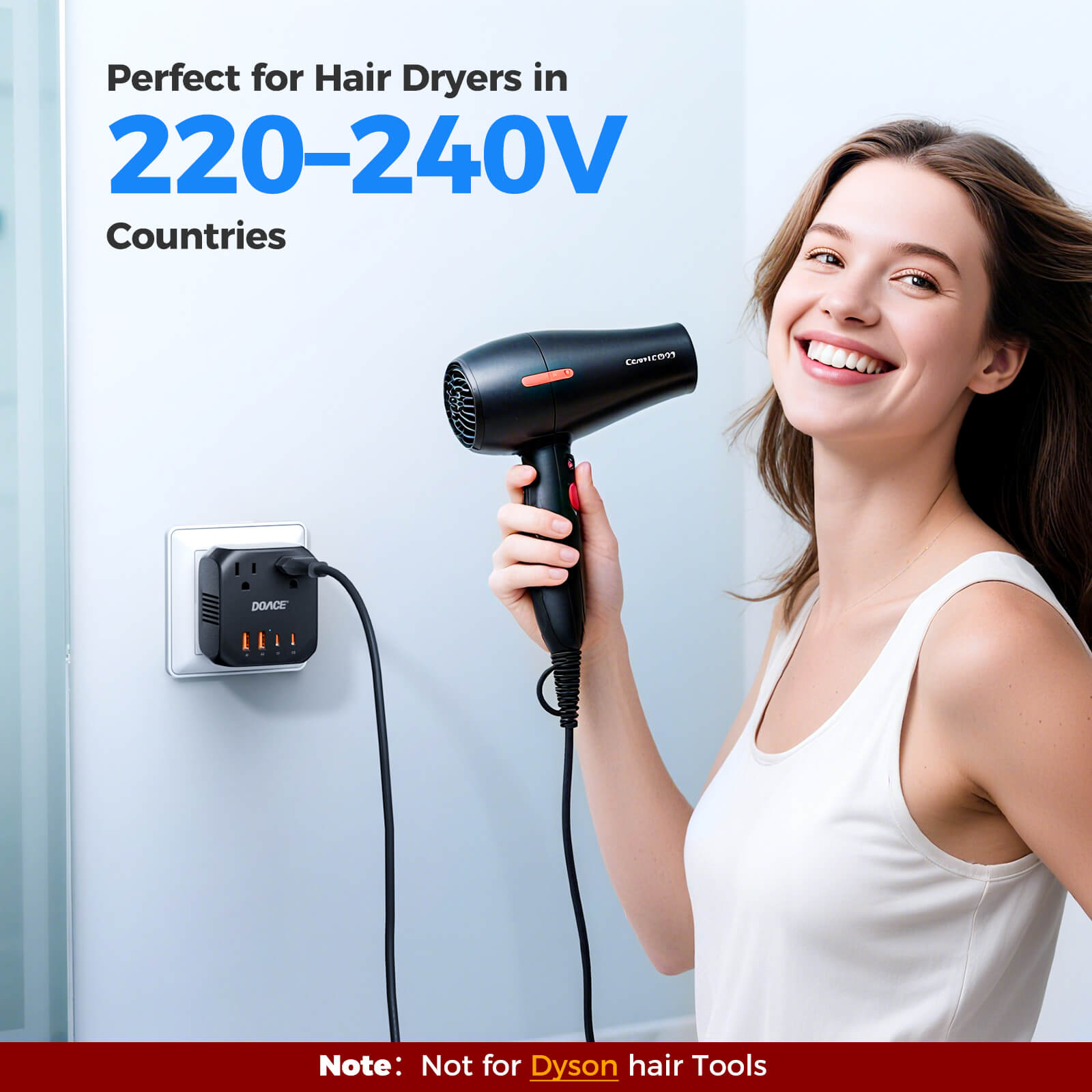
DOACE C15 2000W Voltage Converter
Best fit: compatible traditional high-watt mechanical tools where manufacturer guidance allows conversion.
Not for: Dyson-style, chip-controlled, or manufacturer-prohibited hair tools.
When a New Travel Curling Iron Is the Better Buy
A converter is useful when you already own a compatible single-voltage tool and you can verify the label, wattage, and control type. It is not always the cheapest or safest path. If you travel often, a confirmed dual-voltage curling iron may be simpler than carrying a converter, checking ratings, and worrying about hotel outlets.
For weddings, business trips, performances, or trips where styling reliability matters, consider the cost of failure. A burnt curling iron is annoying; a damaged premium tool or a styling failure on the morning of an event is worse. A compact dual-voltage travel styler plus the right plug adapter is often the lowest-risk setup for frequent international travel.
The same logic applies if your current tool has digital controls or a premium heating system. Even if you find a converter that looks powerful enough, compatibility is not proven by wattage alone. The safer purchase may be a travel-ready model that clearly lists 100-240V on the tool itself.
What Not to Plug Into a Travel Converter
Do not use a converter with a tool that has no readable label. Do not use it with a device whose manual says not to use converters. Do not use it with a tool that exceeds the converter's continuous rating. Do not use it with wet hands, in a bathroom shaver outlet, or with a loose travel adapter stacked into another adapter.
Be especially cautious with high-speed dryers, air stylers, and expensive smart tools. They may include motors, sensors, and electronic protection that make them very different from a basic curling iron. If the manufacturer sells separate US and EU versions, treat that as a sign that voltage region matters.
If Something Feels Wrong, Stop
A compatible setup should behave normally. Stop using it if the converter buzzes loudly, the tool heats unevenly, the plug gets hot, the converter cycles off, the display flickers, or the tool smells unusual. Do not keep testing it to see if it improves. Unstable heat behavior is a warning sign, not a minor inconvenience.
If you are already abroad and unsure, the safest answer is usually local replacement: buy a destination-voltage curling iron, use a hotel tool, or visit a salon. That may feel less convenient than using the tool you packed, but it avoids damage to the device, the converter, or the hotel outlet.
Common Travel Scenarios
A one-week Europe trip with a dual-voltage mini curling iron is the easiest case. Pack the right plug adapter for the country, keep the tool below the adapter's rating, and you do not need voltage conversion. This is the cleanest setup for most travelers because there is no converter heat, no waveform question, and fewer parts to misplace.
A one-week Europe trip with a 120V-only mechanical curling iron is a converter question. If the tool is low wattage, has a basic switch or dial, and the converter has enough headroom, it may be reasonable. Still test the setup before the trip if possible, and bring a backup plan for important events. Do not wait until the morning of a wedding or business meeting to learn that a converter trips off after five minutes.
A long trip, semester abroad, work assignment, or multi-country itinerary changes the math. Carrying a converter everywhere may be less convenient than buying a dual-voltage travel styler. If you will be using the tool every week for months, a local-voltage or wide-voltage curling iron can be safer and lighter than relying on a converter as a daily-use appliance.
A cruise itinerary adds another layer: cabin outlet rules, power strip restrictions, and limited bathroom outlet capacity. Even if the electrical label looks compatible, follow cruise rules for heat tools and power accessories. Use normal cabin outlets only as permitted, and avoid stacking adapters, extension cords, and converters in tight spaces.
How Curling Irons Differ From Laptops and Phones
Phones and laptops usually travel well because their chargers are designed as universal power supplies. The charger brick commonly accepts 100-240V and converts it internally to low-voltage DC for the device. That is why a plug adapter is often enough for a laptop charger.
A curling iron is different because the heat element often runs from the wall power design of the target market. If it is sold as a US-only 120V appliance, the heating circuit may expect 120V. Plugging it directly into 230V can overheat the element rapidly. The tool may fail before you have time to react.
This difference explains why one travel adapter can safely charge your phone but still be dangerous for a 120V-only curling iron. Do not use the success of a phone charger as proof that your beauty tool is compatible.
Packing Strategy for More Than One Hair Tool
Check each tool separately. A curling iron, flat iron, hot brush, and hair dryer may all have different labels. One may be 100-240V, another may be 120V only, and a third may have electronic controls that make converter use risky. Do not let one dual-voltage label in your bag create false confidence for every other tool.
If you only have room for one styling tool, prioritize the one with the simplest electrical answer. A dual-voltage curling iron plus a plug adapter is usually easier than a 120V-only digital styler plus a converter. If you need multiple tools, write the voltage and wattage on a small packing note so you are not trying to read tiny molded text in a hotel room.
What to Check Before Buying a Converter
Before buying any converter, write down five facts: the destination voltage, the plug type, the curling iron voltage label, the wattage or amp rating, and the control type. If any of those facts are unknown, pause the purchase. A converter listing cannot make an unknown tool safe.
Then read the converter's not-for list. If the converter says not to use with electronic controls, automatic shutoff circuits, digital displays, or certain beauty appliances, take that seriously. Those limits are not fine print; they are the compatibility boundary between a simple heater and a more complex appliance.
Finally, decide whether the converter is solving a real problem or adding complexity. If a $30 dual-voltage travel curling iron solves the same trip with less weight and lower risk, that may be the better travel purchase. If you already own a reliable mechanical single-voltage tool and it fits within a converter's real capacity, then a converter can be useful.
Mistakes That Damage Curling Irons Abroad
- Using only an adapter on a 120V-only tool. The plug may fit, but the voltage is still wrong.
- Ignoring the control type. Digital temperature control can be the difference between compatible and high-risk.
- Matching wattage exactly. Heat tools need headroom, especially during continuous use.
- Assuming pure sine wave fixes everything. It improves waveform quality, not power capacity or manufacturer restrictions.
- Testing in the hotel bathroom. Do not experiment with unknown voltage or shaver-only outlets.
Pre-Trip Checklist
Use this checklist before buying anything. It prevents the most common mistake: solving the plug first and the voltage second. The voltage decision should come first because it determines whether the device can safely receive power at all. The plug decision comes after that.
- Take a photo of the INPUT label before packing.
- Confirm destination voltage and plug type.
- If the label says 100-240V, pack the right adapter.
- If the label says 120V only, check wattage and control type before buying a converter.
- For smart or expensive tools, consider a dual-voltage or local-voltage replacement.
Frequently Asked Questions
Can I use a US curling iron in Europe with just an adapter?
Only if the label says 100-240V or 110-240V. If it says 120V only, a plug adapter is not enough in Europe.
How do I know if my curling iron is dual voltage?
Look for INPUT: 100-240V or 110-240V on the tool or manual. A label that only says 120V, 110V, or 125V is not dual voltage.
What converter size do I need?
Use the wattage label and choose meaningful headroom. A 120W curling iron should not be paired with a converter running exactly at 120W.
Is pure sine wave better for curling irons?
Pure sine wave is cleaner and closer to wall power. It can help compatible sensitive devices, but wattage and control design still decide whether the setup is safe.
Can I use a converter with a Dyson Airwrap or smart styling tool?
Do not rely on a travel converter unless the manufacturer explicitly allows it. Smart styling tools can reject converter waveforms or shut down.
Should I buy a dual-voltage travel curling iron instead?
For frequent travel, weddings, business trips, or expensive tools, a confirmed dual-voltage curling iron is often the lowest-risk route.


