

The safest travel-power decision separates four questions: plug shape, voltage, frequency, and wattage. A plug adapter solves only plug shape. It does not make a 120V-only appliance safe in a 230V socket.
Start with the INPUT Label
Find the word INPUT on the charger, power brick, appliance, or manual. That line matters more than marketing words like ?international,? ?universal,? or ?travel size.?

| Input label | Meaning | Usual travel need |
|---|---|---|
| 100-240V, 50/60Hz | Works with common worldwide voltage and frequency. | Plug adapter or USB-C/GaN charger. |
| 120V, 60Hz | Single-voltage North America device. | Step-down converter, transformer, or local device in 220-240V countries. |
| 220-240V, 50Hz | Single-voltage higher-voltage device. | Step-up solution or local device in 120V countries. |
| Only DC output listed | That is charger output, not wall input. | Find the AC input line. |
Voltage: 110V vs 220V in Travel Terms
Travelers say 110V and 220V, but modern labels may show 100V, 120V, 127V, 220V, 230V, or 240V. For travel decisions, divide them into lower-voltage regions around 100-127V and higher-voltage regions around 220-240V.
Figure 1: Common household voltage families by destination.
A 120V-only device in a 230V outlet is the dangerous direction: heat, smoke, blown fuses, or permanent damage can happen quickly. A 230V-only device in a 120V outlet usually receives too little voltage and may run weakly or fail to start.
Frequency: 50Hz vs 60Hz
Frequency means how many AC cycles occur each second. A charger labeled 50/60Hz normally handles both. A motor, clock, pump, compressor, turntable, or older transformer-based device may not.
Figure 2: 60Hz completes more AC cycles in the same time window than 50Hz.
Adapter, Converter, Transformer, or Frequency Converter?
| Tool | Changes plug? | Changes voltage? | Changes frequency? | Best use |
|---|---|---|---|---|
| Plug adapter | Yes | No | No | Wide-voltage chargers. |
| Voltage converter | Often | Yes | Usually no | Compatible single-voltage travel devices. |
| Transformer | Usually no | Yes | No | Long-duration or stationary conversion. |
| Frequency converter | No | Sometimes | Yes | Special frequency-sensitive equipment. |
| USB-C/GaN charger | Sometimes | Its input handles voltage if rated 100-240V | Its input handles 50/60Hz if rated | Phones, tablets, cameras, many laptops. |
Common Devices: What Usually Matters
Figure 3: Typical travel power path by device category.
| Device | Typical pattern | Main risk | Likely path |
|---|---|---|---|
| Phone / tablet | Charger often 100-240V | Plug shape or charger wattage | Adapter or GaN charger |
| Laptop | Power brick often 100-240V | USB-C PD wattage | Adapter or high-watt GaN charger |
| Toothbrush / shaver | Mixed | Single-voltage base | Check label |
| Curling iron / flat iron | Mixed; often 120V-only | Voltage and watts | Dual-voltage tool, converter, or local device |
| Hair dryer | Often high-watt | Overvoltage and heat load | Dual-voltage/local device or high-watt compatible converter |
| CPAP | Many supplies are wide-voltage | Manual, humidifier, battery setup | Manual-first; adapter if wide-voltage |
| Fan / clock / turntable | May be frequency-specific | Speed, timing, hum | Manual, local device, transformer, or frequency converter |
Destination Quick Table
| Destination | Common voltage | Frequency | Plug types | U.S. traveler note |
|---|---|---|---|---|
| U.S. / Canada | 120V | 60Hz | A/B | Home baseline. |
| Continental Europe | 230V | 50Hz | C/E/F | 120V-only devices need a solution. |
| UK / Ireland | 230V | 50Hz | G | Type G plug plus voltage check. |
| Australia / NZ | 230V | 50Hz | I | Same voltage risk as Europe. |
| Japan | 100V | 50Hz east / 60Hz west | A/B | Plug may fit; voltage and frequency differ. |
| Brazil | 127V or 220V | 60Hz | N | Check city and outlet. |
| India | 230V | 50Hz | C/D/M | 120V-only devices need conversion or replacement. |
When You Probably Do Not Need a Voltage Converter
If every charger says 100-240V, 50/60Hz, your real problem is plug shape and charging capacity. A compact adapter or USB-C/GaN charger is usually cleaner than carrying a voltage converter.
When a Converter, Transformer, or Local Device Makes More Sense
- Voltage converter: compatible single-voltage travel devices within wattage and use limits.
- Transformer: long-duration or stationary voltage conversion.
- Frequency converter: devices that truly require a different AC frequency.
- Local device: high-watt heat tools, smart hair tools, kitchen appliances, or anything the manual warns against using with converters.
DOACE Product Direction After You Check the Label
Choose after you know voltage, frequency, watts, and device type. For sizing details, use the voltage converter sizing guide. For category differences, use the adapter vs converter vs transformer guide.
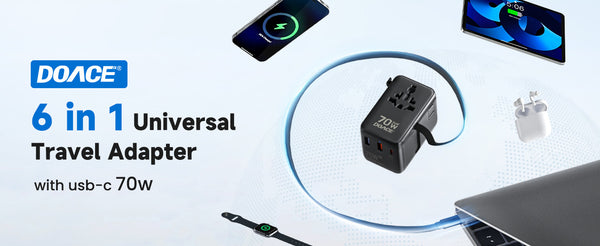
Wide-voltage electronics: GaN adapter path
For phones, tablets, cameras, and many laptops labeled 100-240V, choose plug adaptation and enough USB-C power. A GaN adapter is not a voltage converter.

Sensitive compatible devices: LC-X35 path
For compatible low-to-mid-watt single-voltage devices where pure sine wave output matters, LC-X35 may be the path to evaluate. Do not treat it as a universal frequency converter.
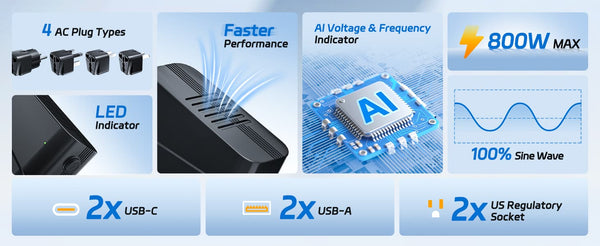
Higher compatible travel loads: LC-X80 path
For compatible devices needing more capacity, compare device watts against converter rating and avoid excluded smart or motor-heavy loads.
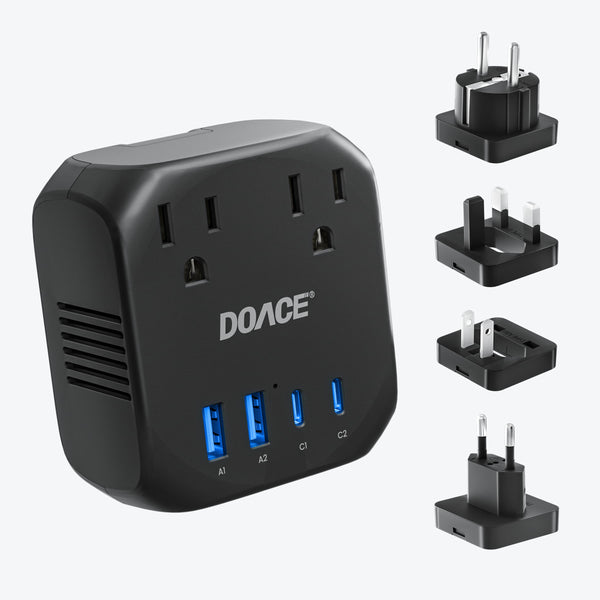
High-watt compatible heat tools: C15 or HC-X11 path
For compatible mechanical heat tools, a high-watt converter may be relevant. If the tool has smart controls or manufacturer warnings, do not assume compatibility.
Pre-Trip Checklist
- Photograph every INPUT label.
- Confirm destination voltage, frequency, and plug type.
- Separate wide-voltage chargers from single-voltage devices.
- Calculate watts before choosing a converter.
- Check motors, clocks, pumps, CPAP, medical devices, and smart heat tools carefully.
- Use local devices or manufacturer support when compatibility is unclear.
FAQ
Is 110V the same as 120V?
For travel decisions, usually yes. 110V is common shorthand; 120V is the modern nominal U.S. reference.
Is 220V the same as 230V or 240V?
For travel decisions, they are the higher-voltage family. A 120V-only appliance should not be plugged into any of them with only a plug adapter.
Will my U.S. device work in Japan?
Often, but not always. Japan is 100V, and frequency is 50Hz in the east and 60Hz in the west.
Does frequency matter for my laptop or phone?
Usually no if the charger says 50/60Hz. It matters more for motors, clocks, turntables, pumps, and older devices.
Does a voltage converter change 50Hz to 60Hz?
Usually no. A typical travel voltage converter changes voltage. A frequency converter is a separate category.
Do CPAP machines need voltage converters?
Many modern CPAP supplies are 100-240V, 50/60Hz. Check the exact power supply and manual before buying any accessory.
Can I use a converter for months abroad?
For long-duration use, a transformer or local-voltage device may be safer and simpler than a compact travel converter.
What if my device has no label?
Do not guess. Search the model manual, contact the manufacturer, or buy a local replacement.


