

The phrase “my adapter is not working” hides several different electrical and mechanical problems. A German Schuko outlet that blocks a flat adapter is not the same problem as a hotel outlet controlled by a key-card slot. A phone charger working while a hair dryer fails is usually not an outlet issue at all — it usually means the hair dryer has the wrong voltage or wattage for that country.
60-Second Troubleshooting Sequence
- Start with a phone charger. Use a low-power charger labeled 100-240V. If it works, the outlet and adapter are basically powered.
- Check physical fit. The adapter must seat fully. If it stops halfway in a recessed socket, do not force it.
- Check room power controls. Look for a wall switch, outlet switch, hotel key-card slot, or tripped breaker/RCD.
- Read your device label. 100-240V means adapter-safe. 120V-only in a 230V country needs a voltage converter or should not be used.
- Check load. A travel adapter can power a laptop charger but fail dangerously with a 1500-1875W hair dryer or kettle.
- Stop if anything is hot, loose, sparking repeatedly, or smells burnt. Those are safety warnings, not normal travel inconvenience.
Figure 1: Troubleshooting flow — separate fit problems, no-power problems, and device compatibility problems
Problem 1: The Adapter Will Not Physically Fit
Schuko Type F: correct pins, wrong body shape
Type F Schuko sockets are common in Germany, Spain, the Netherlands, Austria, Portugal, Scandinavia, and parts of Eastern Europe. A Schuko outlet is round, recessed, and grounded through metal clips on the side rather than a third pin.
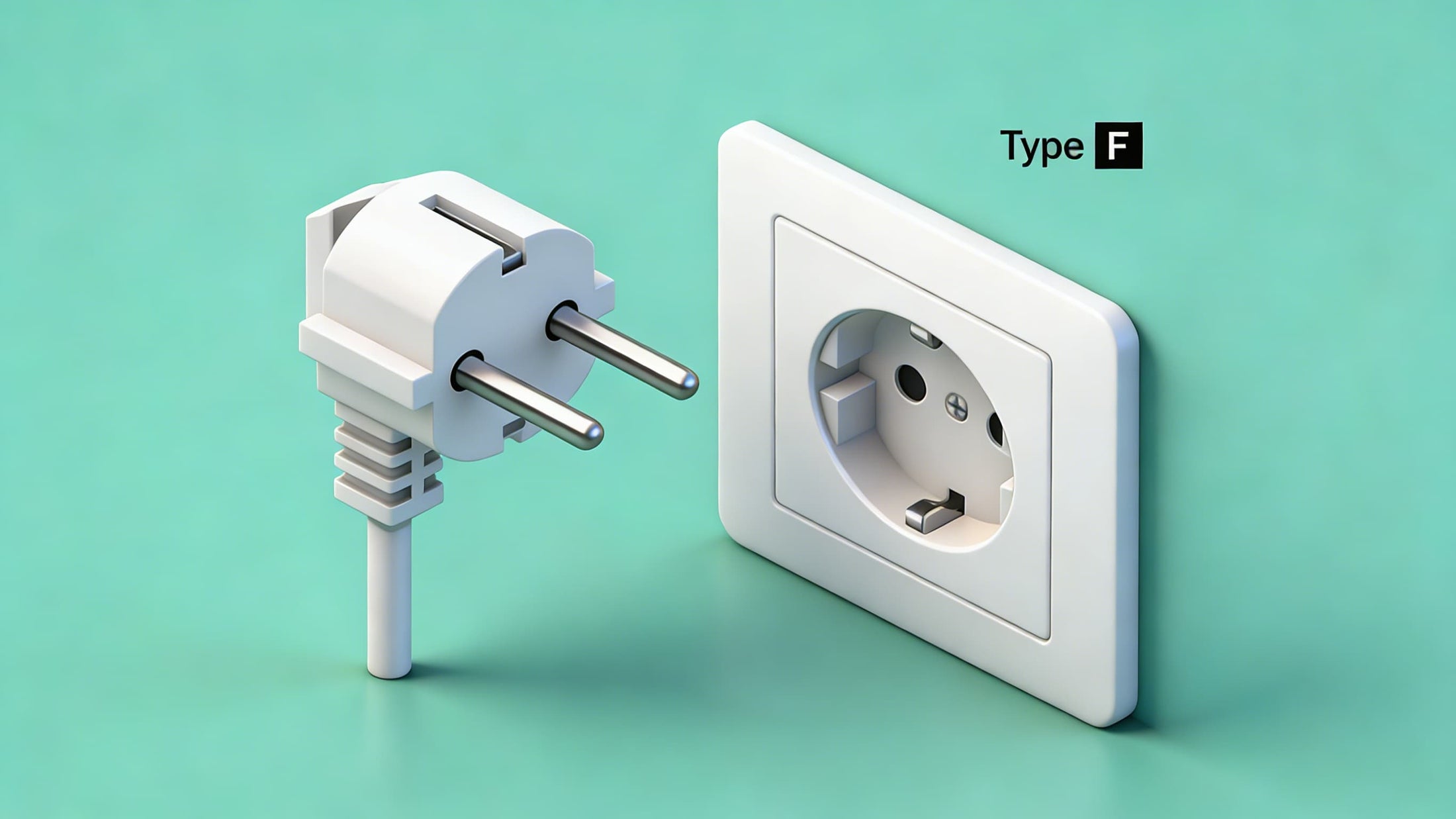
This is why some universal adapters “look right” but still will not fit. The two round pins may match, but the adapter body may be too wide or too shallow to enter the recessed circular socket. The adapter hits the rim before the pins reach the internal contacts.
Type E France and Belgium: the grounding pin is in the socket
Type E sockets look similar to Type F, but grounding is different: the socket has a protruding center grounding pin. If your adapter has no center hole to accept that pin, it will not seat fully. Use an E+F compatible adapter (often called CEE 7/7 compatible) with both side grounding slots and a center grounding-pin hole.
Type L Italy: two versions, two pin spacings
Italy uses Type L, commonly found in 10A and 16A versions. The 10A version has smaller pins and closer spacing; the 16A version uses larger spacing. A simple Type C plug may fit some Italian sockets, while a Schuko-style adapter may not fit older Type L outlets. In older Italian apartments, a dedicated Type L adapter is often more reliable than a bulky universal adapter.
Type G UK, Singapore, Malaysia, Hong Kong: safety shutters
Type G sockets use a shutter mechanism. The longer ground pin opens the safety shutters before live and neutral can enter. If an adapter’s ground pin is too short, misaligned, or non-compliant, the live pins may not enter. Do not use tools to poke the shutter open.
Switzerland Type J: similar to Europe, not the same
Type J has a recessed shape and an offset grounding pin. Many “Europe adapters” do not fit Swiss sockets correctly. If Switzerland is on your itinerary, carry a Type J-compatible adapter.
Problem 2: It Fits, But There Is No Power
Hotel key-card power systems
Many hotels cut power to most room outlets when the key card is removed from the slot near the door. You may plug in a charger, leave the room, and return to find it barely charged because the outlet turned off 15-60 seconds after you left.
Look for always-on outlets near the TV, mini-fridge, safe, desk, or bathroom mirror. If you are unsure, ask the front desk which outlet remains powered when the room card is removed.
Wall switches and outlet switches
In the UK, Australia, New Zealand, Singapore, Malaysia, and many Asian hotels, outlets may have their own ON/OFF switch. “I” usually means ON and “O” means OFF. If the adapter fits but has no power, check the small switch before assuming the adapter is defective.
Bathroom shaver sockets are intentionally low-power
Many hotel bathroom outlets are shaver sockets with isolation transformers. Electrical Safety First notes bathroom outlet restrictions because wet environments require special protection. These sockets are designed for shavers or electric toothbrushes, not hair dryers, kettles, laptop chargers, or travel converters.
Loose old outlets and intermittent contact
Old hotels and apartments may have worn socket contacts. If the adapter droops, wiggles, or loses power when touched, do not run high loads through it. Try another outlet. A loose connection can arc and overheat even when a low-power phone charger appears to work.
RCD/GFCI trips
If an adapter or device trips a residual-current device, the entire circuit may lose power. RCDs detect leakage current and shut off quickly to reduce shock risk. If one device repeatedly trips the room, stop using it and do not keep resetting the breaker.
Problem 3: Phone Works, But the Appliance Does Not
This is the most important distinction: a travel adapter changes plug shape only. It does not convert voltage. If your phone charges but your hair dryer, curling iron, kettle, CPAP, or appliance fails, the outlet is probably fine. The device may have a voltage or wattage problem.
| Device label | What it means abroad | What you need |
|---|---|---|
| INPUT: 100-240V 50/60Hz | Worldwide voltage compatible | Plug adapter only |
| INPUT: 120V 60Hz | US/Canada/Japan-style voltage only | Voltage converter in 220-240V countries |
| INPUT: 220-240V | Europe/Asia-style voltage only | May not work properly in 120V countries |
| 1500W / 1875W | High-watt heat device | High-watt converter or local device |
A 20W phone charger and a 1875W hair dryer are not comparable loads. A phone charger can confirm the outlet has power; it does not prove the adapter or outlet is safe for a high-watt heating appliance.
Symptom-by-Symptom Diagnosis
| Symptom | Likely cause | What to do |
|---|---|---|
| Adapter will not go all the way in | Recessed Schuko, Type E pin, wrong plug type | Use the correct country-specific or E/F-compatible adapter; do not force it. |
| Adapter fits but no power | Wall switch, key-card slot, dead outlet, breaker/RCD | Test with a phone charger, check switches, try another outlet. |
| Phone charges, hair tool fails | Voltage mismatch or wattage overload | Read the device label; use a converter only if compatible and properly sized. |
| Laptop charges slowly | Low-watt USB port, weak cable, shared charger limit | Use a USB-C PD GaN adapter and rated cable. |
| Adapter wiggles or droops | Worn outlet or poor mechanical fit | Do not run high loads. Try another outlet or better-fitting adapter. |
| Adapter gets hot | High load, poor contact, overload | Unplug immediately and reduce load. |
| Entire room loses power | Breaker or RCD trip | Stop using the device that triggered it; ask hotel staff if needed. |
Regional Troubleshooting Notes
| Destination | Socket type | Common issue | Better solution |
|---|---|---|---|
| Germany, Spain, Netherlands, Austria | Type F Schuko | Universal adapter too wide or shallow | Schuko-compatible recessed adapter |
| France, Belgium | Type E | Center grounding pin blocks adapter | E+F / CEE 7/7 compatible adapter |
| Italy | Type L 10A/16A | Pin spacing and diameter mismatch | Type L adapter |
| UK, Singapore, Malaysia, Hong Kong | Type G | Safety shutter or outlet switch | Compliant Type G adapter; turn socket switch on |
| Switzerland | Type J | Offset ground pin | Type J adapter |
| India | Type C/D/M mixed | Different buildings use different sockets | Multi-type adapter or local adapter |
| South Africa | Type M/N | Large round pins or newer Type N | Destination-specific adapter |
When to Stop Using the Adapter
A half-contact connection is dangerous because contact area is small and resistance is high. Current through a small contact point creates concentrated I²R heating. As the contact heats, the metal can soften or oxidize, which increases resistance even more. A phone charger may appear fine at 20W; a 1800W heat device can turn the same poor contact into an overheating hazard.
Grounding: Do Not Trust the Shape Alone
A three-hole adapter does not guarantee a real ground path. Grounding can fail if the adapter has no internal ground connection, if Type F side clips do not touch, if a Type E grounding pin cannot enter the adapter, if the building outlet has no ground wire, or if you are using an ungrounded Type C two-pin adapter.
For double-insulated phone and laptop chargers, grounding is often not central to operation. For metal-cased, three-prong, medical, or high-watt devices, false grounding is a much more serious issue. If grounding matters, use a properly grounded country-specific adapter and avoid worn or unverified outlets.
What to Pack Instead
The best packing setup depends on what you actually power. Most phones, laptops, tablets, cameras, and modern CPAP power supplies already accept 100-240V. They need a high-quality travel adapter or USB-C charger — not a voltage converter.

DOACE 100W GaN International Power Adapter
Best for electronics that already accept 100-240V: laptops, phones, tablets, and camera chargers. It is not a voltage converter, so do not use it to power 120V-only heat tools through the AC outlet.

DOACE LC-C30 Travel Voltage Converter
For selected 120V-only low-watt devices after you confirm voltage, wattage, and device type. Use a converter only when the device label proves you need voltage conversion.
If the issue is high-watt heating equipment, use the voltage converter sizing guide. If your converter restarts or flashes, follow the converter restart troubleshooting guide.
FAQ
Why won't my adapter fit in a German outlet?
Germany commonly uses recessed Type F Schuko sockets. Some universal adapters have correct round pins but a body that is too wide or shallow to enter the recess. Use a Schuko-compatible adapter and do not force it.
Why does my adapter work for my phone but not my hair dryer?
Your phone charger likely accepts 100-240V and draws low power. A US hair dryer is often 120V-only and 1500-1875W. A travel adapter only changes plug shape; it does not convert voltage or increase safe wattage.
Can I use a Type C adapter in a Type F outlet?
Often yes for small two-prong low-power devices, but Type C is ungrounded and may fit loosely in some Schuko sockets. It is not ideal for heavier plugs or grounded devices.
Why is my hotel outlet dead?
The outlet may be controlled by a key-card slot, wall switch, outlet switch, or breaker/RCD. Test with a phone charger, turn on any nearby switch, and try another outlet before assuming the adapter is faulty.
Is it safe if the adapter wiggles in the socket?
No, especially for high loads. A loose contact can arc and overheat. Use another outlet or a better-fitting adapter.
Why does my adapter spark when I plug it in?
A tiny single spark can happen with some chargers because internal capacitors charge instantly. Repeated sparking, burning smell, visible heat, or black marks are not normal. Stop using that outlet or adapter.
Do Schuko outlets have grounding?
Yes, Type F Schuko outlets ground through side clips. But your adapter must actually connect to those clips, and the building wiring must include a real ground. Many small universal adapters do not pass ground through every plug configuration.
Should I carry separate adapters instead of one universal adapter?
For USB electronics, a quality GaN travel adapter is usually simplest. For tricky destinations such as Germany/Schuko, France/Type E, Italy/Type L, Switzerland/Type J, or South Africa/Type M, a country-specific adapter can fit more reliably than one bulky universal adapter.
Can a travel adapter fix a 120V-only device?
No. A travel adapter cannot change voltage. A 120V-only device used in a 220-240V country needs a properly sized step-down voltage converter, and some devices should not be used with converters at all.
What should I test first when nothing works?
Use a low-power phone charger labeled 100-240V. If it works, the outlet and adapter have power, and your problem is likely device voltage, wattage, or compatibility. If it does not work, check fit, room switches, key-card power, and another outlet.


