

Quick Answer: The third pin matters when your device was designed to use earth/ground as a safety path. That usually means three-prong devices, metal-cased equipment, some medical or audio gear, desktop computers, power strips, and surge protectors. It usually does not matter for small two-prong, double-insulated, wide-voltage chargers such as phone chargers, camera chargers, and many USB-C laptop chargers.
A grounded travel adapter can preserve the safety ground if it is built for the destination plug system. An ungrounded adapter only passes power through live and neutral. Neither one converts voltage. If your device says 120V only and you are visiting a 220V/230V country, you need a voltage decision, not just a third pin.
Grounded vs Ungrounded: What Actually Changes?
A plug adapter is first a shape tool. It changes the physical pins so your device can fit a foreign outlet. A simple ungrounded adapter passes the two current-carrying conductors through: live and neutral. A grounded adapter adds a third path: earth/ground. That third path is not there to make charging faster. It is there so a fault current has a low-resistance route away from you if a live wire touches exposed metal inside the device.
That is why the third pin matters for some devices and not for others. A small plastic phone charger with a two-prong plug was not designed to use a ground conductor. A desktop computer power supply with a three-prong cord was. If you plug the desktop into an ungrounded travel adapter, it may power on, but you have removed a safety path the device expected to have.
The important boundary: grounding is not voltage conversion. A grounded US-to-UK adapter will not turn UK 230V into US 120V. A three-prong adapter can still destroy a 120V-only appliance if you use it in a 230V country. For the full difference between adapter, converter, and transformer, see our adapter vs converter guide.
When an Ungrounded Adapter Is Usually Fine
An ungrounded travel adapter is not automatically unsafe. Many modern travel devices are double-insulated and wide-voltage. They are designed without a ground pin from the start. For these devices, an ungrounded adapter does not remove a safety feature that was originally present.
- Phone chargers and tablet chargers labeled 100-240V
- USB-C GaN chargers and many compact laptop chargers
- Camera battery chargers and drone battery chargers labeled 100-240V
- Electric toothbrush chargers, shaver chargers, and small USB accessories
- Two-prong device power supplies with a double-insulated design
The practical rule is simple: if the device has a two-prong plug and the INPUT label says 100-240V, 50/60Hz, the ground pin is usually not the deciding factor. You still need the correct plug shape and a well-built adapter, but you usually do not need a grounded adapter or a voltage converter.
This is the reason many experienced travelers have used simple two-pin adapters for years without a problem. They were mostly charging devices that were already designed for international voltage and isolated low-voltage output. The adapter did not have to carry a ground connection because the device did not ask for one. The real safety checks in that case are build quality, fit, rated current, and avoiding overloaded stacks of devices.
Look for the double-insulated design pattern: compact plastic power bricks, two-pin detachable cords, no exposed metal case connected to mains, and a printed input range that covers both 100-120V and 220-240V. You do not need to know the engineering details to use the rule. If the manufacturer shipped the charger with a two-prong plug and the label accepts 100-240V, the charger was not relying on a third pin for ordinary use.
There is still one caveat: "ungrounded" does not mean "any cheap adapter is good enough." Loose contacts, thin metal, poor heat resistance, and incorrect country fit can still create heat and arcing. For small electronics, choose a compact adapter or charger that fits firmly, lists a realistic amp rating, and does not wobble in the wall outlet. A tiny phone charger is low risk; a warm, loose adapter in a hotel outlet is not something to leave hidden behind a bed overnight.
When the Third Pin Matters
The third pin starts to matter when the device was designed around a grounding path. The clearest sign is a three-prong plug. A three-prong device may still operate through an ungrounded adapter, but "it turns on" is not the same as "the safety design is intact."
- Metal-cased equipment: desktop computers, monitors, audio interfaces, amplifiers, and some lab or work equipment.
- Medical or overnight devices: CPAP setups, especially when the power supply uses a three-prong cord or the device runs unattended.
- Power strips and surge protectors: a missing upstream ground can make every outlet on the strip ungrounded.
- High-power equipment: not because ground changes voltage, but because high load makes poor contacts and loose adapters more serious.
- Long-stay setups: remote work desks, gaming setups, audio rigs, or equipment used daily for weeks.
The laptop charger gray zone
Laptop chargers are the category where the answer gets messy. Many USB-C laptop chargers are simple two-prong, wide-voltage bricks. They travel easily. Other laptop power supplies, especially high-wattage workstation or gaming chargers, use a three-prong AC cord. Dell, Lenovo, Apple, and other manufacturers sell different cord styles for different regions and power levels. The power brick may accept 100-240V, but the AC cord can still be grounded.
If your charger uses a three-prong cord, an ungrounded adapter may still let the laptop charge. That does not prove the original design no longer needs ground. A missing ground can increase touch-current sensations on metal laptops, add electrical noise to audio gear, or make a high-power setup less ideal for long work sessions. This is why a remote worker staying abroad for a month should think differently from a tourist charging a laptop for two hours.
The most stable long-stay solution is often not a travel adapter at all. If the power brick accepts 100-240V and uses a detachable IEC cable, buy the correct local grounded cable for the country. The brick stays the same, the wall-side plug becomes native, and you avoid stacking a heavy adapter between the outlet and the cord.
Medical and overnight devices
CPAP machines and similar overnight devices deserve a more conservative approach. Many modern CPAP power supplies are wide-voltage, so they do not need a voltage converter. But the device runs for hours while you sleep, and a poor adapter fit is harder to notice. If your CPAP power supply has a three-prong cord, preserve the grounding path where possible. If it has a two-prong wide-voltage brick, focus on a firm-fitting adapter and manufacturer guidance.
Do not assume by the machine model alone. CPAP setups can vary by power supply, humidifier, heated tube, region, and replacement brick. Read the label on the actual power supply you are packing. If it says 100-240V, adapter-only is usually the right path. If it is 120V-only and you are going to a 220V/230V country, ask your equipment provider or manufacturer before using any external converter. The medical-device answer should come from the label and manual, not from a generic travel adapter listing.
Desktop, audio, and metal-cased equipment
Desktop computers, monitors, powered speakers, audio interfaces, guitar amplifiers, and some work equipment often have metal chassis and IEC power cords. These devices may be wide-voltage, but they still commonly expect a grounded AC connection. For a short hotel stay, you might leave this gear at home. For a long stay, studio setup, trade show, or remote-work desk, use a grounded local cord or a dedicated grounded adapter for the destination plug type.
Audio gear also adds a non-safety reason to care: noise. A missing or poor ground can introduce hum, buzz, or unstable behavior in sensitive signal chains. Ground loops are their own topic, but a random ungrounded travel adapter is rarely the right way to solve them. Start with the correct local power connection, then troubleshoot audio noise separately.
Device Decision Matrix
Use this matrix before buying a grounded adapter or a voltage converter. The plug pins tell you whether ground may matter. The INPUT label tells you whether voltage conversion may matter. The device type tells you how conservative you should be.
| Device | Grounding Priority | Voltage Priority | Best Travel Action |
|---|---|---|---|
| Phone / tablet charger | Low | Check for 100-240V | Use a reliable plug adapter or GaN travel adapter. |
| USB-C laptop charger | Low to medium | Usually 100-240V | Adapter-only if label confirms wide voltage. |
| High-power laptop brick with three-prong cord | Medium | Usually 100-240V | Prefer a grounded country-specific adapter or local cord. |
| CPAP machine | Medium to high | Check power supply label | Wide-voltage CPAP: adapter only. 120V-only CPAP: ask manufacturer before using a converter. |
| Desktop PC / monitor / audio gear | High | Check PSU input | Use a grounded local cord or grounded country-specific adapter. |
| US power strip or surge protector | High | Often voltage-limited | Avoid using it abroad through a travel adapter. |
| 120V-only hair dryer / flat iron | Secondary | High | Needs a compatible voltage converter in 220V/230V countries, or use hotel/local device. |
Higher bars mean that category deserves more caution. Grounding is only one axis; voltage and load can be more important for some devices.
Plug Types That Commonly Lose Ground Abroad
One reason grounded travel adapters are confusing is that countries do not all ground plugs the same way. A US Type B plug uses a round third pin. A German Type F Schuko outlet uses side grounding clips. A UK Type G plug uses a rectangular earth pin and a fuse. Swiss Type J, Danish Type K, Italian Type L, and Brazilian Type N all have their own geometry.
| Plug Type | Grounding Method | Travel Adapter Trap |
|---|---|---|
| Type B | Round third pin | A US three-prong device can lose ground if the adapter only accepts the pin mechanically. |
| Type C | No ground | Fine for small two-prong chargers; not a grounded substitute for three-prong devices. |
| Type F Schuko | Side grounding clips | Some universal adapters fit the socket but do not touch the side clips reliably. |
| Type G | Top earth pin; plug fuse | Choose a UK adapter with appropriate build quality and fuse protection. |
| Type J / K / L / N | Country-specific third-pin geometry | Same-looking European adapters may fit poorly or lose ground. |

Type F Schuko uses side grounding contacts, which many sliding universal adapters do not preserve well.
For deeper country-specific cases, see our guides to Type E vs Type F, Denmark Type K grounding, Switzerland Type J, Italy Type L, and Brazil Type N.
Why universal adapters often drop the ground
A universal adapter has to slide or rotate between many plug shapes. That mechanical trick works fairly well for live and neutral pins, because most plug systems have two current-carrying contacts. Grounding is harder. Type B uses a round pin. Type G uses a rectangular earth pin that is longer than the live and neutral pins. Type F uses side clips inside a recessed socket. Type E uses a pin projecting from the outlet itself. Type J, K, L, and N each have their own geometry.
To preserve ground properly, the adapter has to connect the device's ground contact to the destination outlet's ground contact with reliable pressure and metal continuity. Many all-in-one sliding adapters simply cannot do that for every country. Some accept a three-prong plug on the input side but only output two active pins on the wall side. Others have a metal-looking contact that does not align well enough with Schuko side clips or recessed sockets.
This is why a dedicated country-specific adapter can be safer for three-prong equipment. A US-to-UK grounded adapter can be built around the Type G earth pin. A US-to-Schuko grounded adapter can be built with side grounding contacts. A universal adapter is convenient for light electronics across many countries, but convenience is not the same as full earth continuity for every plug standard.
False grounding: the outlet can look grounded and still be wrong
Even a good grounded adapter cannot create a ground wire in the building. Old hotels, older apartments, and poorly renovated rooms can have outlets that look grounded but are not actually wired to ground. A three-hole outlet faceplate or Schuko side clips do not prove that the earth conductor is connected behind the wall.
You cannot verify this by sight. A socket tester is the practical tool for people who truly need to know. Most short-trip travelers do not need to carry one. But if you travel with medical devices, expensive desktop equipment, audio gear, or a long-term remote-work setup, a small tester can answer a question that no product photo can answer: is this specific outlet wired correctly?
False grounding also explains why some travelers report different experiences in the same country. One hotel room may have a correctly grounded Schuko outlet; another older apartment may have a similar-looking faceplate with poor or missing earth continuity. One coworking space may have clean grounded power; a small guesthouse may not. The country plug type tells you what the standard expects. It does not certify the wiring of the specific wall outlet in front of you.
That distinction matters for advice. A blog can tell you that Type G is grounded by design or that Type F uses side grounding contacts. It cannot promise that every building you visit is wired correctly. If grounding is safety-critical for your equipment, treat the adapter as only one part of the chain. The wall outlet, building wiring, power cord, adapter, and device all have to preserve the path.
Why Power Strips Change the Answer
A single phone charger through an adapter is a small load. A US power strip through an adapter is a different situation. Every device on that strip sends current through one travel adapter. If the adapter is loose, underrated, or ungrounded, the whole setup inherits that weakness.
Surge protectors create another problem. Many surge strips expect a real ground path. If the upstream travel adapter does not preserve ground, the surge protection may be reduced or meaningless. The protection light may not tell the full story, and the third holes on the strip do not magically become grounded.
There is also a voltage issue. Many US power strips are designed and labeled for 125V. If you plug that strip into a 230V country through a travel adapter, the strip itself may be outside its rating even before you connect anything. The adapter did its job by changing the plug shape. It did not make the strip compatible with the local electrical system.
For a long stay, the better approach is usually local. Use a power strip sold for the destination country's voltage and plug type, then connect wide-voltage chargers and power bricks to it. For a short trip, consolidate charging around USB-C instead of carrying a strip. One quality multi-port charger can replace the need to split one wall outlet into five AC outlets.
Adapter Purchase Checklist
Product listings can be vague. Some say "grounded" when they only mean the input side accepts a three-prong plug. Others highlight a huge wattage number without explaining continuous current, fuse protection, or country-specific ground contact. Use this checklist before buying or packing an adapter for grounded devices.
| Check | What You Want to See | Why It Matters |
|---|---|---|
| Ground wording | Clearly says grounded, earthed, or preserves earth continuity for the destination plug type. | Accepting a three-prong plug is not the same as passing ground through. |
| Destination fit | Lists the exact country or plug type, not only "Europe" or "worldwide." | Schuko, Type E, Type J, Type K, Type L, and Type N have different ground geometry. |
| Voltage statement | Clearly says it does not convert voltage. | Honest adapters do not pretend a third pin can step down voltage. |
| Current rating | Realistic amp rating for continuous use, not only a marketing watt number. | Heat comes from current and contact resistance over time. |
| Fuse or protection | For UK Type G, a fuse is expected; for other regions, look for recognized safety marks and solid construction. | Protection varies by plug system and country code. |
| Mechanical fit | No wobble, no loose grip, no exposed metal, no overheating after normal use. | A poor physical connection can defeat an otherwise correct spec sheet. |
Certification marks can help, but they are not magic. UL, ETL, CE, UKCA, and other marks belong to different markets and test frameworks. A trustworthy adapter still needs to match your destination plug type, your device load, and your grounding need. If the listing only says "universal" and never explains voltage or ground, treat it as a light-electronics adapter, not a safety solution for three-prong gear.
Country Examples: Same Question, Different Grounding Details
The grounded-vs-ungrounded decision becomes easier when you look at real destinations. In Germany, the common Type F Schuko outlet grounds through side contacts. A small two-pin phone charger is fine, but a three-prong US device needs an adapter that can actually contact the Schuko grounding clips. A plastic sliding adapter that only sends out two round pins may power the device without preserving earth.
In the UK, Type G plugs are physically large because the plug includes an earth pin and a fuse. A lightweight adapter that does not include proper fuse protection or a stable earth path is not equivalent to a real UK plug. For a phone charger, that may not matter much. For a power strip, desktop, or medical setup, it does.
In Switzerland, Denmark, Italy, and Brazil, the issue is not just "Europe uses round pins." Switzerland's Type J has a different earth-pin offset. Denmark's Type K can accept some European plugs while losing grounding. Italy has 10A and 16A Type L variants. Brazil Type N has different pin diameters and mixed city voltage. These are exactly the cases where a generic "Europe/South America adapter" can be physically misleading.
For a multi-country trip, decide by the most demanding device you are carrying. If your whole kit is USB-C, a compact adapter solution may be enough. If your kit includes a grounded desktop monitor, an audio interface, a CPAP with a three-prong supply, or a US power strip, plan country by country. The right grounded path in the UK is not the same physical design as the right grounded path in Germany or Denmark.
It also helps to separate short-use and long-use setups. Charging a laptop for an hour in a hotel lobby is one risk profile. Running a monitor, dock, speakers, and laptop eight hours a day from the same outlet is another. The longer the session and the more expensive or essential the equipment, the more worthwhile a proper grounded local connection becomes.
How to Pack by Traveler Type
Light vacation traveler
If you are packing a phone, tablet, camera, earbuds, smartwatch, and maybe a compact laptop, your priority is not usually a grounded adapter. Your priority is reading the INPUT labels and keeping the load simple. A multi-port charger plus the correct plug shape can charge the whole kit without a power strip. Keep the adapter accessible, do not bury it under bedding, and stop using it if it gets loose or hot.
Remote worker or student abroad
A remote-work setup often includes a laptop, monitor, dock, external drives, camera charger, and sometimes audio equipment. This is where a local power strategy is better than a pocket adapter strategy. Use wide-voltage power supplies where possible. Buy a local grounded IEC cable for monitors or laptop bricks that support 100-240V. Use a local power strip rated for the country rather than a US strip through a travel adapter.
Medical-device traveler
For a CPAP or other medically necessary device, test the setup before travel. Confirm the power supply label, plug type, and whether the device or humidifier changes the power requirement. Pack a backup adapter if the device is essential. If the setup uses a three-prong cord, do not assume a small universal adapter preserves that ground. If the power supply is 100-240V, the adapter only needs to solve plug shape and connection quality; if it is 120V-only, contact the manufacturer before choosing a converter.
Beauty-tool traveler
For hair dryers, flat irons, curling irons, and hot brushes, grounding is rarely the first question. Voltage, wattage, and device electronics are the first questions. A 120V-only hair dryer in a 230V country needs a compatible converter or should stay home. A smart brushless-motor tool may not be converter-compatible at all. A grounded adapter does not solve either issue. The safest packing choice is often a dual-voltage travel tool, a local tool, or the hotel dryer.
Photographer or trade-show traveler
Camera battery chargers are usually wide-voltage and low load. Lighting kits, monitors, desktop chargers, and power stations vary. Read each label. For a booth or production setup, do not rely on a pocket adapter to distribute power to a whole table. Use local compliant cords and strips, and keep high-load equipment on the correct voltage. The adapter that works for a camera battery may not be appropriate for a display wall.
Grounded Adapter vs Voltage Converter
This is the mistake that destroys devices: a grounded adapter can keep the third pin path, but it still sends the local voltage straight through. In Europe, that means about 230V. In the UK, about 230V. In Australia, about 230V. In Brazil, depending on the city, it may be 127V or 220V.
Before packing any device, read the INPUT label. If it says 100-240V, 50/60Hz, the device is wide-voltage. It needs plug adaptation only. If it says 120V or 110-120V only, the device is single-voltage and may need a voltage converter in 220V/230V countries.
Frequency is another separate field. Grounding does not change 50Hz to 60Hz. A plug adapter does not change frequency. Most modern chargers say 50/60Hz and are fine. Older motor-driven appliances, clocks, pumps, or fans may behave differently across frequency systems. That is a device-label issue, not a third-pin issue.
For hair tools and heat appliances, voltage and wattage usually matter more than grounding. A 120V-only hair dryer plugged into 230V can fail in seconds even if the adapter is grounded. A high-wattage tool can also exceed a converter or adapter rating. Ground is a safety path for faults; it is not a permission slip to ignore INPUT labels.
That separation also helps avoid overbuying. If every device you pack is wide-voltage, a converter adds bulk and cost without solving a real problem. If a device is single-voltage but the manufacturer says not to use external converters, buying a converter still does not make it approved. The right answer may be a local replacement, a travel version of the device, or leaving it home.
The label check should happen before the product search. A product page can only tell you what the adapter or converter can do. It cannot know whether your specific appliance is wide-voltage, grounded, converter-compatible, or frequency-sensitive. Your device label and manual come first; the travel power product comes second.

A 100-240V label means the device can accept both North American and overseas voltage. A plug adapter may be enough.
The DOACE 4-Check for Grounding and Voltage
- Check the plug: two-prong or three-prong? A three-prong plug means the manufacturer expected a ground path.
- Check the INPUT label: 100-240V means adapter-only; 120V-only needs a voltage decision in 220V/230V countries.
- Check the device type: phone charger, laptop brick, CPAP, desktop PC, hair tool, or power strip all carry different risks.
- Check the load and setup: one small charger is different from a power strip, overnight medical device, or high-wattage heat tool.
If one of those four checks is unknown, pause. The most dangerous travel power decisions happen when a traveler guesses: "It has three pins, so it must be safe," or "It worked in one country, so it will work in the next." A device can have the same plug shape and a different voltage requirement. A country can use the same plug type and a different grounding implementation. A universal adapter can fit the outlet but still omit ground.
The safest packing habit is boring but effective: line up every device before the trip and sort it into three piles. First, adapter-only wide-voltage devices. Second, devices that need a grounded path or local cord. Third, single-voltage devices that require a converter or should stay home. This five-minute check prevents most adapter mistakes.
| Pile | Typical Devices | Action |
|---|---|---|
| Adapter-only | Phone charger, tablet charger, USB-C laptop charger, camera charger labeled 100-240V | Pack a reliable plug adapter or GaN travel adapter. |
| Ground-aware | Three-prong laptop brick, monitor, desktop PC, audio gear, CPAP with grounded cord | Prefer a grounded destination adapter or local grounded power cord. |
| Voltage decision | 120V-only hair tool, appliance, older charger, or medical supply | Use a compatible converter only if the device allows it; otherwise do not pack it. |
Recommended DOACE Products
Choose by device, not by country name alone. A grounded adapter decision and a voltage converter decision are separate. These product paths are meant to keep that separation clear.
One honest limitation matters here: the DOACE 70W GaN travel adapter is an adapter-only / charging path for wide-voltage electronics. It does not provide a grounded earth path for three-prong equipment. When your main concern is preserving ground for a desktop, audio rig, medical setup, or long-term work station, the better answer may be a local grounded power cord or a dedicated grounded country-specific adapter rather than a compact multi-country charger.

DOACE 70W GaN 3.0 Universal Travel Adapter
Best fit: phones, tablets, cameras, USB-C laptops, and other two-prong or USB-powered wide-voltage devices labeled 100-240V.
Not for: providing earth/ground continuity, converting 220V/230V down to 120V, or replacing a true grounded country-specific adapter for three-prong metal-cased equipment.

DOACE LC-X35 Travel Voltage Converter
Best fit: compatible 120V-only low or medium power devices when the destination voltage is 220V/230V and the device manufacturer allows an external converter.
Not for: wide-voltage devices that only need an adapter, devices with unknown labels, or equipment whose manufacturer forbids converters.
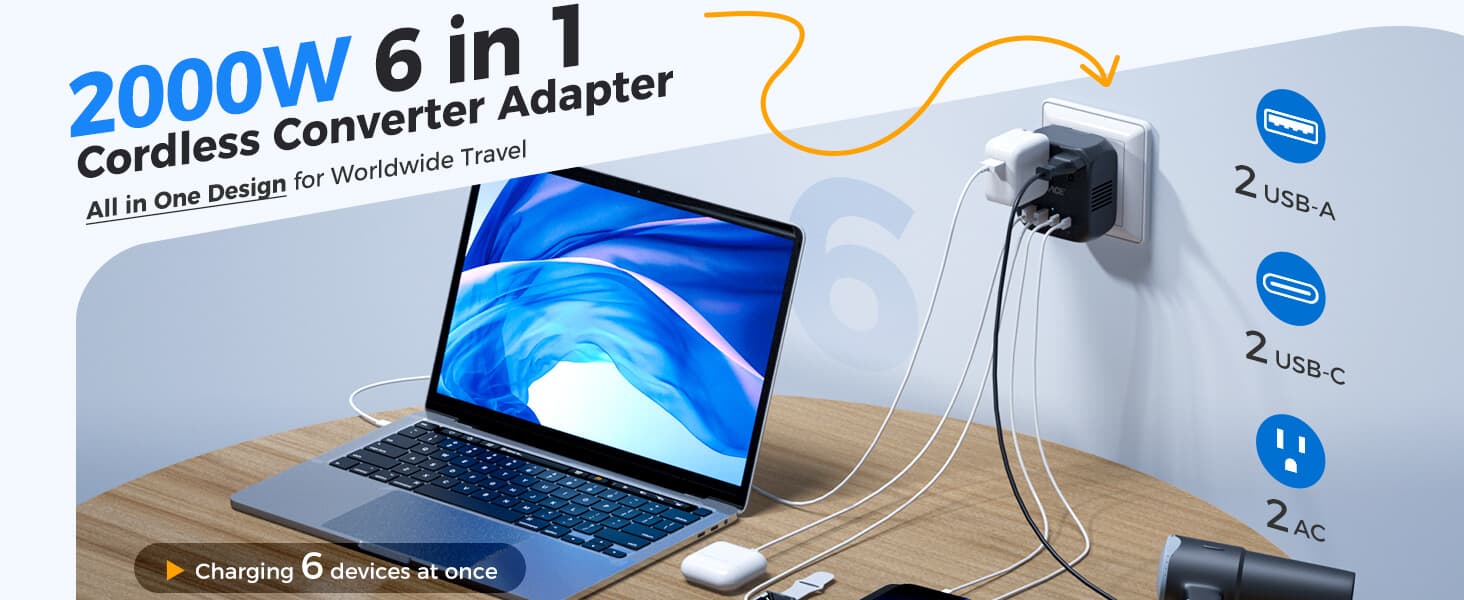
DOACE C15 2000W Voltage Converter
Best fit: compatible traditional high-wattage 120V devices when traveling to 220V/230V countries.
Not for: Dyson, Shark, Laifen, smart brushless-motor hair tools, unknown high-wattage devices, or any device that exceeds the converter rating.
When You Do Not Need a Grounded Adapter
You probably do not need a grounded travel adapter if every device you carry has a two-prong plug and a 100-240V label. A phone, tablet, camera charger, compact USB-C laptop charger, and headphones can usually travel with a simple quality adapter or a multi-port GaN travel adapter.
You may also be better off buying a local power cable instead of a travel adapter. Desktop computers, monitors, and some laptop power bricks use detachable IEC power cords. If the power supply itself is rated 100-240V, replacing the cord with a local grounded cord can be more secure than stacking a travel adapter onto the original plug.
And sometimes the safest product is no product. If your high-wattage hair tool is 120V-only and not converter-compatible, use the hotel dryer, buy a local tool, or leave it at home. A grounded adapter cannot make an incompatible device safe.
You also do not need to chase a grounded adapter for every two-prong device just because the destination outlet has a ground. A Type C phone charger in a Type F outlet is ungrounded by design. A compact USB-C charger in a UK adapter is still doing low-voltage charging through an isolated power supply. The right question is not "does the wall have a third contact?" It is "did my device need that contact in the first place?"
For travelers carrying only phones, tablets, a camera battery, and a USB-C laptop, the simplest kit is often one compact travel adapter plus one multi-port charger. For travelers carrying a workstation, CPAP, power strip, or high-wattage appliance, the kit needs more thought. That difference is the whole point of grounded vs ungrounded adapters.
A final sanity check: never let the adapter make a risky device feel normal. If a device is heavy, hot, metal-cased, three-prong, medical, old, or single-voltage, slow down and check it. If the adapter feels loose, smells warm, or needs to be propped up to stay connected, stop using it. A correct plug shape is the beginning of the decision, not the end.
The best travel power kit is usually smaller than people think. Pack fewer AC appliances, more wide-voltage USB-C gear, and only the country-specific grounded pieces your actual devices require. That approach reduces weight and reduces the chance that one universal adapter becomes responsible for every device you own.
FAQ
Do I need a grounded travel adapter?
You need one when your device has a three-prong plug and depends on ground as part of its safety design. Desktop computers, some monitors, medical setups, audio equipment, and power strips deserve a grounded path. For two-prong wide-voltage chargers, an ungrounded adapter is usually fine.
Is an ungrounded travel adapter dangerous?
Not by itself. It is normal for many small chargers. It becomes risky when used with three-prong devices, power strips, surge protectors, loose outlets, high loads, or single-voltage devices in the wrong country.
Does a grounded adapter convert voltage?
No. A grounded adapter can preserve earth continuity, but it still passes local voltage through. If your device is 120V-only and the destination is 220V/230V, you need a compatible voltage converter or a different device.
Can I remove the third pin from a plug?
No. Removing the third pin defeats the device's designed safety path. Use the correct grounded adapter, local power cord, or manufacturer-approved travel setup instead.
Can I use a Type C Europlug adapter for my laptop?
If your laptop charger has a two-prong plug and is labeled 100-240V, usually yes. If the original laptop power cord is three-prong, a Type C adapter may power it but will not provide ground. For long use or high-power laptop bricks, prefer a grounded country-specific adapter or local cord.
Does a power strip need grounding abroad?
If it is a three-prong strip or surge protector, yes, it was designed with ground in mind. Using it through an ungrounded travel adapter removes that path. It can also overload the adapter. A multi-port USB-C charger is usually better for travel electronics.
Are all three-hole foreign outlets actually grounded?
No. Outlet shape does not prove wiring. Old or poorly renovated buildings may have grounded-looking outlets without a connected ground wire. A socket tester is the only practical way to verify ground in the room.
Do CPAP machines need a grounded adapter?
Check the CPAP power supply. Many modern CPAP supplies are 100-240V and only need a reliable adapter. If the power supply is three-prong or the device is medically necessary and runs overnight, use a conservative setup and follow manufacturer guidance.
What should I buy for a simple phone-and-laptop trip?
If both chargers say 100-240V, a compact travel adapter or GaN travel adapter is usually enough. You do not need a voltage converter, and you probably do not need a grounded adapter unless your laptop power brick uses a three-prong cord and you want to preserve that path.
What is the safest rule before plugging in abroad?
Read the INPUT label first, then look at the plug. Wide-voltage two-prong devices usually need only adapter shape. Three-prong, metal-cased, medical, power-strip, or 120V-only devices need a more careful decision.
Is a country-specific adapter better than a universal adapter?
For small wide-voltage electronics, a good universal adapter can be more convenient. For three-prong equipment where grounding matters, a country-specific grounded adapter or local power cord is often better because it can match the destination grounding system more precisely.
Why does my metal laptop tingle when I use a travel adapter?
Some metal laptops or high-power chargers can produce a mild touch-current sensation when used without the original grounded path. The laptop may still work, but a grounded local cord or grounded adapter is a better setup for long sessions.
Should I bring a socket tester?
Most vacation travelers do not need one. It is useful for long stays, remote-work setups, audio gear, medical devices, or any situation where you must verify that the room outlet is actually grounded and wired correctly.


