

Quick Answer: For South Africa, pack a travel adapter that explicitly supports Type M (the large three-round-pin outlet), and ideally one that also covers Type N (the newer compact standard). Type M is still the dominant outlet in most hotels, safari lodges, and guesthouses. Type N appears in newer buildings constructed after January 2018. A plug adapter fixes shape only; it does not make a 120V-only US appliance safe on South Africa's 230V/50Hz supply. If your device label says "Input 100-240V, 50/60Hz," you only need the right plug shape. If it says "Input 120V" or "110-120V," you also need a voltage converter or should leave that device at home.
South Africa uses three socket types: Type M (SANS 164-1, the big three-round-pin), Type N (SANS 164-2, the newer compact standard), and the rarely seen Type D (SANS 164-3, old lighting circuits). As a traveler in 2026, you will almost certainly encounter Type M. You might also see Type N if your accommodation is new or recently renovated. The two are not interchangeable, and an adapter designed for one will not fit the other.
Why South Africa Has Two Plug Standards
South Africa's plug situation is a direct result of its electrical history. In the 1920s, the British BS 546 standard (15A three-round-pin) was introduced during the colonial era. This large round-pin plug became the foundation of South Africa's electrical infrastructure and eventually evolved into the modern SANS 164-1 standard, also known internationally as Type M (Plug & Socket Museum). Why did South Africa not switch to the more modern British BS 1363 (Type G, the rectangular-pin plug used in the UK today)? The answer is timing: BS 1363 was not published until 1946, by which point South Africa had already built an entire national electrical system around the BS 546 round-pin format. The cost and disruption of switching were simply too great, so South Africa kept the round-pin tradition while the UK itself moved to square pins.
In 1994, the South African Bureau of Standards (SABS) formally published the SANS 164 standard, codifying the BS 546 15A version as SANS 164-1 with a slight current rating update from 15A to 16A. The physical dimensions stayed the same: 7.0mm diameter line and neutral pins spaced 25.4mm apart, with an 8.7mm earth pin. This is the plug that most South Africans know simply as the "three-pin plug" or "big plug," and it remains the default in the vast majority of existing buildings.
In 2013, South Africa adopted the international IEC 60906-1 standard as SANS 164-2, known as Type N. The IEC 60906-1 standard was originally published in 1986 with the ambitious goal of creating a single global plug and socket system. It features much smaller 4.5mm pins spaced 19.0mm apart, recessed sockets (10mm deep) for improved safety, insulated pin sleeves to prevent shock from partially inserted plugs, and mandatory safety shutters to protect children. From January 2018, South African wiring regulations (SANS 10142-1) require all new buildings to include at least one SANS 164-2 socket per outlet point (Delberg Attorneys). Non-compliance means the building cannot receive an Electrical Certificate of Compliance, which in turn blocks the Occupation Certificate required under the Occupational Health and Safety Act.
However, old buildings do not need to be retrofitted. SABS has stated the transition will take "a very long period of time" (Interpower). SABS Electrical Standards Manager Willa Breed explained that a SANS 164-2 plug can be connected to a SANS 164-1 socket via an adapter, but the full transition of the national installed base is expected to span decades. In practice, Type M remains the most common outlet you will encounter as a traveler in 2026, particularly in safari lodges, guesthouses, and older hotels.
The old SANS 164-1 standard has recognized safety issues that motivated the switch. Most Type M plugs lack insulated pin sleeves, meaning that when a plug is partially pulled out, the live pins are exposed and can cause shock. This is particularly dangerous in households with young children, who may pull a plug partway out while it is still carrying current. The non-recessed socket design makes it easier for objects to accidentally contact live terminals, and the large pin holes on SANS 164-1 sockets are wide enough that a child could potentially insert a small metal object. Many older outlets lack safety shutters, creating an additional risk for children. And fully inserted Type M plugs require significant force to remove, due to the tight friction fit of the large 7.0mm pins in the socket. This led to the development of South African innovations like the Pop-a-Plug (patented in 2000 by Willem C. Botbyl and Hans Zander under South African patent number 2000/02856), which features a push-button ejection mechanism that mechanically pushes the plug out of the socket. Another solution was the Easy-Pull plug by Electrapac, which incorporated a built-in handle for easier grip and removal (Plug & Socket Museum). These homegrown inventions are a testament to the real daily frustration of using the large Type M plug and were among the factors that convinced South African regulators a new standard was needed.

Type M: the large three-round-pin outlet still dominant across South Africa.
Type M vs Type N: What's Actually Different?
The physical differences between Type M and Type N are significant and go well beyond just size. A Type M plug has large 7.0mm diameter pins spaced 25.4mm apart, while a Type N plug has much smaller 4.5mm pins spaced only 19.0mm apart (Plug & Socket Museum). They are not interchangeable, and an adapter designed for one will not fit the other. The earth pin on Type M is 8.7mm in diameter and 29.0mm long, while Type N's earth pin is just 4.5mm and 18.9mm long. Even the plug body dimensions differ: Type M is substantially larger and heavier.
Both standards carry a 16A / 250V rating, so they handle the same electrical load. The difference is entirely in physical geometry and safety design. Type N was designed with modern safety expectations in mind: recessed sockets that protect against accidental contact, insulated pin sleeves that prevent shock when a plug is partially withdrawn, and safety shutters that block children from inserting objects into live terminals. Type N sockets also accept the two-pin Europlug (Type C / SANS 164-5), which means phone chargers and small electronics with Europlug pins can plug directly into a Type N outlet without any adapter at all.
There is also a third, much less common standard: Type D (SANS 164-3), which has 5.1mm pins spaced 19.9mm apart and is rated at only 6A. Type D is found mainly on old lighting circuits in some heritage buildings and is gradually being phased out. The ungrounded version of SANS 164-3 was officially withdrawn in 2003. As a traveler, you are unlikely to encounter Type D unless you are plugging into a very old light fixture connection. However, it is worth knowing about because some travel guides and adapter websites list South Africa as using Type D, M, and N, and travelers sometimes confuse Type D with the more common Type M due to their similar triangular three-pin layout. The key visual difference is size: Type M is noticeably larger than Type D, and the pins are thicker. If your adapter has holes that look like they could accept either, try the adapter on the actual socket before assuming it will work.
| Feature | Type M (SANS 164-1) | Type N (SANS 164-2) | Type D (SANS 164-3) |
|---|---|---|---|
| Pin diameter (L/N) | 7.0mm | 4.5mm | 5.1mm |
| Pin spacing (L-N) | 25.4mm | 19.0mm | 19.9mm |
| Current rating | 16A / 250V | 16A / 250V | 6A / 250V |
| Safety shutters | Optional (most older outlets: no) | Mandatory | Rare |
| Recessed socket | No | Yes (10mm deep) | No |
| Where travelers see it | Most hotels, lodges, guesthouses | Newer buildings (post-2018) | Old lighting circuits (rare) |
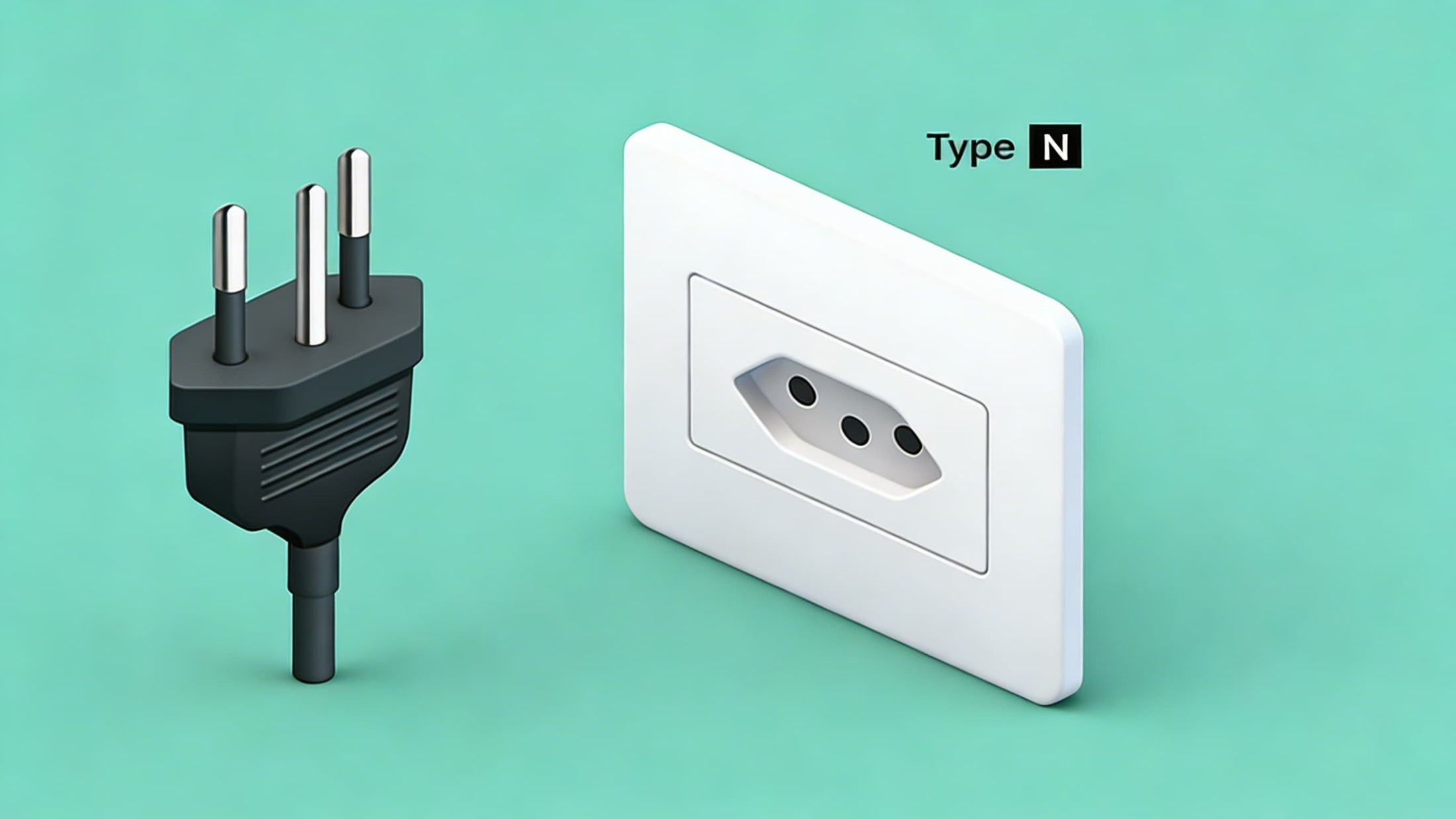
Type N: the newer compact standard appearing in buildings erected after January 2018.
Where You Will Encounter Each Plug Type
| Accommodation type | Most likely outlet | Notes |
|---|---|---|
| Safari lodges and game reserves | Type M | Remote locations, traditional builds. Some have solar backup power. |
| Hotels in Cape Town, Johannesburg, Durban | Type M (older) or Type N (newer/renovated) | May have both in dual sockets. Ask at booking. |
| Guesthouses and B&Bs | Type M | Mostly older electrical systems. |
| New apartments or Airbnb (post-2018) | Type N (+ Type M in same outlet) | Building regulations require at least one Type N per outlet point. |
| Campsites | Type M | Shared power points, often limited in number. |
The practical takeaway: do not assume your accommodation will have the newer Type N socket. Pack for Type M as your primary adapter, and confirm with your accommodation if you want to be certain.
Safari lodges deserve special mention because they represent one of South Africa's most popular travel experiences and also the scenario where Type M is most dominant. Kruger National Park area lodges, private game reserves like Sabi Sands and Timbavati, and remote bush camps in Limpopo and Mpumalanga almost universally use Type M outlets. Many of these lodges were built decades ago and their electrical systems reflect the SANS 164-1 standard. The construction style of safari lodges, which often features natural materials, thatched roofs, and traditional building methods, means that electrical upgrades to the newer SANS 164-2 standard are not a priority compared to guest experience investments like better viewing platforms or upgraded game drive vehicles. Some high-end lodges that have been recently built or renovated may include SANS 164-2 (Type N) outlets, but this is not guaranteed and should never be assumed. Campsites and overland tour stops typically provide Type M power points, though they may be shared among many guests and limited in number. At popular campsites during peak season (June through September for the dry-season safari window, and December through January for the summer holidays), you may find yourself competing with other travelers for available power points. If you are planning a safari trip, contact your lodge or tour operator in advance to confirm the outlet type and whether backup power is available. The safest approach is to bring your own Type M adapter, a power bank rated at 10,000mAh or more, and a charging cable long enough to reach from the outlet to your bedside (Wild Wings Safaris).
South Africa vs India vs Brazil: Avoiding the Global Plug Confusion
One of the most common mistakes travelers make is assuming that plug type letters are universal across countries. They are not. South Africa's plug types overlap with India and Brazil in ways that create serious confusion. The international plug lettering system (A through O) was created as a shorthand by the International Trade Administration, but different countries that share the same letter may have implemented the standard differently, with different pin dimensions, different current ratings, and different safety requirements. This is especially true for Type M and Type N.
South Africa vs India: Both countries use Type M, and the physical plug is identical (same BS 546 15A heritage, same 7.0mm pins, same 25.4mm spacing). However, India's everyday household socket is Type D (5A), which is much smaller with 5.1mm pins and 19.9mm spacing. In India, you mostly use a Type D adapter for phone chargers and small devices, and Type M only for heavy appliances like air conditioners and geysers. In South Africa, Type M is the standard for everything, from phone charging to kettles to laundry machines. The 5A/Type D circuit in India and the 15A/Type M circuit in South Africa serve completely different roles in the household. A traveler going to both countries needs an adapter that covers both Type D and Type M, which is rare in compact universal adapters for the same engineering reasons discussed above.
South Africa vs Brazil: Both countries adopted the IEC 60906-1 framework and both call their plug "Type N." But the physical dimensions are different. South Africa's SANS 164-2 plug has 4.5mm diameter pins, while Brazil's NBR 14136 10A plug has 4.0mm pins (Plug & Socket Museum: IEC 60906-1). A South African Type N plug will not fit a Brazilian 10A socket because the pins are too thick. A Brazilian 10A plug inserted into a South African Type N socket may be loose and unreliable because the pins are too thin. Additionally, South Africa mandates insulated pin sleeves while Brazil does not. The plug body thickness differs (South Africa 17.0mm vs Brazil 17.6mm). And Brazil's voltage varies by city (127V in Sao Paulo, 220V in Rio de Janeiro), while South Africa is a uniform 230V nationwide. The lesson: never rely on the letter "N" alone. Always check the adapter's specific country compatibility list.
Why Your Universal Adapter Might Not Work
Many travelers assume a universal travel adapter covers every country. South Africa is one of the places where that assumption frequently fails. The reason is physical: Type M's 7.0mm pin diameter is simply too large for the pin holes on most compact universal adapters. Manufacturers like Epicka (TA-205, TA-105) explicitly exclude Type M from their supported plug types (Trips of a Lifestyle). Tessan's 2026 guide confirms: "Type M's large pins don't fit many universal adapters" (Tessan). Travel-Adaptor.com warns that ungrounded worldwide adapters cannot be used in South African Type M outlets (Travel-Adaptor.com).
Why is this so hard to solve? The engineering challenge is the extreme size difference between Type M and other common plug types. Type M's line and neutral pins are 7.0mm in diameter. Type C (Europlug) pins are only 4.0mm. To cover Type M, a universal adapter needs pin holes large enough for 7.0mm, but those same holes would leave a Type C plug wobbling loosely. Manufacturers face a choice: make the adapter larger and heavier to accommodate Type M's big pins, or keep it compact and drop Type M support. Most choose compactness, which is why you see products advertising "150+ countries" with fine print that says "not compatible with South Africa / Type M." The DOACE International Travel Adapter Guide also notes that many compact universal adapters do not fully support the large Type M format.
On Reddit, travelers consistently report: "Type M is still the most common" and advise against relying on a generic universal adapter. On TripAdvisor, one traveler noted: "A universal adapter may not have the Type M adapter required for most South African sockets" (TripAdvisor). The current rating difference also matters: Type M is rated for 16A, while many universal adapters are designed for lower-current plug types, and safely handling the full 16A through a multi-standard pin hole is an engineering challenge that adds cost.
Before your trip, check your adapter's packaging or product page. If it lists Type A through I but does not explicitly say "Type M" or "South Africa," it likely will not fit. The safest approach is to buy an adapter that clearly states South Africa Type M compatibility. Some travelers carry a dedicated South Africa adapter as a backup even if their universal adapter claims broad coverage.
Some hotels do offer adapter lending, but this is not reliable, especially at smaller guesthouses, during peak season, or at remote safari lodges. The adapter you borrow may be a Type M to Type G (UK) or Type M to Type C (Europlug) converter, which may not match your US Type A/B plugs. During busy tourist seasons, the limited supply of loaner adapters can run out entirely. Having your own adapter eliminates this uncertainty and ensures you can charge your devices from the moment you arrive.
Adapter or Converter: Which Do You Actually Need?
There are two separate questions every US traveler to South Africa must answer. First, can your plug physically fit the outlet? That is the adapter question. Second, can your device safely accept South Africa's 230V voltage at 50Hz? That is the converter question. A plug adapter fixes shape only. It does not convert voltage. Confusing the two is the single most common cause of burned-out appliances and, in worst cases, electrical fires among international travelers.
South Africa's electrical supply is 230V at 50Hz, which is the standard across most of Europe, Africa, and Asia. The United States uses 120V at 60Hz. The voltage difference is nearly double. If you plug a 120V-only device into a 230V outlet, even with the correct plug adapter, the device will receive roughly twice the voltage it was designed for. The result can range from immediate failure (a blown fuse or tripped breaker) to gradual damage (overheated components, shortened lifespan) to dangerous outcomes (sparking, melting, or fire).

Check your device label: "Input 100-240V, 50/60Hz" means wide voltage. "Input 120V" or "110-120V" means single voltage and may need a converter.
- Phones, laptops, tablets, camera chargers, and most CPAP power supplies: If the label says Input 100-240V, 50/60Hz, they usually need only the correct plug adapter or a GaN travel adapter. No voltage conversion needed.
- US hair dryers, curling irons, kettles, and other 120V-only heat appliances: A plug adapter alone is not enough. These devices may overheat, spark, or fail on 230V unless they are dual-voltage or used with a correctly rated voltage converter.
- Sensitive or overnight equipment: If the device is single-voltage and sensitive (certain medical, audio, or electronic-control devices), consider clean power conversion designed for sensitive electronics instead of a basic converter.
| Your device | Label to look for | Likely solution | Important limit |
|---|---|---|---|
| Phone, laptop, tablet, camera charger | 100-240V, 50/60Hz | South Africa plug adapter or GaN travel adapter | No voltage conversion needed if the label truly covers 230V |
| 120V-only shaver, toothbrush, small appliance | 120V or 110-120V only | Voltage converter sized to watts and use time | Do not plug directly into 230V with only an adapter |
| Hair dryer, curling iron, flat iron | 120V only, often 1000W+ | Dual-voltage travel tool, local tool, or high-wattage converter only if compatible | Many smart heat tools are poor converter candidates |
| CPAP or sensitive overnight device | Check the power brick, not only the machine | Adapter if wide-voltage; clean-output converter if conversion is actually required | Test before travel and keep the original power supply |
For the broader country-level voltage decision, see our guide to whether you need a voltage converter for South Africa from the US.
A note on frequency: South Africa uses 50Hz while the US uses 60Hz. Most modern electronics with switching power supplies (phones, laptops, camera chargers) are not affected by this frequency difference. However, devices with AC motors (some clocks, turntables, certain kitchen appliances) may run slower on 50Hz. Devices with heating elements (hair dryers, kettles) are generally not affected by frequency. If a device label says 50/60Hz, it handles both frequencies. If it says 60Hz only, check the manufacturer's documentation before using it on South Africa's 50Hz supply.
For travelers who frequently visit countries with different voltages, investing in dual-voltage travel versions of common tools (hair dryers, straighteners, electric toothbrushes) can eliminate the converter question entirely. Dual-voltage travel hair dryers typically have a manual switch on the handle to toggle between 120V and 240V. This is simpler and safer than relying on a voltage converter, especially for heat tools that draw high wattage and may have electronic controls that do not respond well to converter output.
Load Shedding: What It Means for Your Devices
South Africa's power utility, Eskom, implements a system of planned power outages called "load shedding" to manage supply shortages. During load shedding, power to specific areas is switched off on a rotating schedule, sometimes for several hours at a time. Load shedding is organized into stages from Stage 1 (least severe, roughly two hours per outage) to Stage 8 (most severe, potentially ten or more hours without power per day). In 2022 and 2023, South Africa experienced its worst load shedding periods with frequent Stage 6 outages. The situation has improved somewhat in 2024 and 2025, with Stage 2 to Stage 3 being more common, but load shedding remains a reality of daily life and travel in South Africa.
For most travelers, the direct impact is minimal because hotels, safari lodges, and restaurants typically have backup generators, inverter systems, or solar installations (Wild Wings Safaris). The safari lodge industry in particular has almost universally adopted solar power solutions, since many lodges are in remote locations that were off-grid to begin with. According to Travel Weekly, load shedding's impact on tourism has been relatively minimal because the hospitality sector invested heavily in backup infrastructure.
However, there is one risk worth understanding clearly: when power is restored after an outage, a voltage surge can occur that may damage sensitive electronics left plugged in. The sudden restoration of power creates a spike that can exceed the normal 230V level, potentially harming laptop power supplies, phone chargers, CPAP machines, and other sensitive devices. Eskom itself recommends unplugging appliances before or during load shedding to protect against surge damage (Eskom). Insurance companies in South Africa routinely process claims for electronics damaged by load shedding surges (Leigh Insurance).
Practical tips for travelers dealing with load shedding:
- Carry a power bank (10,000mAh or larger) so your phone stays charged regardless of grid status. This is arguably the single most useful item for load shedding.
- Unplug sensitive devices (laptop chargers, CPAP machines, camera battery chargers) during a known outage if possible. The surge when power returns is more dangerous than the outage itself.
- Download a load shedding schedule app such as EskomSePush (available on both iOS and Android) to track planned outages in your specific area. The schedules are predictable and location-specific.
- Confirm with your accommodation whether they have backup power before your stay. Most hotels and lodges will advertise this on their booking page, but it is worth asking directly.
- If you rely on a CPAP machine or other medical device, bring a battery backup or confirm that your accommodation's backup power covers the outlets you need.
- Keep a small LED flashlight or headlamp accessible at night. While most hotels have emergency lighting, navigating unfamiliar hallways during an unexpected outage is easier with your own light source.
Recommended DOACE Products for South Africa
Choose the product by the device, not by the country name alone. South Africa's outlet shape tells you what adapter you need. Your device label tells you whether you need voltage conversion. Here are three DOACE products matched to the most common South Africa travel scenarios:
For wide-voltage USB-C devices (phones, tablets, laptops, cameras): if every device you carry is labeled 100-240V, a good GaN travel adapter with Type M support is all you need. No converter required. For single-voltage 120V devices that must come with you (certain shavers, toothbrushes, small appliances): you need a properly rated voltage converter, not just an adapter. For high-wattage heat tools (some hair dryers, curling irons): check whether the tool is dual-voltage and whether it is compatible with converter use before attempting to use a converter.

DOACE 70W GaN 3.0 Universal Travel Adapter
Best for: phones, tablets, laptops, cameras, and other wide-voltage devices labeled 100-240V.
Not for: converting 230V down to 120V for single-voltage US appliances.

DOACE LC-X35 Travel Voltage Converter
Best for: compatible 120V-only sensitive or overnight devices within the converter's 350W wattage limit.
Not for: high-wattage hair dryers, kettles, or devices that exceed its rated load.
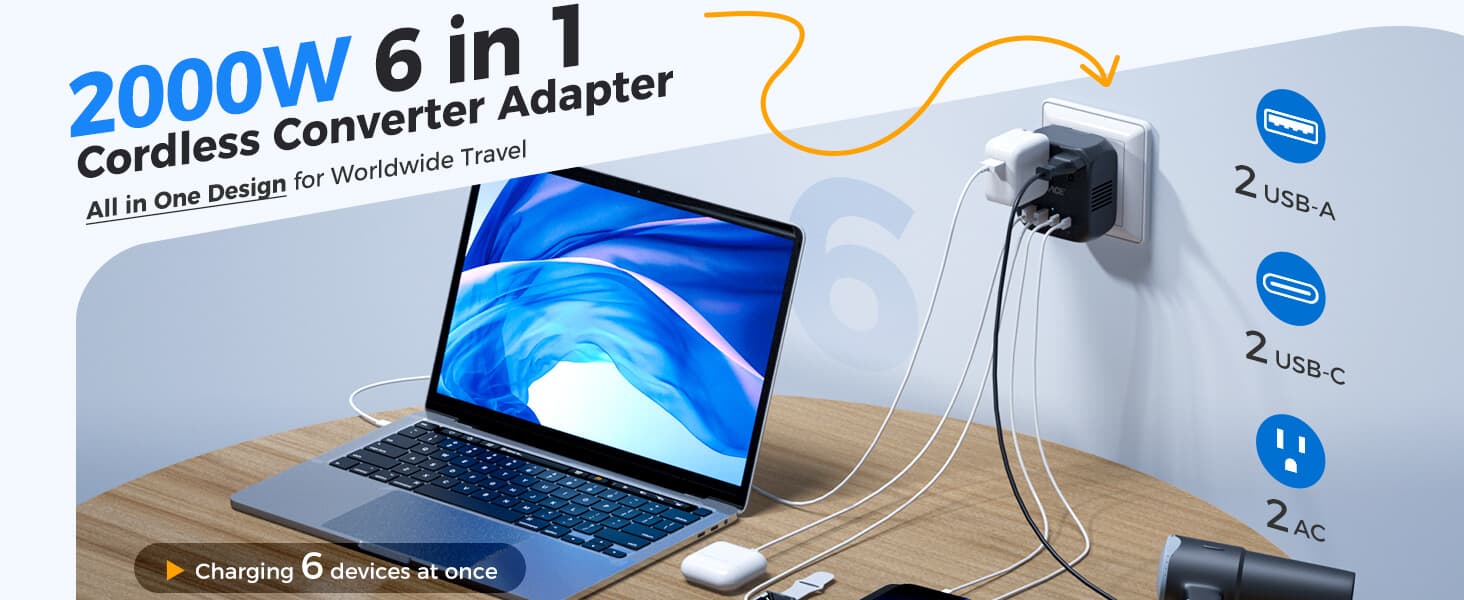
DOACE C15 2000W Voltage Converter
Best for: compatible high-wattage single-voltage devices that fit the product's usage rules.
Not for: assuming every smart hair tool or electronically controlled heat appliance is converter-safe.
When You Don't Need a DOACE Converter
You may not need a voltage converter at all if every device you plan to plug in is wide-voltage (labeled 100-240V, 50/60Hz). Most modern phone chargers, laptop power supplies, tablet chargers, camera battery chargers, and many CPAP power supplies fall into this category. In that case, the useful purchase is usually a reliable South Africa-ready travel adapter that explicitly supports Type M, not a transformer. Many travelers are surprised to discover that nearly every device they own is already wide-voltage, which means the entire voltage converter question becomes irrelevant for their trip. The only remaining question is whether their plug adapter physically fits the outlet.
You may also be better off using a hotel hair dryer, buying a local heat tool, or carrying only USB-C devices when your trip is short. Many South African hotels and lodges provide hair dryers, and the risk of damaging your own 120V-only tool on 230V may not be worth the packing space. A growing number of travelers simply standardize on USB-C for everything: phone, tablet, laptop, toothbrush, and even compact travel razors with USB-C charging. This approach eliminates the plug shape and voltage questions entirely, as long as you have a USB-C charger that accepts Type M input. If your universal adapter already explicitly lists Type M support and all your devices are wide-voltage, you may not need to buy anything new. The key is to verify the "Type M" listing before you leave, not discover the problem at a Johannesburg hotel socket at 11pm after a long flight.
For travelers visiting both South Africa and neighboring countries (Namibia, Botswana, Zimbabwe, Mozambique), note that these countries use different plug types. Namibia uses Type M (same as South Africa, since it was historically administered by South Africa). Botswana uses Type D and G. Zimbabwe uses Type D and G. Mozambique uses Type C, F, and M. Lesotho and Eswatini (formerly Swaziland) also use Type M. A single adapter rarely covers all of these destinations, which makes multi-country southern Africa itineraries one of the most adapter-challenging travel scenarios in the world. Plan your adapter kit based on every country on your itinerary, not just the first stop. If your trip includes both South Africa and Botswana, for example, you will need adapters for both Type M and Type G, and no single universal adapter is likely to cover both reliably.
Common Mistakes Travelers Make with South Africa Adapters
After reviewing hundreds of traveler reports, forum posts, and product reviews, certain mistakes appear again and again among US visitors to South Africa. Understanding these in advance can save you from a frustrating experience at a hotel socket after a long international flight:
- Assuming "universal" means truly universal: As explained above, Type M's large pins are excluded from most compact universal adapters. Check before you fly.
- Confusing Type M with Type D: They look similar (both three round pins in a triangular layout) but Type M pins are 7.0mm while Type D pins are 5.1mm. A Type D adapter will not fit a Type M socket.
- Assuming Type N means the same in South Africa and Brazil: The pin diameter difference (4.5mm vs 4.0mm) makes them incompatible despite sharing the letter N.
- Plugging a 120V-only device into a 230V outlet with only an adapter: An adapter changes plug shape, not voltage. A 120V hair dryer on 230V will overheat and may spark or fail within seconds.
- Not checking the device power brick: Some devices (especially CPAP machines) have a power brick that may be wide-voltage even if the device itself is not. Check the label on the power supply, not just the device.
- Leaving devices plugged in during load shedding: The power surge when electricity returns can damage sensitive electronics. Unplug during known outages.
- Only packing one adapter: If your only adapter breaks, gets lost, or turns out not to fit, you may struggle to find a replacement in smaller South African towns. Carrying a backup adapter or a combination of a universal adapter plus a dedicated Type M adapter is a smart redundancy strategy.
- Ignoring the device power brick label: Some devices (especially CPAP machines, electric shavers, and toothbrush chargers) have a separate power supply brick. The voltage rating on the brick is what matters, not the rating printed on the device itself. A CPAP machine may say "120V" on the unit, but its power brick may accept 100-240V, meaning only a plug adapter is needed.
- Assuming newer means universal: Some travelers assume that because South Africa adopted a "new" standard (Type N / SANS 164-2), all outlets must be Type N now. As explained, Type M remains the dominant outlet type and will be for years to come.
FAQ
Can I use a normal Europe adapter in South Africa?
Not as your only adapter. Some small two-pin Europlugs may work in limited situations, but South Africa's most common outlet is Type M with large 7.0mm pins and 25.4mm spacing. A standard Europe Type C/F adapter does not reliably solve the South Africa plug problem. European adapters are designed for Type C, E, and F sockets with 4.0mm pins and 19.0mm spacing, which are completely different from South Africa's Type M geometry. Even if you find a way to physically connect a European adapter to a Type M socket, the connection will likely be unstable and unsafe.
Is Type M the same as Type D?
They look similar because both use three round pins in a triangular layout, but Type M has much larger pins (7.0mm vs 5.1mm for Type D). The pin spacing is also different: Type M uses 25.4mm spacing while Type D uses 19.9mm. Do not assume a Type D adapter will fit a South African Type M socket unless the adapter specifically lists Type M or South Africa compatibility. India uses both Type D and Type M, but in a different role distribution than South Africa. In India, Type D handles light loads (phone chargers, lamps) while Type M is reserved for heavy appliances. In South Africa, Type M is the universal standard for all household loads.
Does Type N mean Brazil and South Africa use the same adapter?
Not always. Both countries adopted the IEC 60906-1 framework, but South Africa's SANS 164-2 plug has 4.5mm diameter pins, while Brazil's NBR 14136 10A plug has 4.0mm pins (Plug & Socket Museum: IEC 60906-1). A South African Type N plug does not fit a Brazilian 10A socket. Check the adapter's specific country list rather than relying on the letter N alone.
Do I need a voltage converter for my iPhone in South Africa?
Usually no. Apple USB power adapters and most modern phone chargers are typically wide-voltage (100-240V). Check the label on your charger. If it says 100-240V, you need the right plug adapter, not a voltage converter.
Can I use my US hair dryer in South Africa?
Only if it is dual-voltage or used with a correctly rated converter and the device is compatible with converter use. Many US hair dryers are 120V-only and high wattage (1000W+), which makes them risky on South Africa's 230V supply. Hair dryers with electronic controls, ionic technology, or smart heat sensors are particularly poor candidates for converter use because the non-standard output waveform from a basic converter can confuse the electronics. Consider a dual-voltage travel dryer with a manual voltage switch, or simply use the hair dryer provided by your hotel. Many South African accommodations provide wall-mounted hair dryers as standard.
What is the safest packing rule for South Africa?
Bring an adapter that clearly supports South Africa Type M (and ideally Type N), check every device label before you pack, and carry a power bank as a backup against load shedding. Wide-voltage devices need plug adaptation only. 120V-only devices need a real voltage decision. Write down the adapter type you need before you leave and verify it against your adapter's packaging.
Will Type N eventually replace Type M in South Africa?
Not in the foreseeable future. The SABS has stated the transition will take "a very long period of time." South Africa has millions of existing SANS 164-1 (Type M) outlets in buildings that do not need to be retrofitted. The 2018 regulation only requires SANS 164-2 in new construction. Safari lodges, older hotels, and guesthouses are especially unlikely to upgrade soon. Plan for Type M as your primary adapter for years to come (Interpower).
Do safari lodges have reliable electricity?
Most safari lodges in South Africa have reliable electricity, but the source varies. Lodges connected to the national grid have standard Type M outlets and 230V power, subject to load shedding schedules. Remote lodges often rely on solar power systems with battery storage, which provide reliable but sometimes limited power. In solar-powered lodges, outlets may only work during certain hours, or may be limited to charging stations rather than in-room outlets. Always confirm with your lodge before arrival. Bring a power bank and a long USB-C cable as insurance (Wild Wings Safaris).
Can I charge my USB-C laptop directly in a South African outlet?
If your laptop's USB-C charger is labeled 100-240V (which virtually all modern laptop chargers are), you only need a plug adapter that fits the outlet shape. You do not need a voltage converter. A GaN travel adapter with Type M support and USB-C output is the simplest solution. The 50Hz frequency in South Africa (vs 60Hz in the US) does not affect modern switching power supplies.


