

Quick Answer
- Switzerland uses Type J outlets (SEV 1011) — not the same as the rest of continental Europe.
- A standard Type C Europlug (4.0 mm thin pins) fits directly into Swiss Type J sockets. Most phone and laptop chargers already have this plug shape.
- Schuko / Type F "Europe adapters" do NOT fit — the 4.8 mm pins are too thick for the 4.0 mm holes in Swiss sockets.
- No voltage converter needed — Switzerland runs on 230V 50Hz, same as the rest of Europe. If your charger says "100-240V," you only need a plug adapter.
- DOACE GaN travel adapters work — the fold-out EU plug is a Type C 2-pin that fits Swiss Type J directly.
If you have already bought a "Europe adapter" for your trip to France or Germany, you might assume it will work everywhere on the continent. Switzerland is the notable exception that catches thousands of travelers off guard every year. The problem is not voltage (Switzerland uses the same 230V as its neighbors) — it is the physical shape of the plug and socket. This guide explains exactly why Swiss outlets are different, what fits, what does not fit, and what you actually need to pack for a hassle-free trip.
For a broader look at European outlet differences, see our guide on Type E vs Type F outlets in Europe. For multi-country trip planning, check our adapter vs converter explainer.
Why Switzerland Has Different Outlets Than the Rest of Europe
The SEV and the Birth of an Independent Standard (1889-1930s)
Switzerland's electrical standard dates back to 1889, when the Swiss Electrotechnical Association (Schweizerischer Elektrotechnischer Verein, SEV — now Electrosuisse) was established. Switzerland was among the earliest European countries to develop large-scale hydroelectric power, giving it a head start in electrical infrastructure before France or Germany had settled on their own standards.
While France developed its Type E system with a protruding earth pin in the 1920s, and Germany's Albert Buttner patented the Schuko (Type F) with side-clip grounding in 1926, Swiss engineers in the 1920s-1930s took a deliberately different path: an offset earth pin positioned below the two power pins in an asymmetric triangle. The SEV formally published the SEV 1011 standard (now revised as SN SEV 1011:2009) to define this uniquely Swiss plug and socket system.
The engineering logic behind this design was deliberate:
- Polarity enforcement — the triangular pin arrangement ensures plugs can only be inserted in the correct orientation, preventing live/neutral reversal. Neither the French Type E nor the German Schuko enforce plug orientation.
- Compact form factor — the Type J socket recess is approximately 26 mm in diameter, significantly smaller than the Schuko's 34 mm recess, saving panel space in compact Swiss apartments and mountain chalets.
- Safety isolation through device certification control — by making the standard physically incompatible with neighboring countries, SEV ensured that only devices passing Swiss safety certification could connect to the Swiss grid. This gave Switzerland sovereign control over which electrical products could be sold domestically.
- Early infrastructure lock-in — because Switzerland electrified earlier than many neighbors (via abundant hydropower from Alpine rivers), by the time France and Germany standardized their own systems, millions of Swiss outlets were already installed. The sunk cost of replacing them was prohibitive.
IEC Standardization and the "Type J" Letter (1960s)
In the 1960s, the International Electrotechnical Commission (IEC) attempted to unify global plug standards through IEC 60083, which cataloged every national plug type and assigned letter designations. Switzerland's SEV 1011 was assigned Type J. However, the IEC's unification effort ultimately failed — every country had too much existing infrastructure to justify the enormous cost of switching to a common standard. The letter designations stuck, but the plugs remained different.
CENELEC, the EU, and Swiss Political Independence
Switzerland is not an EU member state. In the 1990s, the European Committee for Electrotechnical Standardization (CENELEC) pushed for harmonized plug standards across EU/EEA countries. Switzerland participates in CENELEC as an affiliate member through bilateral agreements, which means:
- Switzerland recognizes CE-marked low-voltage electrical products for market access.
- Switzerland is not legally required to adopt harmonized EU plug standards.
- Domestically sold electrical devices must still pass SEV certification or equivalent testing.
Multiple Swiss referendums have rejected EU/EEA membership, so this political independence — and by extension, the Type J standard — is unlikely to change in the foreseeable future. Type J will remain Switzerland's wall outlet standard for decades to come.
Tourism Growth and the Hotel Adaptation Problem (2000s-Present)
After 2000, Swiss inbound tourism grew significantly — reaching approximately 12 million overnight stays per year by 2019 (Swiss Federal Statistical Office). Hotels began facing constant complaints from international guests about plug incompatibility. The response has been uneven:
- Luxury hotels (4-5 star) — installed multi-standard universal outlets (accepting Type C/E/F/G/J/I) at desks and bathrooms, roughly 80% coverage.
- Mid-range hotels (3 star) — front desk loaner adapters, bathroom shaver outlets only. About 50% have any universal outlets.
- Budget/hostel/Airbnb — original Type J outlets throughout. No universal sockets, no loaner adapters.
The takeaway: do not assume your hotel will solve the plug problem for you. Even in 5-star properties, the universal outlets are limited to 1-2 per room.
Type J vs Type L: Similar Appearance, Different Standard
The Swiss Type J plug bears a visual resemblance to the Italian Type L plug — both use three round pins in a triangular arrangement with 4.0 mm diameter. However, they are NOT interchangeable. The key difference is the earth pin position: Type J offsets it below and to one side of center, while Type L centers it directly between the live and neutral pins. This means a 3-pin Italian plug cannot properly seat in a Swiss socket, and grounding contact will be unreliable or absent. Do not rely on Italian adapters in Switzerland.
For a deeper look at the Type J standard, see our complete Type J plug and socket guide. For the broader context of plug standard diversity across Europe, see our Type E vs Type F comparison.

Type J (SEV 1011) — Switzerland and Liechtenstein. Three round pins in asymmetric triangle. 4.0 mm diameter. Earth pin offset below center.
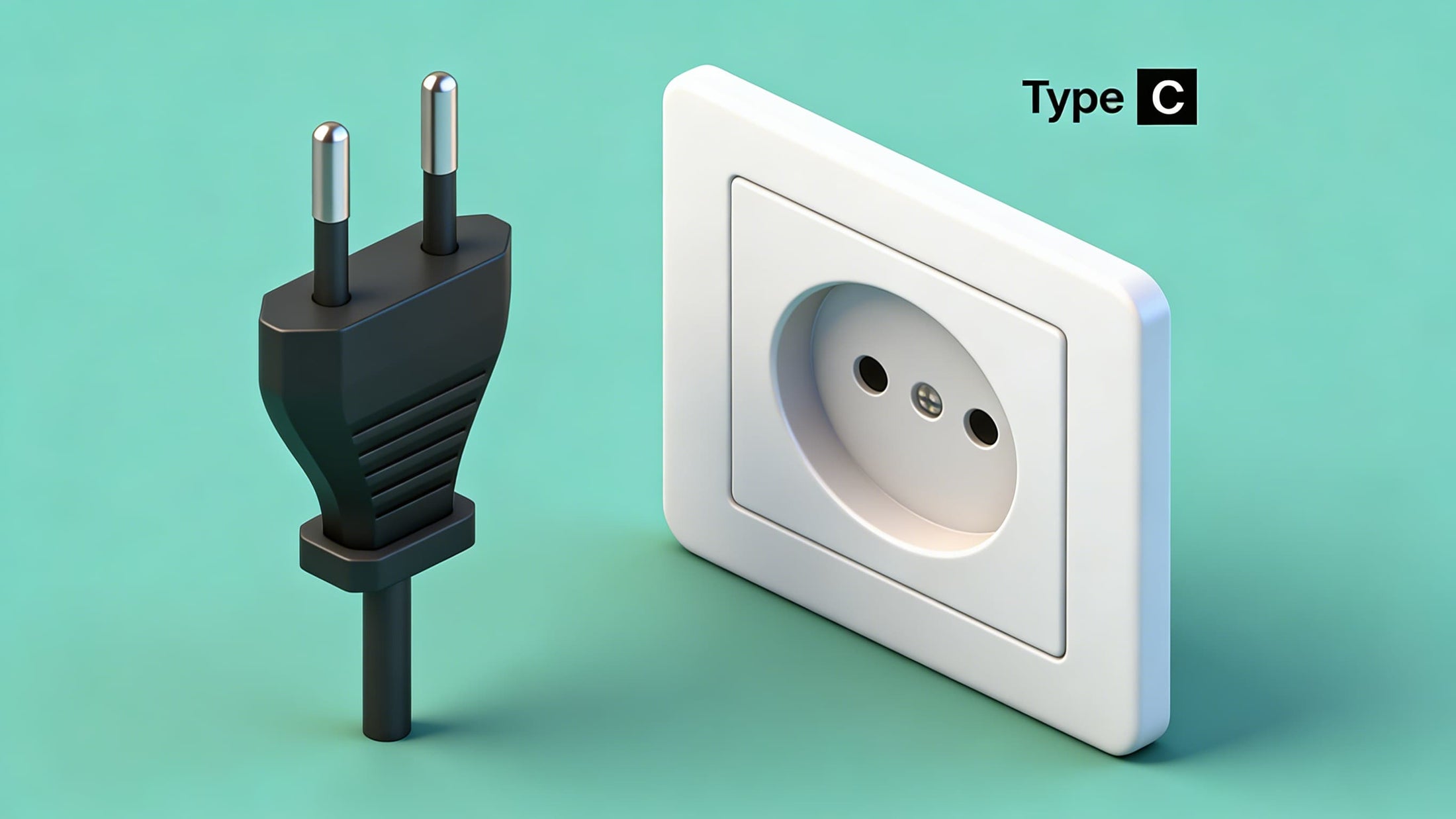
Type C (Europlug) — 2-pin, 4.0 mm diameter, 19 mm spacing. Fits directly into Swiss Type J sockets. Type C guide
Type J Technical Specifications
The Swiss standard defines several socket/plug configurations under SEV 1011 (IEC Type J):
| Designation | Pins | Rated Current | Pin Diameter | L-N Spacing | Recess | Notes |
|---|---|---|---|---|---|---|
| T12 socket / T11 plug | 2 (L + N) | 10A | 4.0 mm | 19 mm | ~26 mm | Accepts Type C Europlug |
| T13 socket / T12 plug | 3 (L + N + E) | 10A | 4.0 mm | 19 mm | ~26 mm | Standard Swiss 3-pin, earth offset ~5 mm from center |
| T23 socket | 3 (L + N + E) | 16A | 4.0 mm | 19 mm | ~28 mm | Accepts T12/T13 plugs (backward compatible) |
| T25 socket | 3 (L + N + E) | 16A | 4.0 mm | 19 mm | ~28 mm | New-build standard, larger body for higher loads |
Why Type C Europlug Fits Swiss Sockets
The Type C Europlug (CEE 7/16) has pin diameter of 4.0 mm and pin spacing of 19 mm — exactly matching the live and neutral holes in all Swiss Type J sockets. This is the single most important compatibility fact for travelers. The Type C plugs slides into the L and N holes of a T12, T13, T23, or T25 socket without any adapter. It does not provide grounding (no earth pin), but for Class II devices this is irrelevant.
Type C is rated at 2.5A (625W at 250V). This is more than sufficient for any single USB charger — even a 140W USB-C PD laptop charger draws less than 0.7A from a 230V supply. The 2.5A limit only becomes relevant if you try to power a high-draw device like a heater or hair dryer directly through a Type C connection (which you should never do — those devices need their own dedicated plug).
Why Schuko / Type F Does NOT Fit
The Type F Schuko (CEE 7/4) has fundamentally incompatible dimensions:
- Pin diameter: 4.8 mm vs 4.0 mm — the Schuko pin is 20% thicker than the Swiss hole. A 4.8 mm pin physically cannot enter a 4.0 mm opening. This is not a "tight fit" situation — it is a hard physical impossibility.
- Socket recess: 34 mm vs 26 mm — even if you could somehow force the pins in (you cannot), the Schuko's round body is 34 mm wide while the Swiss recess is only 26 mm. The adapter housing would sit proud of the wall, unable to seat properly.
- Grounding method: side clips vs offset pin — Schuko uses spring-loaded metal clips on the sides of the socket recess for earth contact. Swiss Type J uses an offset round pin. These systems are completely incompatible.
This triple incompatibility (pin diameter + recess size + grounding method) is why "Europe adapters" designed for France/Germany/Spain fail in Switzerland. The CEE 7/7 hybrid plug (compatible with both Type E and Type F) has the same 4.8 mm pins and fails for the same reason.
T23/T25: The New Swiss Standard for New Construction
Since around 2017, Switzerland has been promoting T23 and T25 sockets (rated at 16A) in new construction and major renovations. These newer sockets have a slightly larger recess (~28 mm vs ~26 mm for the older T13) and are designed for backward compatibility:
- Older 3-pin 10A plugs (T12) fit into new 16A sockets (T23/T25) — safe, because the wiring supports 16A.
- New 16A plugs cannot fit into old 10A sockets — this safety feature prevents users from accidentally drawing 16A through wiring rated for only 10A.
- Type C Europlug (2-pin) fits all versions — T12, T13, T23, and T25 all accept the standard 4.0 mm 2-pin Europlug.
As a traveler, you may encounter any mix of these socket types depending on the age of the building. The good news: a Type C Europlug or DOACE GaN adapter works in all of them.
Switzerland uses 230V at 50Hz — identical to France, Germany, Italy, and the rest of continental Europe. This means voltage is never the issue for travelers. The only barrier is the physical plug shape, not the electrical supply characteristics. If your charger label says "100-240V~50/60Hz," it is fully compatible with Swiss electricity — you just need the right plug shape to connect to the wall.
What Fits Swiss Outlets — and What Does Not
This is the most important section for travelers. The core incompatibility comes down to one number: pin diameter.
| Plug Type | Pin Diameter | Fits Swiss Type J? | Reason |
|---|---|---|---|
| Type C (Europlug, 2-pin) | 4.0 mm | Yes | Pin diameter and 19 mm spacing match exactly |
| Type E (French, 3-pin) | 4.8 mm | No | Pins too thick (4.8 > 4.0) |
| Type F (Schuko, 2+ground clips) | 4.8 mm | No | Pins too thick + recess too wide (34 mm vs 26 mm) |
| CEE 7/7 (hybrid E/F) | 4.8 mm | No | Same 4.8 mm issue |
| Type G (UK, 3 rectangular pins) | Rectangular | No | Completely different shape |
| Type I (Australia/China) | Angled flat | No | Completely different shape |
| Type A/B (US/Canada) | Flat blades | No | Completely different shape |
| Type L (Italy, 10A) | 4.0 mm | Partial | Same pin diameter but different earth pin position |
Many travel blogs and even some Reddit travel threads incorrectly state that "Schuko adapters work in Switzerland." This is physically impossible due to the pin diameter mismatch (4.8 mm vs 4.0 mm). The most common complaint on TripAdvisor's Switzerland forum is: "I bought a Europe adapter but it doesn't fit Swiss outlets." The cause is always the same — they bought a Schuko/Type F adapter instead of confirming Type C compatibility.
The only standard European plug that fits Swiss outlets directly is the Type C Europlug (2-pin, 4.0 mm thin pins, 19 mm spacing). This includes most USB chargers sold worldwide, which typically come with a Type C Europlug for European markets. According to the IEC World Plugs database, Type C is accepted in nearly every European and South American country, making it the most universally compatible plug in the world.
A note on Type L (Italian): while Type L also uses 4.0 mm pins, the earth pin is positioned differently (centered between live and neutral, rather than offset to one side). The 10A Italian plug may physically fit in some Swiss sockets due to similar pin diameter and 19 mm spacing, but this is not officially supported by SEV 1011 and may result in poor contact or absent grounding. Do not rely on Italian adapters in Switzerland.
For context on why Type E and Type F are also different from each other, see our Type E vs Type F comparison. For the full Type F standard, see our Type F guide.
4 Adapter Options for Travelers to Switzerland
Option A: Universal Travel Adapter (Epicka, TESSAN, etc.)
Most universal adapters have a "Europe" mode that outputs a Type C Europlug shape (4.0 mm thin pins). In theory, this fits Swiss Type J sockets. In practice, there are common issues:
- Body too thick — many universal adapters have a housing diameter exceeding 26 mm (due to the rotating multi-country mechanism), so the pins align but the body cannot seat into the Swiss recess.
- No grounding — the Type C output provides no earth connection.
- Loose fit — some adapters wobble in the socket due to pin length or angle tolerances.
Verdict: works for basic charging if the body fits, but not ideal for long-term or multi-device use. Amazon reviews for popular universal adapters frequently mention "adapter was loose in Swiss outlet" or "too thick to fit the recessed socket" — particularly for larger multi-country adapters with rotating heads. Common user complaint keywords from Amazon reviews: "loose fit," "wobbles," "adapter too thick for recessed socket." If you already own a universal adapter, test whether its Europe output module is slim enough (under 26 mm diameter) before relying on it for Switzerland. Also note that Type C output on universal adapters is rated at only 2.5A — fine for USB chargers, but insufficient for high-draw appliances.
Option B: Switzerland-Specific Adapter (Ceptics, Skross)
Dedicated Switzerland adapters precisely match the T13 recess shape, provide a snug fit, and some models include grounding passthrough (3-pin output). Popular options include:
- Ceptics CTU-11A — the most commonly purchased Switzerland adapter on Amazon. US 2-prong to Swiss 3-pin. Compact body fits the Type J recess. Does not pass through grounding from the US plug.
- Skross Country Adapter World to Switzerland — made by the Swiss brand Skross. Accepts plugs from multiple countries and outputs Swiss Type J. Available in Swiss airports, train stations, Coop, and Migros stores for CHF 12-20.
- Swiss MQ Brand adapters — local Swiss brand offering various input-to-Swiss-output converters, available at Interdiscount and MediaMarkt stores.
Downside: these adapters ONLY work in Switzerland and Liechtenstein. If your trip continues to France, Germany, or Italy, you need yet another adapter — making your bag heavier with single-purpose accessories. No USB ports, no fast charging capability, no voltage conversion. Price: $8-15 USD on Amazon, or CHF 12-25 if purchased in Switzerland.
Option C: DOACE GaN Travel Adapter (Recommended)
The DOACE GaN 70W travel adapter has a fold-out EU plug that is a standard Type C Europlug (4.0 mm thin pins, 19 mm spacing). This means it plugs directly into Swiss Type J sockets — including T12, T13, T23, and T25 variants.

DOACE 70W GaN Universal Travel Adapter
70W USB-C PD + USB-A output. Built-in foldable plugs for EU (Type C), UK, US, and AU. GaN 3.0 technology keeps it compact. Charges a MacBook Air and an iPhone simultaneously. Works in Switzerland, all EU countries, UK, Australia, and US with one device.
Not needed if: you already have a slim Type C Europlug charger and only need to charge one device. The GaN adapter is designed for travelers who want USB-C fast charging for multiple devices across multiple countries in one compact unit.
Why this works in Switzerland: the EU fold-out plug has 4.0 mm pins at 19 mm spacing — the exact dimensions that Swiss Type J sockets accept. Unlike bulky universal adapters, the GaN adapter's compact body fits within the Swiss socket recess without protruding. The same adapter also works across the entire EU (Type C/E/F), UK (Type G), Australia (Type I), and US (Type A/B) — eliminating the need to carry multiple single-country adapters. For a detailed wattage comparison of DOACE GaN 70W/100W/140W models, see our GaN adapter comparison guide. To understand when you need an adapter vs a converter, see our adapter vs converter explainer.
Important product boundary disclosure: The DOACE GaN adapter does NOT provide AC grounding. The EU fold-out plug is 2-pin (Type C) with no earth connection. For 99% of travelers (phones, laptops, tablets, cameras), this is irrelevant because these are Class II double-insulated devices. However, if you have Class I equipment requiring earth (certain CPAP machines, professional audio), you need a dedicated Type J 3-pin grounded adapter instead. We are transparent about this limitation.
Option D: Buy Locally in Switzerland
You can purchase adapters at Swiss airports (ZRH, GVA), train stations (SBB shops), Coop/Migros supermarkets, or electronics chains like Interdiscount or MediaMarkt. Expect to pay CHF 10-25 (roughly $11-28 USD) — significantly more than ordering from Amazon before your trip due to Switzerland's famously high cost of living. Availability in smaller mountain towns (Zermatt, Grindelwald, Wengen) may be limited to one general store. If you arrive on a Sunday, most Swiss shops are closed (except in major train stations and airports), making these your only emergency options.
Our recommendation: order before you leave. A $25 GaN adapter from Amazon that works in 200+ countries is better value than a CHF 20 single-country adapter bought in panic at Zurich Airport.
Do You Even Need a Special Adapter?
Before buying anything, check the label on your device's charger. If it reads "INPUT: 100-240V~50/60Hz", your device is already compatible with Swiss electricity. You only need to solve the physical plug shape — not voltage conversion.

Most modern electronics — smartphones, laptops, tablets, cameras, electric toothbrushes, wireless earbuds — come with wide-voltage chargers. For these devices, a simple plug adapter (or a GaN charger with the right plug) is all you need.
The "Type C Europlug is enough for 99% of travelers" claim is essentially true. Here is why:
- All USB chargers (phone, tablet, laptop) are wide-voltage Class II devices with Type C 2-pin inputs.
- Type C plugs have 4.0 mm pins at 19 mm spacing — exactly what Swiss Type J sockets accept.
- Type C is rated at 2.5A (625W at 250V) — far more than any single USB charger draws (max ~140W for high-end laptop chargers).
For a deeper explanation of adapters vs converters, see our adapter vs voltage converter guide.
The USB-C Era: Why Plug Standards Matter Less Every Year
The EU Common Charger Directive (2022/2380) requires all portable electronic devices sold in the EU to use USB-C charging by December 2024 (laptops by April 2026). Switzerland is not bound by EU directives, but since 95%+ of consumer electronics sold in Switzerland come from global/EU brands, manufacturers are not creating separate Swiss-only versions. By 2026, nearly every travel device (phone, tablet, laptop, earbuds, camera) charges via USB-C.
What this means for travelers: the physical wall plug standard is becoming less relevant. As long as your GaN charger's plug can physically connect to the Swiss wall outlet, the USB-C cable handles everything else. You no longer need to worry about whether your laptop needs a special cord — you just need the charger's input plug to fit the socket. This is why a DOACE GaN adapter with a Type C EU fold-out plug is increasingly the only travel power accessory most people need for Switzerland.
Future Outlook: Type J Is Not Going Away
Will Switzerland ever switch to a unified European plug? Almost certainly not in our lifetime. The reasons:
- Political — Swiss voters have repeatedly rejected EU/EEA membership. CENELEC cannot force plug standard changes on a non-member state.
- Infrastructure cost — millions of installed Type J outlets across every building, train, and public space in Switzerland. Replacement cost would be in the billions of CHF.
- Diminishing urgency — as USB-C charging becomes universal, the "inconvenience" of Type J diminishes. New Swiss buildings may install T25 sockets with built-in USB-C ports (similar to UK Type G + USB combo panels already on the market), making the wall plug format almost irrelevant for guests.
Short-term (2026-2030): Type J remains the only wall standard. More hotels and public spaces add USB-C charging ports alongside Type J outlets. Medium-term (2030+): new construction may include integrated USB-C PD panels, but the underlying wall socket remains Type J.
When Grounding Actually Matters in Switzerland
The DOACE GaN adapter (and any Type C 2-pin adapter) does not provide AC grounding. For most travelers, this is irrelevant. But there is a narrow set of devices where grounding matters:
The easiest way to decide is to look at both the plug and the device label. If the charger has only two pins and shows the double-insulation symbol (a square inside another square), it is a Class II device. Class II devices do not rely on the earth conductor for shock protection; they use reinforced insulation inside the power supply. If the appliance has a 3-prong AC cord, a metal chassis, or a manual that says "must be connected to a grounded outlet," treat it as Class I and do not run it through a 2-pin Type C travel adapter.
Class II Devices (No Grounding Needed)
These devices have double insulation and only require 2-pin connections (live + neutral). Look for the "box within a box" symbol on the charger label:
- Smartphone chargers
- Laptop chargers (most models)
- Tablet chargers
- Camera battery chargers
- Electric toothbrush charging bases
- Wireless earbud cases
- Electric shavers
- Portable speakers
Class I Devices (Grounding Required)
These devices have metal housings and require earth connection for safety. Their power cords have 3 pins:
- Some CPAP machines (check your specific model)
- Professional audio/recording equipment
- Desktop computers with metal chassis
- Soldering stations and lab instruments
If you travel with a Class I device, you need a dedicated Type J 3-pin grounded adapter (like the Ceptics CTU-11A with ground passthrough). The DOACE GaN adapter cannot provide this, and we are transparent about that limitation.
If your trip includes a CPAP or other medical device, do not rely on generic plug advice. Read the power brick label, check whether the cord is 2-prong or 3-prong, and confirm the manufacturer's travel guidance before departure. For a deeper CPAP-specific voltage and adapter checklist, see our ResMed AirSense 10/11 travel voltage guide. The key distinction is not "Switzerland vs Europe"; it is whether your machine needs an earth connection or simply a wide-voltage power supply.
When You DO Need a Voltage Converter
Switzerland runs on 230V 50Hz — identical to the rest of Europe. You only need a voltage converter if you are bringing a device labeled "120V only" (common on older US hair dryers, curling irons, and some kitchen appliances). Modern electronics are nearly always 100-240V compatible.

DOACE LC-X35 Travel Voltage Converter (350W)
350W continuous clean AC output. Steps down 220-240V to 110-120V for US single-voltage devices (hair dryers, curling irons). Built-in plug adapters for 190+ countries including Switzerland (Type J compatible via EU plug). USB-A + USB-C ports. Weighs 245g.
Not needed if: all your devices say "100-240V" on the label. In that case, a plug adapter or GaN charger is sufficient. Most modern phones, laptops, tablets, and cameras do NOT need a voltage converter.
Switzerland-Specific Charging Tips
Swiss Trains (SBB/CFF/FFS)
The Swiss Federal Railway network is one of the best in the world — and most long-distance trains have power outlets. This matters because many Switzerland itineraries involve long rail segments: Zurich to Geneva, Zurich to Lugano, Interlaken to Zermatt, or panoramic routes such as the Glacier Express and Bernina Express. Key facts:
- First class (IC/ICN/Giruno): Type J outlet at every seat. Some newer Giruno trains also have USB-A ports.
- Second class (IC/ICN): Type J outlets shared between 2-4 seats, typically under window seats or in the center console.
- Regional trains (S-Bahn): Usually no outlets on short-distance routes.
- Panoramic trains (Glacier Express, Bernina Express): First class always has Type J outlets.
All train outlets are standard Type J — not universal. If your adapter only outputs Schuko/Type F, it will not work on Swiss trains. A Type C Europlug or DOACE GaN EU plug works perfectly.
Do not assume that a train's USB-A port, if present, will fast-charge a modern phone or laptop. Many train USB ports are low-output maintenance ports intended for phones only. If you need reliable charging for a laptop, camera batteries, or multiple phones on a long rail day, use the Type J wall outlet with a Type C Europlug-compatible GaN charger.
Swiss Airports (ZRH, GVA)
Zurich Airport (ZRH) has Type J wall outlets in most gate seating areas, plus some USB-A charging points. Geneva Airport (GVA) is similar but with fewer charging stations. Do not count on finding universal outlets at Swiss airports — bring your adapter for transit charging.
This is especially important for travelers arriving from the US or UK and connecting onward by train. After an overnight flight, your phone may be low, your eSIM may need activation, and your SBB mobile ticket may be on the same device. A working Type J-compatible charger becomes part of your arrival logistics, not just a hotel-room convenience.
Hotels vs Airbnb
- 4-5 star hotels: ~80% have at least one universal outlet per room (bathroom or desk), but others are still Type J.
- 3 star hotels: ~50% have universal outlets, often only the low-amperage shaver socket in the bathroom.
- Budget hotels/hostels: Mostly standard Type J throughout.
- Airbnb/vacation rentals: Almost always original Type J outlets. Do not expect the host to provide adapters.
Even in luxury hotels, the number of universal outlets is typically limited to 1-2 per room. If you need to charge 3-4 devices overnight (phone, laptop, tablet, smartwatch), a single universal outlet is insufficient. Bringing your own multi-port adapter like the DOACE GaN 70W — which charges multiple devices from one Type J outlet — is far more practical than fighting over the one universal socket in the room.
A note on shaver outlets: many Swiss hotel bathrooms have a two-pin "shaver only" outlet (often labeled 110V/220V). These are low-amperage (max 200mA) and designed only for electric shavers. Do NOT attempt to charge a laptop or high-wattage device from a shaver outlet — it may trip the circuit breaker or overheat.
Airbnb and vacation apartments deserve special attention. Swiss holiday rentals in Zermatt, Interlaken, Grindelwald, Wengen, and other mountain towns are often older buildings with original T12/T13 outlets and no front desk. Unlike a hotel, there may be no one nearby to lend you an adapter at 10 p.m. If you are traveling as a family, assume you need enough charging capacity for phones, watches, cameras, power banks, and possibly ski-camera batteries from a limited number of Type J wall outlets.
Liechtenstein
If your itinerary includes Liechtenstein (a popular day trip from Zurich to Vaduz), you need zero additional preparation — Liechtenstein uses the exact same Type J standard as Switzerland, with the same SEV certification system.
5 Common Mistakes Travelers Make with Swiss Outlets
Mistake 1: Assuming "Europe adapter" covers Switzerland. Most adapters labeled "Europe" are designed for Type C/E/F outlets (France, Germany, Spain). They may not physically fit the narrower Swiss Type J recess. This is the most common failure mode reported in traveler forums and product reviews: the traveler did buy an adapter, but it was the wrong "Europe" adapter. Look for "Type C Europlug" or "Switzerland / Type J compatible," not simply "Europe."
Mistake 2: Buying a universal adapter that is too bulky for Swiss recessed sockets. The Swiss recess is ~26 mm diameter vs Schuko's 34 mm. If your adapter's Europe output module is wider than 26 mm, it cannot seat properly. The pins may touch loosely, but the adapter body remains outside the recess, causing wobble, intermittent contact, or a plug that falls out under the weight of a charger cable.
Mistake 3: Assuming Swiss hotels all have universal outlets. Only high-end hotels partially do, and even then, not in every location. Budget accommodations and Airbnbs are all standard Type J. Even when a universal outlet exists, it may be located at the desk, while the bedside outlets are still Swiss Type J. That matters if you need to charge a phone beside the bed for alarms, navigation, or emergency calls.
Mistake 4: Buying an expensive Swiss-specific adapter when a Type C Europlug charger would suffice. If all your devices charge via USB, a slim Type C plug charger is all you need — no Switzerland-only 3-pin adapter required. Many travelers overpay for a dedicated Swiss adapter because they assume Type J means "nothing European fits." In reality, the 2-pin Type C Europlug is intentionally compatible with Swiss Type J sockets.
Mistake 5: Confusing "adapter" with "voltage converter." Switzerland uses 230V, same as Europe. If your charger says 100-240V, you do NOT need a converter — you only need the correct plug shape. If your device says "120V only" (common on older US hair dryers, curling irons, and some heated styling tools), THEN you need a step-down voltage converter like the DOACE LC-X35. Plugging a 120V-only device directly into a 230V Swiss outlet will destroy it instantly. See our guide on why an adapter is not a voltage converter.
A useful rule of thumb: if your device charges via USB-C or USB-A, it is virtually always 100-240V compatible (the USB charger handles voltage conversion internally). If your device plugs directly into the wall with a fixed power cord (no separate charger brick), check the label carefully — those are the devices most likely to be 120V-only.
Quick Decision Checklist: What Should You Pack?
| Your Situation | What You Need | What You Do NOT Need |
|---|---|---|
| Phone, laptop, tablet, camera, earbuds only | Type C Europlug charger or DOACE GaN adapter | Voltage converter, grounded adapter |
| Multi-country Europe + UK trip | Multi-region adapter with EU Type C + UK Type G | Switzerland-only adapter |
| CPAP or medical device with 2-prong wide-voltage power brick | Type C / Type J physical adapter after checking label | Converter, unless label says 120V only |
| CPAP or equipment with grounded 3-prong AC cord | Dedicated Swiss Type J grounded adapter | 2-pin Type C-only adapter |
| US hair dryer/curling iron labeled 120V only | Step-down voltage converter rated for the device wattage | Plug adapter alone |
| Staying in Airbnb / mountain chalet | Bring your own adapter before arrival | Assuming host/front desk support |
If your itinerary includes several European countries, also read our Europe multi-country adapter guide. If an adapter fails abroad even though it looks correct, our troubleshooting guide explains common causes such as recessed outlets, loose contacts, wattage overload, and voltage mismatch: why your travel adapter is not working abroad.
Frequently Asked Questions
Does a regular "Europe adapter" work in Switzerland?
It depends on the plug output. If the adapter outputs a Type C Europlug (4.0 mm thin pins, 19 mm spacing), yes — it fits Swiss Type J sockets. If it outputs a Schuko/Type F with 4.8 mm pins, no — the pins are physically too thick for the 4.0 mm holes in Swiss sockets. Before traveling, check the pin thickness on your adapter's Europe output mode. Many "Europe universal adapters" sold on Amazon are actually Schuko-format (4.8 mm) and will not work. Look for adapters that specify "Type C" or "Europlug" output rather than "Schuko" or "Type F."
What plug type does Switzerland use?
Switzerland uses Type J (SEV 1011). It has three round pins in an asymmetric triangle arrangement: two power pins (live + neutral) at 19 mm spacing and one earth pin offset below center. The pin diameter is 4.0 mm. The socket has a recessed opening approximately 26 mm in diameter.
Can I use a Type C Europlug in Swiss outlets?
Yes. Type C Europlug has 4.0 mm pins at 19 mm spacing — this matches Swiss Type J sockets exactly. The 2-pin Europlug fits into the live and neutral holes of any Swiss socket (T12, T13, T23, or T25). You will not have grounding, but for Class II devices (phones, laptops, tablets), grounding is not required.
Do I need a voltage converter for Switzerland?
Only if your device is labeled "120V only" or "120V 60Hz" without mentioning 220-240V. Switzerland operates at 230V 50Hz, identical to France, Germany, and the rest of continental Europe. The vast majority of modern chargers (phones, laptops, cameras, electric toothbrushes) accept 100-240V input and do NOT need voltage conversion — just the correct plug shape. Devices that commonly DO need a converter include older US hair dryers, curling irons, flat irons, and some heated beauty tools manufactured before 2015. For these, the DOACE LC-X35 provides 350W clean AC step-down conversion.
Does my US laptop charger work in Switzerland?
Almost certainly yes. Check the fine print on your charger brick — if it says "INPUT: 100-240V~50/60Hz," it is compatible with Swiss 230V. You only need a plug adapter (Type C or a multi-country adapter with EU output). If you use a DOACE GaN adapter, the USB-C output provides the correct voltage to your laptop regardless of wall voltage.
Do Swiss hotels provide adapters?
High-end hotels (4-5 star) in cities like Zurich, Geneva, and Lucerne often have 1-2 universal outlets per room (typically at the desk and/or bathroom) or offer loaner adapters at the front desk. Mid-range hotels (3 star) may have a shaver-only outlet in the bathroom but standard Type J elsewhere. Budget hotels, hostels, and mountain lodges almost never provide universal outlets. Airbnb hosts are not present to help. Our recommendation: always pack your own adapter regardless of where you are staying. The cost of a good travel adapter ($15-30) is trivial compared to the frustration of arriving with dead devices and no way to charge them.
Can I charge my phone on Swiss trains?
Yes, most long-distance Swiss trains (IC, ICN, Giruno) have Type J outlets. First class has one at every seat. Second class has shared outlets between 2-4 seats (check under the window seat or in the center armrest console). The scenic Glacier Express and Bernina Express also have outlets in first class. However, all train outlets are standard Type J — not universal. Your Type C Europlug charger or DOACE GaN adapter with EU fold-out plug works perfectly. Regional commuter trains (S-Bahn) and some older rolling stock typically do not have power outlets.
Is Liechtenstein the same plug as Switzerland?
Yes. Liechtenstein uses the identical Type J (SEV 1011) standard as Switzerland. The same adapter works in both countries.
Switzerland's Neighbors: Plug Type Map
Figure: Switzerland is surrounded by countries that all use different standards. If your trip includes multiple countries, this compatibility map shows which plug families are accepted where:
Figure: The interactive heatmap below repeats the same compatibility logic visually; the HTML matrix above remains the primary readable reference.
Chart fallback: Type C Europlug is accepted in Switzerland, France, Germany, Austria, Italy, and Liechtenstein. Type J is used in Switzerland and Liechtenstein; Type E is used in France; Type F is used in France, Germany, and Austria; Type L is used in Italy.
Key takeaway: a Type C Europlug fits in ALL of these countries (Switzerland, France, Germany, Austria, Italy, Liechtenstein) because they all accept 4.0 mm round pins at 19 mm spacing. This is the universal common denominator across continental Europe — regardless of whether the country uses Type E, Type F, Type J, or Type L as its primary standard. A DOACE GaN adapter with its fold-out EU plug (Type C) is therefore a genuine one-adapter solution for the entire region, including Switzerland.
If your trip also includes the UK (Type G, rectangular pins) or Ireland, you will need an adapter with UK capability as well. The DOACE GaN 70W/100W/140W adapters include fold-out plugs for both EU and UK, eliminating the need for separate adapters per country. For a full multi-country planning guide, see our adapter vs converter guide.
For help finding the right adapter for any specific country, use our country plug adapter finder. For deeper info on European plug differences, see our Type E vs Type F guide.


