

Quick Answer: Brazil uses Type N outlets (NBR 14136 standard) with two versions: 10A (4.0mm pins) and 20A (4.8mm pins). The voltage depends on your destination city — Rio de Janeiro and São Paulo are 127V, while Brasília, Recife, and Fortaleza are 220V. Both use 60Hz, the same frequency as the US. A plug adapter is required for all US devices. A voltage converter is only needed for 120V-only appliances when visiting 220V cities. If every device you carry says "INPUT 100-240V" on its label, you only need a Type N adapter — no converter.
The tricky part is that Brazil is the only country in the Americas where you can fly from one major city to another and encounter a completely different voltage. A 120V-only hair dryer that works fine in Rio will be destroyed if you plug it into a Brasília outlet — the socket looks identical, but the voltage jumps from 127V to 220V. Before packing any device, check its INPUT label and confirm your destination city's voltage.
Brazil's Voltage: 127V or 220V?
Brazil does not have a single national voltage. The country inherited a split electrical system from its early 20th-century development, when different cities adopted different standards — some modeled after the US 110V system, others after European 220V. Brazil eventually unified the frequency at 60Hz (matching North America), but the voltage split remains to this day (The Brazil Business). Roughly two-thirds of Brazil's population lives in 127V areas, but over a third of its states — including the capital and most of the northeast coast — run on 220V.
Voltage by Major Tourist Cities
Here is the voltage for the cities most US travelers visit. The frequency is 60Hz everywhere in Brazil, which matches the US and means motor-driven devices (electric shavers, fans) will run at the correct speed. The voltage is the variable you need to watch (Aventura do Brasil; PlugHopper):
| City | Voltage | US 120V Devices | Notes |
|---|---|---|---|
| Rio de Janeiro | 127V | Generally safe | Most popular tourist destination; 127V is ~5.8% above US 120V, within tolerance for most devices |
| São Paulo | 127V | Generally safe | Business hub; most hotels have Type N outlets, some older buildings retain Type A |
| Foz do Iguaçu | 127V | Generally safe | Waterfall destination; same voltage as Rio |
| Belo Horizonte | 127V | Generally safe | Gateway to colonial towns of Minas Gerais |
| Manaus | 127V | Generally safe | Amazon gateway city |
| Cuiabá | 127V | Generally safe | Pantanal gateway |
| Brasília | 220V | Converter needed | National capital; 220V will destroy 120V-only devices |
| Recife | 220V | Converter needed | Northeast beach destination |
| Fortaleza | 220V | Converter needed | Popular northeast coast city |
| Natal | 220V | Converter needed | Northeast coast; dune beaches |
| Florianópolis | 220V | Converter needed | Southern beach island city |
| Salvador | 127V | Generally safe | Some sources list 110V; confirm at your accommodation |
The pattern is clear: the two most-visited cities (Rio and São Paulo) are 127V, which means most US travelers never encounter a voltage problem. But if your itinerary includes Brasília, the northeast coast (Recife, Fortaleza, Natal), or the southern beach city of Florianópolis, you are entering 220V territory — and the same Type N outlet shape will not warn you of the change.
The Split-Phase Trap: Two Voltages Under One Roof
Brazil's buildings commonly use split-phase wiring, which means the same building can have both 127V and 220V outlets (Plug & Socket Museum). Here is how it works: the power supply delivers two 127V phases. A standard outlet wired between one phase and neutral gives 127V. A high-power outlet wired between the two phases gives 220V (127V + 127V = 254V nominal, typically measured at 220V under load).
In practice, this means the kitchen outlet for the microwave might be 220V while the bedroom outlet for lamps and phone chargers is 127V — and both outlets may look exactly the same. As The Brazil Business warns: "Since it is not uncommon for both voltages to be present under the same roof, it is not possible to clearly define which cities use 127V or 220V."
Some 220V outlets in Brazil are marked with red labels or red faceplates, but this is not a legal requirement. On a Reddit discussion about Rio voltage, locals confirmed that red outlets "should" indicate 220V but the practice is inconsistent. The only reliable approach is to ask the hotel front desk, check any labeling on or near the outlet, or carry a small voltage tester if you are traveling with 120V-only devices.
Brazil's Plug Type N Explained (NBR 14136, 10A vs 20A)
Before 2007, Brazil had one of the most chaotic plug ecosystems in the world. At least ten different plug and socket types coexisted in the same country: American flat-pin (NEMA 1-15 and 5-15), European two-round-pin (Type C / Europlug), European Schuko (Type F), Italian three-round-pin (CEI 23-50), and Argentine/Australian angled-pin (similar to Type I) — all used in different regions, sometimes in different buildings on the same street (Feller). The confusion caused real electrical problems: devices that worked in one building might not fit the outlet next door. Italian immigrant communities in southern Brazil used CEI 23-50 plugs, while Argentine-style angled pins were common for air conditioners and ovens across the country. A single apartment might have three different socket types in the kitchen, bathroom, and bedroom.
The solution came from an unexpected source. In 1986, the International Electrotechnical Commission published IEC 60906-1, a standard designed to create a single global plug and socket system with 4.5mm pins, 16A rating, and a hexagonal recessed faceplate. European countries refused to abandon their own standards (German Schuko, British Type G, Italian Type L, Swiss Type J, Danish Type K), and the IEC dream stalled. But Brazil — desperate to clean up its plug chaos — became the first country to adopt IEC 60906-1 as a national standard (Plug & Socket Museum: IEC 60906-1).
In 1998, the Brazilian standards body ABNT published the first version of NBR 14136. The 2002 revision established the final form that Brazil uses today. But Brazil made one critical change to the IEC design: instead of a single 4.5mm / 16A version, NBR 14136 defines two variants (cnstrongpower):
| Parameter | 10A Version | 20A Version |
|---|---|---|
| Pin diameter | 4.0mm | 4.8mm |
| Pin length | 19mm | 19mm |
| Current rating | 10A / 250V | 20A / 250V |
| L-N pin spacing | 19mm | 19mm |
| Earth pin offset | 3mm from center line | 3mm from center line |
| Faceplate shape | Hexagonal, recessed | Hexagonal, recessed |
| Typical use | General appliances, electronics | Air conditioners, high-power equipment |
As cnstrongpower explains: "The Brazilian standard has a pin diameter of 4mm for the 10A plug and 4.8mm for the 20A plug, whereas the original IEC 60906-1 standard only has one single pin diameter of 4.5mm and a maximum current of 16A." This split has a direct impact on travelers: a 10A plug can technically fit into a 20A socket (same pin spacing), but the thinner 4.0mm pins will be loose in the 4.8mm holes, creating an unreliable and potentially dangerous connection. A 20A plug cannot fit a 10A socket at all because the 4.8mm pins are too thick for the 4.0mm holes.
The enforcement timeline was phased: from January 2007, all new buildings must install NBR 14136 outlets (Plug & Socket Museum). From January 2010, all equipment sold in Brazil must use NBR 14136 plugs (cnstrongpower). Any hotel, Airbnb, or apartment built or renovated after 2007 should have Type N outlets.

Brazil Type N (NBR 14136): three round pins in a hexagonal recessed socket. The 10A version has 4.0mm pins; the 20A version has 4.8mm pins.
Type N Compatibility Traps
Type N looks familiar to anyone who has seen European, Swiss, or South African plugs — and that resemblance is exactly what makes it dangerous. Several plug types appear compatible with Brazil's Type N outlet but are either physically incompatible or unsafe. Here are the most common traps:
Type C (Europlug) fits but has no ground. The European Type C Europlug has 4.0mm pins — exactly matching the hole diameter of Brazil's Type N 10A socket. It slides in and powers your device. The problem: Type C has only two pins (live and neutral), with no earth pin. When plugged into a Type N socket, your device loses all ground protection. For a phone charger, the risk is low. For a laptop power supply drawing significant current, or any device where grounding is a safety requirement, this is not an acceptable substitute for a proper three-pin Type N connection. Additionally, Type C is rated at only 2.5A — well below Type N's 10A capacity. If you try to draw more current through a Type C plug in a Type N socket, the thin pins may overheat.
Brazil Type N is not the same as South Africa Type N. Both countries adopted the IEC 60906-1 framework, and both call their plug "Type N." But Brazil's NBR 14136 10A pins are 4.0mm, while South Africa's SANS 164-2 pins are approximately 4.5mm (Interpower). A South African Type N plug may not fit a Brazilian 10A socket, and a Brazilian 10A plug will be loose in a South African socket. An adapter labeled "Type N" may work in one country but not the other. Always check the specific country list on your adapter's packaging, not just the letter designation.
Swiss Type J looks identical but is incompatible. Brazil's Type N and Switzerland's Type J (SEV 1011) are visually almost indistinguishable — both have three round pins in a compact design. But the earth pin offset is different: Type N places the earth pin 3mm from the center line, while Type J places it 5mm from the center line (cnstrongpower). That 2mm difference means neither plug fits the other's socket correctly. If your trip combines Brazil with Switzerland, you need two separate adapters.
| Plug Type | Pin Diameter | Earth Pin Offset | Fits Brazil 10A? | Fits Brazil 20A? | Safety |
|---|---|---|---|---|---|
| Brazil 10A (NBR 14136) | 4.0mm | 3mm | Yes (native) | Loose fit (unsafe) | Safe in 10A socket |
| Brazil 20A (NBR 14136) | 4.8mm | 3mm | No (pins too thick) | Yes (native) | Safe in 20A socket |
| South Africa (SANS 164-2) | ~4.5mm | 3mm | Tight / may not fit | Loose fit | Not recommended |
| Switzerland (Type J / SEV 1011) | 4.0mm | 5mm | No (earth pin misaligned) | No | Incompatible |
| Europe (Type C / Europlug) | 4.0mm | N/A (2-pin) | Fits physically | Loose + no ground | No ground — unsafe for grounded devices |
Old Outlets: Don't Trust the Shape
Despite more than 15 years of NBR 14136 enforcement, old-style outlets still exist in Brazilian buildings — particularly in 127V cities like Rio and São Paulo where many residential buildings date from the 1970s to 1990s. The most common legacy outlet is the American-style flat-pin socket (Type A/B, NEMA 1-15 or 5-15), which was widely used before the Type N transition (The Brazil Business): "Some residential spaces and even hotels have older Type A sockets, similar to those found in the United States. This, however, is becoming rarer and rarer."
The danger is not the shape — it is the voltage behind the shape. An old American-style flat-pin outlet in Brazil could be connected to a 127V circuit or a 220V circuit, and there is no visual way to tell. Some Brazilian buildings also have hybrid outlets that accept both flat pins and round pins (Plug & Socket Museum), but the different pin types may be connected to different voltage circuits within the same wall plate.
The practical rule for travelers: never assume an outlet's shape tells you its voltage. If you see a flat American-style outlet in a Brazilian hotel, do not plug in a 120V device until you confirm the voltage. In 220V cities like Brasília, that American-looking outlet could deliver 220V straight into your device. Always check with the front desk, look for voltage labels near the outlet, or use a small pocket voltage tester before connecting any single-voltage equipment. A $10 voltage tester can save you from destroying a $200 device.
Which US Devices Work Without a Converter in Brazil
The good news for most US travelers: the majority of modern electronics you carry are already compatible with Brazil's electrical system. If the INPUT label on your device's power supply reads "100-240V, 50/60Hz," the device handles any voltage between 100V and 240V and any frequency between 50Hz and 60Hz. Brazil's 127V and 220V are both within this range, and Brazil's 60Hz matches the US exactly. You need a Type N plug adapter to change the physical shape, but no voltage converter.

If your device label says "INPUT 100-240V, 50/60Hz," it works in every Brazilian city without a voltage converter. Only a Type N plug adapter is needed.
Devices that are typically wide-voltage and adapter-only in Brazil:
- iPhone, Samsung, and other phone chargers (virtually all USB power bricks are 100-240V)
- Laptop power supplies (MacBook, Dell, Lenovo — check the brick label)
- Tablet chargers (iPad, Samsung Tab)
- Camera battery chargers (Canon, Sony, Nikon — check the charger, not just the camera body)
- USB-C hubs and multiport chargers
- Most modern CPAP power supplies (ResMed AirSense 10/11, Philips DreamStation — check the power brick label; many accept 100-240V)
- Electric toothbrush chargers (many newer models are 100-240V, but check the label)
- E-reader chargers (Kindle, Kobo)
In 127V cities (Rio, São Paulo, Belo Horizonte), even 120V-only devices generally work because 127V is only about 5.8% above the US standard of 120V. Most electrical devices tolerate a ±10% voltage variation, so a 120V hair dryer or shaver will typically run fine on 127V — it may run slightly warmer than usual, but it will not be damaged. Brazil's 60Hz frequency is also identical to the US, so motor-driven devices (electric shavers, fans, clocks) run at the correct speed.
A growing trend among frequent international travelers is to consolidate all charging around USB-C. Modern laptops charge via USB-C (MacBook Air, Dell XPS, Lenovo ThinkPad), smartphones and tablets universally use USB-C, and even travel accessories like electric toothbrushes, portable fans, and compact razors now come with USB-C charging ports. The advantage for Brazil travel is decisive: USB-C chargers are universally wide-voltage (100-240V), and you only need one charger with multiple ports instead of separate power bricks for each device. A single compact GaN charger with two or three USB-C ports plus a Type N plug adapter can power your entire travel kit — phone, tablet, laptop, and accessories — from any outlet in any Brazilian city. This approach eliminates not only the converter question but also the clutter of carrying multiple power bricks. For travelers who have not yet standardized on USB-C for their laptop and accessories, the trip to Brazil is a good opportunity to check whether your devices can be consolidated around a single USB-C charging hub.
Which US Devices Need a Converter in Brazil
The problem starts when you visit a 220V city. In Brasília, Recife, Fortaleza, Natal, and Florianópolis, the outlet delivers 220V — which is 83% above the US standard of 120V. Plugging a 120V-only device directly into a 220V outlet will destroy it almost instantly, and may cause sparks, smoke, or fire.
As Feller explicitly warns: "A radio that was purchased in Minas Gerais designed for 127V would virtually become destroyed if plugged into a socket in somewhere like Distrito Federal." The same principle applies to US devices designed for 120V.
The multi-city trap is the scenario most US travelers miss. You arrive in Rio (127V), plug in your 120V hair dryer, and it works perfectly. A few days later, you fly to Brasília (220V), plug the same hair dryer into the same-looking Type N outlet, and it is destroyed in seconds. The outlet shape does not change between cities — only the voltage does.
Devices that typically need a voltage converter in 220V Brazilian cities:
| Device Type | In 127V Cities (Rio, SP) | In 220V Cities (Brasília, Recife) | Solution for 220V |
|---|---|---|---|
| 120V hair dryer / straightener | Usually works (5.8% over) | Will be destroyed | C15 converter (2000W) or use hotel dryer |
| 120V curling iron | Usually works | Will be destroyed | C15 converter or buy local / dual-voltage model |
| 120V-only CPAP | Usually works | Power supply may be destroyed | LC-X35 converter (350W, pure sine wave) |
| 120V electric shaver | Usually works | Motor may overheat | LC-X35 converter or leave at home |
| 120V electric kettle | Works but runs hotter | Will be destroyed | Not worth converting — use hotel kettle |
| Wide-voltage devices (100-240V) | Works perfectly | Works perfectly | Type N adapter only — no converter needed |
Why Pure Sine Wave Matters for Voltage Converters
Not all voltage converters produce the same type of electricity. The key difference is the output waveform, and understanding it can mean the difference between a device that runs normally and one that buzzes, overheats, or eventually fails. Wall power from your home outlet alternates as a smooth sine wave — a continuous curve that rises and falls without abrupt jumps. Pure sine wave converters reproduce this exact smooth waveform, making them the closest thing to normal wall power available from a portable converter. This matters for sensitive electronics and motor-driven devices, which expect the smooth voltage transitions that wall power provides.

Pure sine wave (top) produces a smooth, continuous curve identical to wall power. Modified/stepped wave (bottom) jumps between voltage levels in discrete steps, causing noise and heat in sensitive devices.
Modified sine wave converters — sometimes labeled "modified/stepped wave" or "square wave" converters — produce a waveform that jumps between voltage levels in discrete steps rather than following a smooth curve. These converters are cheaper to manufacture and work acceptably for simple resistive loads like heating elements and incandescent bulbs. But for anything with a motor, a digital display, or sensitive control electronics, the stepped waveform creates real problems. Motors powered by modified sine wave may buzz audibly, run hotter than normal, and experience accelerated brush wear. CPAP machines may malfunction or produce inaccurate pressure readings. Audio equipment picks up a hum that no filter can fully eliminate. Over time, the extra heat stress from a stepped waveform can shorten the lifespan of sensitive electronics — even if the device appears to work at first.
A pure sine wave converter does not magically make every device compatible. It cannot change a device's fundamental voltage requirement — a 120V-only CPAP still needs the voltage to be stepped down from 220V. It cannot increase your converter's wattage capacity beyond its rated limit. And it cannot override a manufacturer's explicit warning: if your device's manual says not to use it with any external converter, a pure sine wave output does not override that instruction. Always check both the device manufacturer's guidance and the converter's rated specifications before connecting anything. For CPAP users, the combination of a pure sine wave converter plus confirmation from your device manufacturer or DME provider is the safest approach when visiting Brazilian 220V cities.
The DOACE 4-Check for Brazil Travel
Before packing any electrical device for Brazil, run this four-step check on each item:
- Step 1 — Check the label: Find the INPUT rating on the device or its power supply. If it says "100-240V, 50/60Hz," the device is wide-voltage and only needs a plug adapter. If it says "120V" or "110-120V" only, it may need a converter in 220V cities.
- Step 2 — Check your destination voltage: Confirm whether your Brazilian destination is 127V or 220V (see the city table above). If you are visiting only 127V cities, most 120V devices will work without a converter. If any stop is 220V, you need a converter for every 120V-only device.
- Step 3 — Check the wattage: Your converter must handle the device's wattage with headroom. A 1875W hair dryer needs a high-wattage converter (like the DOACE C15 at 2000W). A 50W CPAP machine needs a lower-wattage converter (like the DOACE LC-X35 at 350W). Never exceed the converter's rated capacity.
- Waveform check: Sensitive devices (CPAP machines, audio equipment, precision electronics) may need a pure sine wave output. Standard modified-sine-wave converters can cause buzzing, overheating, or malfunction in these devices. The DOACE LC-X35 provides pure sine wave output for this category.
Recommended DOACE Products for Brazil
Choose the product by the device, not by the country name alone. Brazil's outlet shape tells you what adapter you need. Your device label and your destination city's voltage together determine whether you also need a converter. Here are three DOACE products matched to the most common Brazil travel scenarios:

DOACE 70W GaN 3.0 Universal Travel Adapter
Best for: phones, tablets, laptops, cameras, and other wide-voltage devices labeled 100-240V. The built-in Type C round pins fit Brazil's Type N 10A sockets physically.
Not for: converting 220V down to 120V for single-voltage US appliances. Note: the Type C pins provide no ground connection in a Type N socket — fine for phone chargers, but not ideal for devices that require grounding.

DOACE LC-X35 Travel Voltage Converter
Best for: compatible 120V-only sensitive devices within the 350W limit — CPAP machines, electric shavers, toothbrush chargers — when visiting 220V cities like Brasília, Recife, or Fortaleza. Pure sine wave output protects sensitive electronics.
Not for: high-wattage hair dryers, kettles, or devices that exceed 350W. Also not needed if your device is already labeled 100-240V.
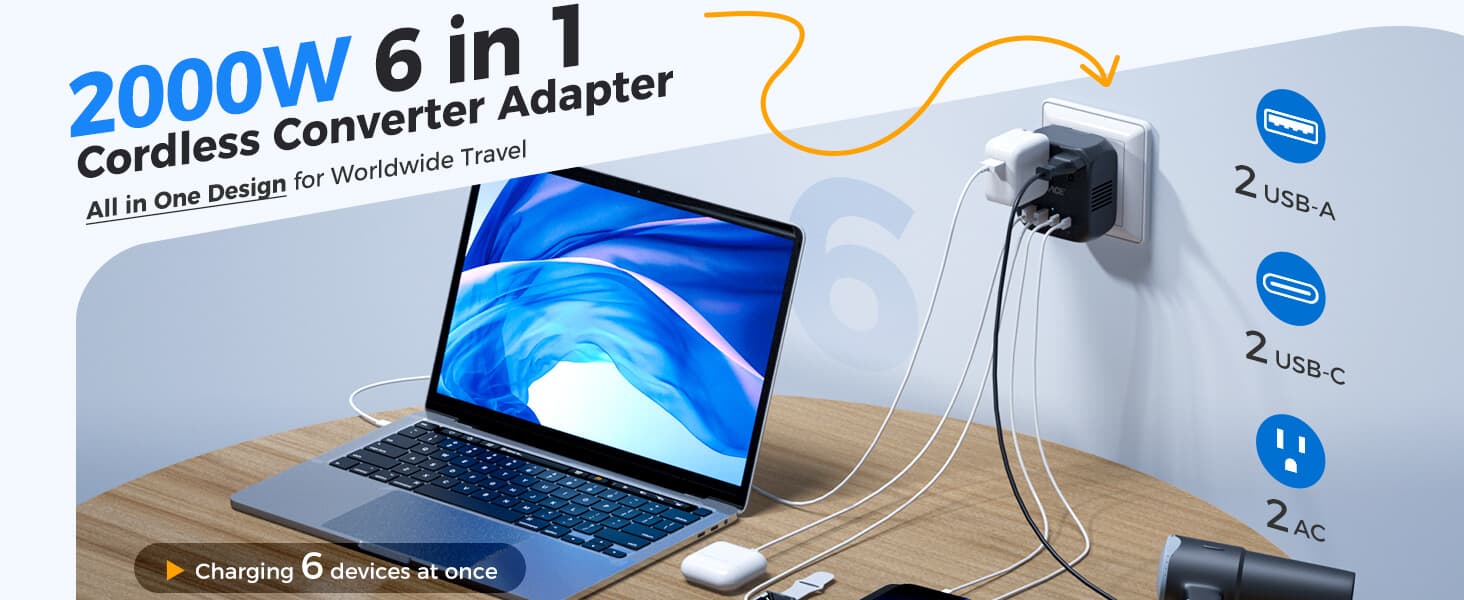
DOACE C15 2000W Voltage Converter
Best for: compatible high-wattage single-voltage heat tools (conventional hair dryers, straighteners) that fit the product's usage rules, when visiting 220V cities.
Not for: Dyson, Shark, Laifen, or other smart hair tools with brushless motors or electronic controls — these devices are typically incompatible with voltage converters regardless of wattage. Check the device label and manufacturer guidance before use.
When You Don't Need DOACE Products for Brazil
You may not need a voltage converter at all if every device you carry is labeled 100-240V, 50/60Hz. Most modern phone chargers, laptop power supplies, tablet chargers, camera battery chargers, and many CPAP power supplies fall into this category. In that case, a reliable Type N adapter is the only purchase you need — and many hotels in Rio and São Paulo will even have outlets that work with Type C Europlug pins as a backup.
Some travelers also find that a dedicated Type N adapter purchased from a cable or electronics store (brands like Cable Matters or Ceptics sell US-to-Brazil Type N adapters for under $10) provides a more secure three-pin grounded connection than a universal adapter's Type C pins. These dedicated adapters are small, inexpensive, and purpose-built for the exact pin geometry of NBR 14136 10A sockets (Cable Matters). If you travel to Brazil frequently, a dedicated Type N adapter is worth carrying alongside or instead of a universal adapter.
You may also be better off leaving high-wattage heat tools at home. Many Brazilian hotels provide wall-mounted hair dryers, and the risk of damaging your own 120V-only tool on 220V — or the hassle of carrying a converter — may not be worth the packing space. A growing number of travelers standardize on USB-C for everything: phone, tablet, laptop, toothbrush, and even compact travel razors with USB-C charging. This approach eliminates the voltage question entirely, as long as you have a USB-C charger that fits Type N.
If you are visiting only 127V cities (Rio, São Paulo, Iguaçu, Belo Horizonte) and your trip is short, most 120V-only devices will tolerate the 5.8% voltage difference without issue. The converter becomes necessary only when your itinerary includes 220V destinations. If your trip is Rio-only, a Type N adapter and your existing devices may be enough.
For multi-country South America trips, the adapter math gets more complicated. A typical backpacker route might include Brazil (Type N), Argentina (Type C and Type I), Peru (Type A and Type C), and Colombia (Type A and Type B). No single universal adapter covers all four countries perfectly. For Brazil you need Type N round pins. For Argentina you need the angled Type I pins. For Peru and Colombia, US-style flat pins work directly. The voltage situation is equally fragmented: Colombia runs on 120V like the US, Peru on 220V, Argentina on 220V, and Brazil splits between 127V and 220V. A practical multi-country packing strategy is to carry a universal adapter for flexibility plus a dedicated Type N adapter for Brazil's unique socket geometry. Check the voltage of each country on your itinerary before you decide whether to bring a converter or leave single-voltage devices at home entirely.
Bottom Line
Brazil is transitioning fully to Type N (NBR 14136), and old-style outlets are disappearing. New buildings have used Type N exclusively since 2007, and all equipment sold since 2010 must have Type N plugs. But the voltage split — 127V in some cities, 220V in others, and sometimes both in the same building — is a deeper infrastructure issue that will not be resolved anytime soon. Unlike the plug standard, which can be mandated by regulation, the voltage split is embedded in the physical wiring of millions of buildings and the distribution networks of dozens of regional power companies. No Brazilian government has proposed a nationwide voltage unification plan, and the cost of such a project would be enormous.
Brazil's adoption of IEC 60906-1 through NBR 14136 is a significant milestone in global plug history. The IEC designed the standard in 1986 as a universal replacement for the world's incompatible plug systems, and by 2025 only two countries had adopted it: Brazil and South Africa. Every other nation on earth stuck with its own regional plug type. The Brazilian experiment proves that a nationwide plug transition is possible — starting from a chaotic mix of at least ten plug types and converging on a single standard within roughly one generation — but the voltage question is harder. Brazil's regional power grids were built by different companies at different times with different voltages, and that physical infrastructure cannot be changed by regulation alone. For the foreseeable future, anyone traveling to Brazil must handle both the plug and the voltage as separate decisions.
For travelers combining Brazil with other South American countries, the adapter challenge extends further. Argentina uses Type C and Type I. Chile uses Type C and Type L. Peru uses Type A and Type C. Colombia uses Type A and Type B (same as the US, at 120V). A single universal adapter rarely covers all of these destinations reliably, and the voltage varies from 110V to 220V across the continent. Plan your adapter kit based on every country on your itinerary, not just the first stop (REI Expert Advice).
Three actions before every Brazil trip:
- Confirm your destination city's voltage. Rio and São Paulo are 127V. Brasília, Recife, Fortaleza, Natal, and Florianópolis are 220V.
- Read the INPUT label on every device you plan to pack. Wide-voltage (100-240V) devices need only a Type N adapter. Single-voltage (120V) devices need a converter in 220V cities.
- Pack a Type N adapter — not Type C, not Type J, not a generic "South America" adapter. Brazil's 4.0mm pin standard is unique, and the wrong adapter may not fit, may be loose, or may lack grounding.
Common Mistakes Travelers Make in Brazil
After reviewing traveler forums, product reviews, and electrical safety reports, certain mistakes appear consistently among US visitors to Brazil. Understanding these in advance can save your devices and your trip:
- Assuming Brazil is all 110V: Brazil's 220V cities include the capital Brasília and most of the northeast coast. Over a third of Brazilian states use 220V. This is not a rare edge case — it affects millions of hotel rooms and Airbnbs in popular travel destinations.
- Using the same device in Rio and Brasília without checking voltage: The outlet shape (Type N) is identical in both cities. The voltage is not. A 120V device that worked perfectly in Rio will be destroyed within seconds in Brasília. There is no warning label on the outlet.
- Bringing a Type C (Europlug) adapter and assuming it is safe: Type C fits the 10A socket physically but provides no grounding. For two-pin phone chargers drawing under 2.5A, this is acceptable. For grounded laptop power supplies, medical devices, or high-draw equipment, it is a safety risk that could cause pin overheating or inadequate ground fault protection.
- Assuming Brazil and South Africa use the same Type N adapter: The pin diameters differ (4.0mm vs ~4.5mm). An adapter that fits snugly in one country may not fit at all in the other, or may be dangerously loose. Read the country list on the packaging, not just the letter designation.
- Trusting outlet color to indicate voltage: Red faceplates are sometimes used for 220V outlets in Brazil, but this practice is inconsistent and not legally required. A white outlet can be 220V, and a red outlet can be 127V depending on the building. Color is not a reliable indicator.
- Ignoring the device power brick label: Some CPAP machines say "120V" on the device body, but their external power brick accepts 100-240V. Always check the power supply unit (the brick or wall wart), not the label on the device housing. This mistake has caused travelers to buy converters they did not need or, worse, skip an adapter they did need.
- Only packing one adapter: If your only adapter breaks, gets lost during a room change, or turns out not to fit your specific outlet, finding a Type N adapter in a smaller Brazilian city can be difficult. Electronics stores in tourist areas of Rio and São Paulo stock them, but in smaller towns, your options shrink dramatically. Carry a backup adapter or a combination of a universal adapter plus a dedicated Type N adapter.
- Assuming newer buildings are always 220V: The voltage is determined by the regional power grid, not the building age. A brand-new hotel in Rio (127V zone) will have 127V outlets. A 1970s apartment in Brasília (220V zone) will have 220V outlets. Building age tells you about the plug type, not the voltage.
- Not checking whether the converter handles continuous use: Some converters are designed for short-term use with heat tools (30-60 minutes) and may overheat if used continuously overnight for a CPAP machine. The DOACE LC-X35 is designed for continuous operation, while the C15 is optimized for intermittent high-wattage use. Match the converter's duty cycle to how you plan to use it.
FAQ
Do I need a voltage converter for Brazil?
It depends on your destination city and your device. If every device is labeled 100-240V (wide voltage), you only need a Type N plug adapter — no converter at all. Most modern electronics fall into this category: phone chargers, laptop power supplies, tablet chargers, and camera battery chargers almost universally accept 100-240V. If you have 120V-only devices and are visiting a 220V city (Brasília, Recife, Fortaleza, Natal, Florianópolis), you need a voltage converter for those specific devices. In 127V cities (Rio, São Paulo), most 120V devices work without a converter because the voltage difference is small (~5.8%), although devices may run slightly warmer than they do at home. The safest pre-trip step is to lay out every device you plan to pack, read the INPUT label on each one, and sort them into "adapter only" and "needs converter" piles before you pack.
What plug type does Brazil use?
Brazil uses Type N (NBR 14136), which comes in two versions: 10A with 4.0mm pins and 20A with 4.8mm pins. Travelers almost always encounter the 10A version for general-purpose wall outlets in hotel rooms, Airbnb rentals, and public spaces. The 20A version is reserved for high-power appliances like air conditioners and electric water heaters. Both versions feature three round pins in a hexagonal recessed faceplate. The 10A and 20A sockets are physically different sizes, so a 10A adapter plug will fit loosely in a 20A socket, and a 20A plug will not fit a 10A socket at all. Most travel adapters designed for Brazil target the 10A standard since that is what travelers encounter at standard wall outlets.
Can I use a Type C (Europlug) adapter in Brazil?
Type C can physically fit into Brazil's Type N 10A socket because both use 4.0mm pin holes. However, Type C has only two pins and provides no grounding. For phone chargers and small USB-powered devices, this is usually acceptable and many travelers use this as a convenient short-term solution. For laptops, medical devices, or anything that requires ground protection, a proper three-pin Type N adapter is the correct choice. Additionally, Type C plugs are rated for only 2.5A of current. If you are charging a high-power laptop that draws more than 2.5A through its power brick, using a Type C plug in a Type N socket creates a risk of pin overheating. The plug may feel warm to the touch, and in worst cases, the thin 4.0mm pins could deform or the plastic casing could melt at the contact point. A dedicated Type N adapter with full 10A rating and three-pin grounding is the safer option for anything beyond basic phone charging.
Is Brazil 110V or 220V?
Both. Brazil has a split voltage system that dates back to the early 20th century when different regions independently built their electrical grids. Most of the population lives in 127V areas (Rio de Janeiro, São Paulo, Belo Horizonte, Manaus), but many states — including the capital Brasília and most northeast coast cities — use 220V. The frequency is 60Hz everywhere in Brazil, which matches the US standard of 60Hz. This frequency match means motor-driven devices like electric shavers, fans, and clocks will run at the correct speed regardless of the voltage. The voltage, however, must be confirmed for your specific destination. The safest approach is to check your destination city against the table in the voltage section above. Do not assume "South America = 110V" — that assumption has destroyed countless US devices in Brazilian 220V cities.
Can I use my US hair dryer in Brazil?
In 127V cities (Rio, São Paulo, Iguaçu), a US 120V hair dryer usually works because the voltage difference is small — the dryer will run slightly hotter and its motor may spin a tiny bit faster, but the difference is unlikely to cause damage during normal use. In 220V cities (Brasília, Recife, Fortaleza), a 120V-only hair dryer connected directly to the outlet will overheat and burn out its heating element almost instantly. If you must bring your own hair dryer to a 220V city, you need a properly rated high-wattage converter like the DOACE C15, which handles up to 2000W. However, smart hair tools with brushless motors or electronic controls — such as Dyson, Shark, and Laifen — should never be used with a voltage converter because the non-standard waveform can damage their control electronics. The simplest solution is to use the hair dryer provided by your hotel. Most Brazilian hotels, especially international chains and mid-range and above properties, provide wall-mounted hair dryers as standard. If you stay primarily at Airbnbs, check the listing for a hair dryer or ask the host before you pack one.
Do I need a different adapter for Rio vs Brasília?
No — the plug type is the same (Type N) in both cities. The physical adapter you need is identical. But the voltage is different: Rio operates at 127V and Brasília at 220V. A wide-voltage device labeled 100-240V will work without any issue in both cities with the same adapter. A 120V-only device will work in Rio but needs a voltage converter in Brasília. The most dangerous scenario is the multi-city itinerary: a traveler uses a 120V hair dryer in Rio without issue, then flies to Brasília and plugs the same device into the same-looking outlet. The outcome is instant destruction because the outlet shape provides no hint that the voltage has changed. If your trip includes both 127V and 220V cities, either leave 120V-only devices at home or bring a voltage converter and use it in all 220V stops.
Is Brazil's Type N the same as South Africa's Type N?
Not exactly. Both countries adopted the IEC 60906-1 framework, but Brazil's NBR 14136 10A pins are 4.0mm while South Africa's SANS 164-2 pins are approximately 4.5mm (Plug & Socket Museum: IEC 60906-1). A South African Type N plug may not fit a Brazilian 10A socket because the pins are too thick for the 4.0mm holes. A Brazilian 10A plug inserted into a South African socket will be loose because the 4.0mm pins are thinner than the socket expects, creating a poor electrical contact. An adapter labeled simply "Type N" on its packaging may work well in one country but poorly or not at all in the other. Always check the specific country list printed on the adapter's packaging or product page. If the packaging only says "Type N" without listing specific countries, do not assume it was tested for both Brazil and South Africa. For travelers visiting both countries, carrying separate dedicated adapters for each is the safest approach (read our detailed South Africa plug guide for the full breakdown of Type M vs Type N in South Africa).
Can I use my CPAP machine in Brazil?
Check the power supply label first. Many modern CPAP machines (ResMed AirSense 10/11, Philips DreamStation) have power bricks labeled "INPUT 100-240V, 50/60Hz," which means they work everywhere in Brazil with just a Type N adapter — no voltage conversion needed. This is the most common scenario, and you may discover you have been traveling with a wide-voltage CPAP power supply all along without realizing it. If your CPAP power supply is 120V-only, it will work in 127V cities (Rio, São Paulo) without a converter but needs a pure sine wave converter in 220V cities (Brasília, Recife). Do not use a modified-sine-wave converter for CPAP machines. Modified sine wave converters output a stepped waveform that can cause CPAP motors to hum, run hot, or malfunction. The DOACE LC-X35 provides clean pure sine wave output specifically for sensitive devices like CPAP machines, and its 350W rating covers most CPAP models comfortably. Always confirm with your CPAP manufacturer or DME provider before using any external converter, and if you rely on a CPAP for medical necessity, carry a battery backup regardless of voltage plans.
Are old US-style outlets still common in Brazil?
They are becoming rare but have not disappeared entirely. Since 2007, all new buildings must install Type N outlets under NBR 14136. Any hotel, Airbnb, or apartment built or substantially renovated after 2007 should have Type N exclusively. However, older buildings — especially residential apartments in Rio de Janeiro's Copacabana and Ipanema neighborhoods or São Paulo's historic center — may still have American-style flat-pin sockets dating from the 1970s to 1990s. These older outlets are typically found in buildings that have not undergone major electrical renovations. The critical warning: these old outlets may be connected to either 127V or 220V circuits, and there is no visual way to tell which voltage is present. An American-looking outlet in Brasília (220V) could destroy a 120V device just as fast as a Type N outlet in the same city. Never assume an American-looking outlet means American-compatible voltage. The safest practice for any older building is to ask at the front desk, look for voltage labels or stickers near the outlet, or test the voltage with a small pocket tester before plugging in any valuable equipment.
What is the safest packing rule for Brazil?
Bring a dedicated Type N adapter that specifies Brazil compatibility (not a generic "Type N" that may mean South Africa). Check every device label before packing — sort your devices into "100-240V" (adapter only) and "120V-only" (may need converter). Confirm your destination city's voltage using the table in this guide. If your itinerary includes any 220V cities and you need to bring 120V-only devices, pack a properly rated voltage converter. Wide-voltage devices need plug adaptation only. 120V-only devices need a real voltage decision. If you are unsure about a device's compatibility or voltage, leave it at home. A $15 adapter is cheaper than replacing a destroyed $200 device. A $10 voltage tester can confirm every outlet's voltage before you plug in. When in doubt, pack light, pack wide-voltage, and confirm before you plug in.


