

Short answer: plug types A to O describe the shape of the wall outlet and plug. They do not tell you by themselves whether your device can handle the local voltage, whether grounding stays intact, or whether you need a voltage converter. Use the A-to-O letters as a visual shortcut, then check your destination voltage and the INPUT label on every device you plan to pack.
For most U.S. travelers carrying phones, tablets, camera chargers, and USB-C laptops, the winning formula is simple: identify the destination plug type, confirm the charger says 100-240V 50/60Hz, and use the right travel adapter or GaN adapter. For a 120V-only appliance, the plug letter is only the beginning. A Type G adapter for the U.K., a Type I adapter for Australia, or a Type C adapter for Europe will not turn a 120V-only appliance into a 230V-ready device.
Quick Answer: Plug Letters Tell You Shape, Not Voltage
The international plug-letter system is useful because it turns a messy world of outlet shapes into a quick A-to-O language. Type A and B are familiar in North America and Japan. Type C, E, and F cover much of Europe, but not all of Europe in the same way. Type G appears in the U.K., Ireland, Hong Kong, Singapore, Malaysia, and other destinations. Type I is common in Australia, New Zealand, China, and Argentina. Type J, K, L, M, N, and O are where many travelers get surprised.
But the letters are only the first filter. A plug adapter changes shape. It does not change voltage. A country can use a familiar-looking plug and still have a different voltage or frequency. A destination can use a plug that accepts your device physically while your device still needs a converter. A three-pin plug shape may also raise grounding questions that a basic two-pin adapter cannot solve.
- Step one: identify the destination plug type or types.
- Step two: read the device INPUT label, especially for voltage and frequency.
- Step three: decide whether grounding matters for that device.
- Step four: choose a plug adapter, GaN travel adapter, local cable, or voltage converter based on the device, not just the country.
The IEC World Plugs reference is a helpful starting point because it keeps plug type, voltage, and frequency together. That is the right way to think about travel power. Shape, voltage, and device type all matter.
World Plug Types A to O Cheat Sheet
Use this table as a travel shortcut, not as the final safety check. The countries listed are common examples, not an exhaustive country database. Hotels, older buildings, cruise cabins, airports, and mixed-standard countries can still surprise you.

| Type | What it looks like | Common examples | Traveler warning | Usual DOACE path |
|---|---|---|---|---|
| A | Two flat parallel blades | U.S., Canada, Japan, Taiwan, parts of Central America | Familiar shape does not guarantee U.S.-style voltage. | Wide-voltage electronics: GaN adapter. Narrow-input devices: check voltage first. |
| B | Type A plus round grounding pin | U.S., Canada, Mexico, Japan, Taiwan | Grounding depends on the outlet and adapter path. | Use a grounded-compatible path only when the device needs it. |
| C | Two round pins | Many European, Asian, African, and South American destinations | Common does not mean universal or grounded. | Good for many low-power wide-voltage chargers. |
| D | Three round pins in a triangle | India, Nepal, parts of Africa | Looks related to Type M but is smaller. | Destination-specific adapter; converter only if the device needs it. |
| E | Round socket with protruding earth pin | France, Belgium, Poland, Czechia and others | Similar to F in region, different grounding style. | Choose E/F-compatible adapters for broad Europe coverage. |
| F | Schuko with side earth contacts | Germany, Spain, Netherlands, Austria and others | A two-pin plug may fit but may not ground a device. | Use E/F support for grounded European devices. |
| G | Three rectangular pins | U.K., Ireland, Hong Kong, Singapore, Malaysia, Gulf destinations | Large plug and fuse do not mean voltage conversion. | Type G adapter for wide-voltage electronics. |
| H | Israeli three-pin system | Israel | Some Type C plugs may fit, but that is not the whole check. | Use an Israel-ready adapter and check voltage. |
| I | Angled flat pins | Australia, New Zealand, China, Argentina | Same broad shape can appear in different voltage contexts. | Type I adapter for wide-voltage gear. |
| J | Swiss three round pins with offset earth | Switzerland, Liechtenstein | Can look close to Type C, but the socket shape and earth pin matter. | Switzerland-compatible adapter. |
| K | Danish grounding system | Denmark, Greenland | European two-pin adapters may not preserve grounding. | Denmark-aware adapter for grounded devices. |
| L | Three inline round pins | Italy, San Marino, Vatican City, parts of Chile and Uruguay | 10A and 16A versions differ. | Italy-ready adapter; check 10A/16A support. |
| M | Large three round pins | South Africa older outlets, India high-current uses, parts of Africa | Bigger than Type D and not the same as Type N. | South Africa/India-specific adapter planning. |
| N | Three round pins in a compact layout | Brazil, South Africa newer standard | Brazil can have mixed voltage; South Africa can have M/N transition. | Adapter plus voltage-label check. |
| O | Thai three-pin standard | Thailand | Hybrid sockets are common, but voltage and grounding still matter. | Thailand-aware adapter for wide-voltage devices. |
Plug Types That Look Similar but Are Not the Same
Type A vs Type B: If you live in the U.S., these are the familiar two- and three-prong shapes. That familiarity can be useful in Canada, Mexico, Japan, Taiwan, and parts of the Americas, but it can also make people skip the label check. Japan is a good example: many plugs look familiar, but nominal voltage is commonly lower than in the U.S. Some devices work fine; others may perform differently. A familiar plug shape is not a promise that every appliance behaves exactly as it does at home.
Type C vs Type E and F: Many people say “European plug” and mean Type C. That is too simple. Type C is the two-round-pin style often used for low-power, non-grounded devices. Type E and Type F are common grounded systems in mainland Europe, and they use different earth-contact designs. If your device has a two-prong phone charger marked 100-240V, a Type C/E/F travel adapter path is often easy. If your device needs grounding, the adapter choice becomes more specific. DOACE has a deeper guide to Type E vs Type F outlets in Europe.
Type D vs Type M vs Type N: These are where round-pin assumptions get expensive. Type D and Type M both use three round pins in a triangular pattern, but Type M is larger. Type N is a different compact three-round-pin system used in Brazil and newer South African installations. South Africa is a classic trap because older Type M and newer Type N realities can overlap. Brazil adds another layer because plug type and local voltage can both vary. See the DOACE guides to South Africa Type M vs Type N and Brazil Type N and mixed voltage for the deeper versions.
Type J, K, and L: Switzerland, Denmark, and Italy are the destinations that expose weak “Europe adapter” claims. Swiss Type J has a different three-pin layout and recessed sockets. Danish Type K has a grounding system that is not the same as Schuko. Italian Type L has 10A and 16A versions with different pin spacing. If your itinerary includes Switzerland, Denmark, or Italy, check that your adapter names those destinations or standards explicitly. A generic two-round-pin adapter may not be the best answer. DOACE has separate guides for Switzerland Type J and Italy Type L 10A vs 16A.
Type G, I, H, and O: These look more distinctive, so they are easier to identify visually. That does not remove the voltage check. Type G destinations are often 230V-class systems. Type I destinations include Australia, New Zealand, China, and Argentina, but the rest of the electrical context can vary. Type H is Israel. Type O is Thailand, where hybrid sockets may accept several shapes. When a socket accepts your plug without an adapter, that can be convenient, but it can also hide the fact that your device still needs to accept the local voltage.
The Four-Step Check Before You Buy an Adapter
A travel plug chart is only useful if it leads to a decision. Use this four-step check every time you pack for a new destination.
1. Match the destination plug shape
Start with the main country or countries in your itinerary. A single-country trip to the U.K. points to Type G. A multi-country Europe trip may need C/E/F plus attention to Switzerland, Italy, and Denmark. A South Africa trip may need both M and N planning. A Brazil trip may need Type N plus local voltage checking. If your trip crosses several standards, a well-designed universal adapter is useful, but only if it covers your actual destinations.
2. Read the INPUT label
The label decides adapter-only vs converter review. Look for INPUT 100-240V 50/60Hz on your charger or device. Phones, tablets, camera chargers, and laptop power bricks are often wide-voltage, but you should still check. If the label says 120V only, 110V 60Hz, or only lists U.S. voltage, a plug adapter is not enough in 220-240V countries.

3. Decide whether grounding matters
If the device is a two-prong phone charger or a double-insulated low-power charger, grounding may not be part of the path. If the device uses a three-prong plug, has a metal body, or the manual expects a grounded connection, do not assume a small two-pin adapter preserves earth continuity. Plug type letters can show where a ground pin might be, but they do not prove the building outlet, adapter, and device path are all grounded. For a deeper explanation, use DOACE's guide to grounded vs ungrounded travel adapters.
4. Separate adapter needs from converter needs
A travel adapter changes shape. A voltage converter changes voltage for a compatible device. Do not mix those jobs. A Type G adapter for London can help your wide-voltage laptop charger connect to the wall. It does not make a 120V-only curling iron safe on 230V power. DOACE's adapter vs converter vs transformer guide explains that difference in more detail.
Voltage and Frequency Still Matter
The A-to-O chart tells you shape. It does not tell you whether the wall power is 100V, 110V, 120V, 127V, 220V, 230V, or 240V. It also does not tell you whether frequency is 50Hz or 60Hz. Most modern switching power supplies for phones and laptops are built to handle a wide range, but appliances, motors, heating tools, older chargers, and specialty devices can be more limited.
This is why “I have the right adapter” is not the same as “my device is safe.” A U.S. 120V-only hair dryer plugged into a European Type C/F adapter still sees European voltage. A U.S. power strip plugged into a universal adapter still passes local voltage through to whatever is connected. A familiar Type A socket in another country may still be paired with a different voltage or electrical environment. For the voltage basics, see DOACE's 110V, 220V, 50Hz, and 60Hz explainer.
Single-Country vs Multi-Country Trips
For a single-country trip, a destination-specific adapter can be the cleanest answer. If you are only going to the U.K., buy a Type G adapter or a universal adapter with a solid Type G design. If you are only going to Australia or New Zealand, focus on Type I. If you are only going to Switzerland, check Type J support instead of assuming “Europe” is enough. Single-country packing is about precision.
For multi-country travel, flexibility matters more. A family visiting London, Paris, Rome, and Zurich may need Type G, C/E/F, L, and J support. A business traveler moving through Singapore, Thailand, and Australia may need G, O or hybrid Thai support, and I. A universal adapter can be a strong fit here, but the product listing must match the itinerary. Do not buy only on the word “worldwide.” Look for the actual plug systems and destination exceptions.
There is also a weight question. If every device is wide-voltage and USB-C-friendly, a compact multi-port GaN adapter can replace several wall bricks and reduce outlet clutter. If you bring 120V-only appliances, your packing list becomes heavier and riskier because you may need a converter or, more often, a local version of the appliance. Many travelers are better off leaving high-watt U.S. heat tools at home.
How to Buy the Right Adapter by Region
For North America, Japan, Taiwan, and much of the Caribbean and Central America, U.S. travelers often see familiar A/B-style sockets. That can reduce plug-shape friction, but it should not erase the voltage check. Japan is the best reminder: many U.S. plugs fit, but the nominal voltage is different. Some simple chargers handle that beautifully; some appliances may run weakly or differently. The right move is to keep the adapter kit light, but still read every device label.
For mainland Europe, do not stop at “Type C.” If you only charge a phone and laptop, a compact C/E/F-compatible adapter for wide-voltage electronics may be enough. If your trip includes France, Germany, Spain, the Netherlands, Austria, Belgium, Poland, or Czechia, E/F support matters more than a bare two-pin shape. If your itinerary adds Switzerland, Denmark, or Italy, confirm J, K, or L support separately. This is where a higher-quality universal adapter or a small set of destination-specific adapters can beat one cheap two-pin plug.
For the U.K., Ireland, Hong Kong, Singapore, Malaysia, and many Gulf destinations, Type G is the shape to recognize. The plug looks serious because it is large and often includes a fuse, but the travel decision is still the same. Your laptop charger marked 100-240V can use the correct Type G path. Your 120V-only appliance cannot rely on the Type G adapter to change voltage. If you are visiting a U.K.-style destination plus mainland Europe, you need both Type G and C/E/F coverage.
For Australia and New Zealand, Type I is the core shape. China and Argentina also use Type I-style plugs, but a traveler should still verify country voltage and the exact socket situation. Universal adapters often include Type I blades, which is helpful for multi-region trips. For USB-C electronics, the practical question is usually output wattage: will the adapter charge your laptop at a useful speed, or only your phone?
For India, South Africa, and nearby mixed-standard destinations, be more careful. Type D, M, and N are not casual variations of the same plug. India can involve C, D, and M situations. South Africa can involve older Type M and newer Type N. If your trip is important, do not wait until the hotel desk to discover the adapter does not fit. Check your exact destination and accommodation, and bring a purpose-built adapter when the country has known transition issues.
For Brazil, Type N and voltage both matter. Brazil is not just a plug-shape question because local voltage can vary by city and building. A traveler with a wide-voltage laptop charger is usually fine once the plug shape is solved. A traveler with a 120V-only appliance must treat the destination voltage as the main decision. For Brazil-specific details, use the dedicated Brazil Type N guide instead of relying only on this A-to-O cheat sheet.
A-O Types by Traveler Risk Level
Some plug types are easy to recognize and easy to plan around. Others are easy to misread. A and B are familiar to U.S. travelers, but the risk is overconfidence. C is globally common, but the risk is assuming “two round pins” means all Europe and all devices. E and F are not difficult if your adapter clearly supports both, but they matter for grounding. G and I are visually clear, but they often appear in 230V destinations. J, K, L, M, N, and O are the types that deserve extra itinerary checking.
Low-risk does not mean no-risk. A phone charger marked 100-240V in a Type C, G, or I country is a simple adapter problem. A U.S. hair dryer marked 120V only in that same country is not simple. The risk belongs to the device and voltage, not only to the plug letter. This is why the same destination can require no converter for one traveler and a careful converter decision for another.
Medium-risk types are the ones with common regional simplifications. “Europe” is the classic example. Many adapters sold to U.S. travelers cover C/E/F, but some do not handle recessed outlets well, some do not support grounding, and some do not cover Switzerland, Denmark, or Italy properly. “South Africa” is another simplification: older Type M and newer Type N realities can overlap. “Thailand” can look easy because hybrid sockets often accept several plug shapes, but hybrid acceptance does not mean every ground path or voltage need is solved.
High-risk devices make any plug type more serious. Heating tools, steamers, kettles, older toothbrush bases, audio equipment, medical equipment, and anything used overnight deserve more than a shape check. If the device is expensive, health-related, or hard to replace during the trip, test the power plan before departure. A cheap adapter bought at the airport should not be the first time you learn whether the setup works.
Common Buying Mistakes
Mistake 1: buying by continent. “Europe adapter” is not specific enough for every itinerary. Mainland C/E/F coverage is different from U.K. Type G, Switzerland Type J, Denmark Type K, and Italy Type L. If the trip crosses several countries, list the plug types before buying.
Mistake 2: buying by the word worldwide. A product may cover many common plug shapes and still exclude Type D, M, O, J, K, or L details. Worldwide is a marketing shorthand. The real question is whether it covers your itinerary and your devices.
Mistake 3: treating USB output as AC voltage conversion. A GaN adapter can provide excellent USB-C charging while still passing local AC voltage through any AC outlet it includes. USB-C output and AC voltage conversion are different jobs. If the appliance plug goes into an AC socket, the device label still matters.
Mistake 4: assuming a three-pin adapter keeps earth continuity. A three-hole faceplate is not proof of a complete ground path. Grounding depends on the destination wall outlet, adapter design, and device plug. For a device that truly needs grounding, check the product specifications and the local outlet type carefully.
Mistake 5: packing U.S. household appliances because the adapter fits. Plug fit is not appliance approval. High-watt U.S. heat tools are often the worst items to force into an overseas plan. In many cases, a dual-voltage travel tool or local appliance is easier, safer, and lighter.
A Practical Grouping of Plug Types
The chart below groups plug types by the travel decisions they tend to create. It is not a country database. It is a quick way to see why some letters are simple for U.S. travelers and others deserve extra attention.
Which DOACE Path Fits Your Trip?
Choose the product path after you know three things: destination plug type, device INPUT label, and charging wattage. Do not choose by country alone. Do not choose by maximum wattage alone. A traveler with only wide-voltage electronics needs a different solution from someone packing a 120V-only appliance.

DOACE 100W GaN International Power Adapter
Best fit: phones, tablets, cameras, earbuds, and many USB-C laptops with 100-240V input on multi-country trips.
Not for: 120V-only appliances, AC voltage conversion, guaranteed grounding, or high-watt heat tools.
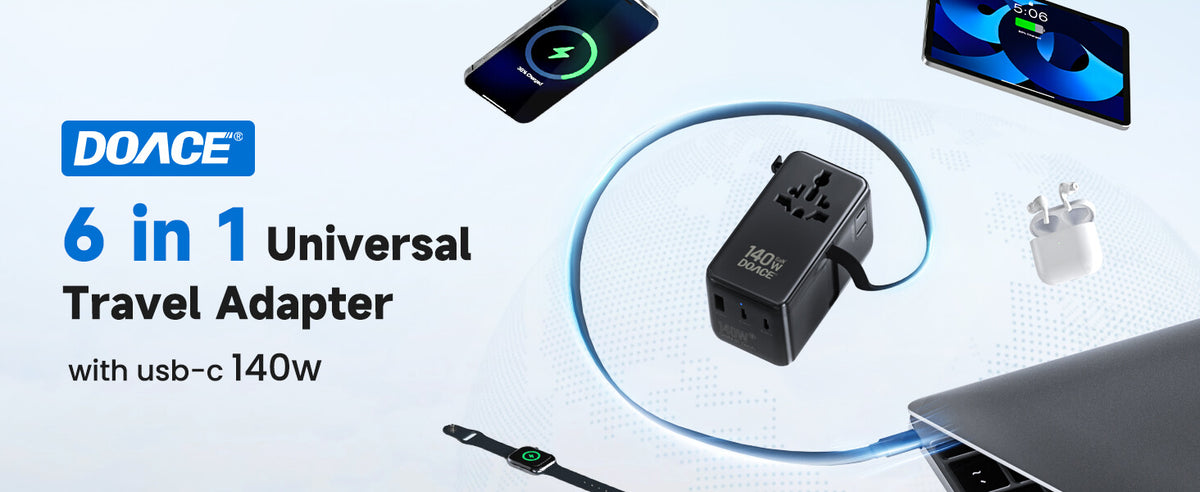
DOACE 140W GaN Travel Adapter
Best fit: travelers carrying a higher-output USB-C laptop plus phone, tablet, or camera gear, when the devices are wide-voltage.
Not for: changing 220-240V to 110-120V, powering U.S. power strips abroad, or replacing a converter for a single-voltage appliance.
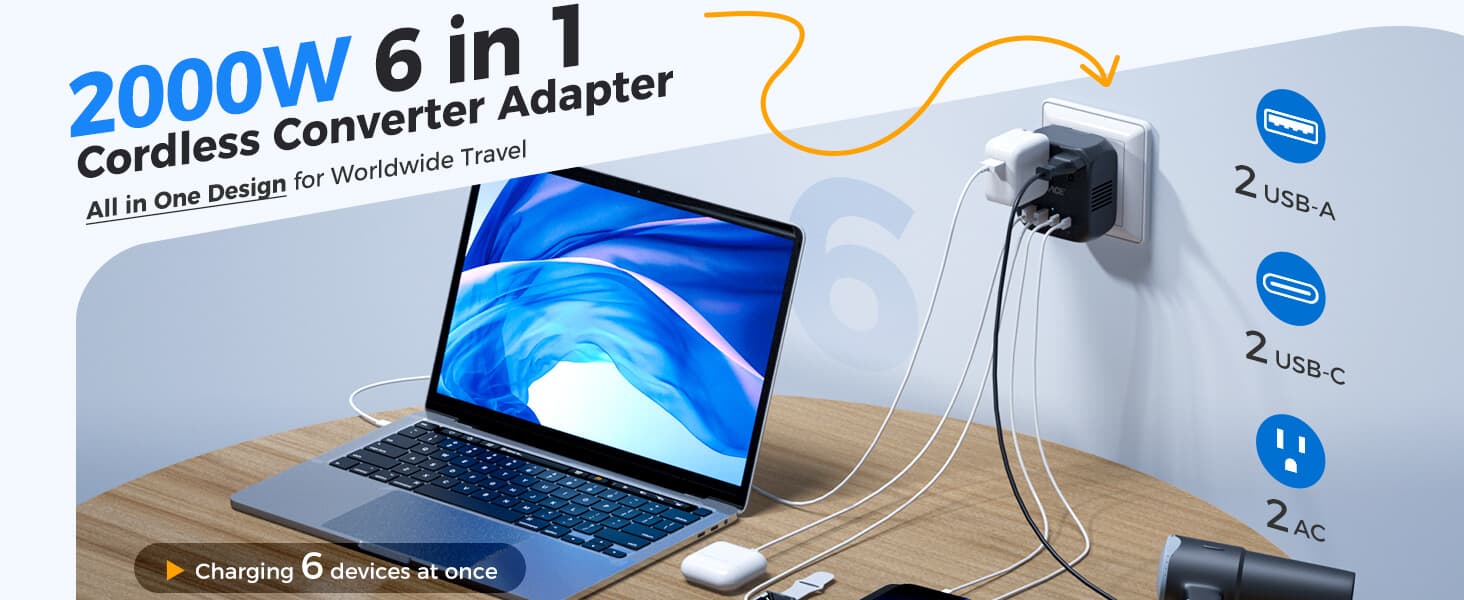
DOACE C15 High-Watt Converter
Best fit: a compatible traditional high-watt 120V device used directly according to the product instructions.
Not for: unknown labels, smart hair tools with manufacturer warnings, Dyson/Shark/Laifen-style tools, mixed loads, or U.S. power strips.
How to Pack for a Real Trip
The easiest packing method is to make a two-column list. In the first column, list destinations and plug types. In the second column, list devices and INPUT labels. Only after those two columns are filled should you choose products. This prevents the common situation where someone buys a universal adapter and then realizes it does not solve the appliance they most wanted to bring.
For a phone-only trip, the kit may be tiny: one plug adapter, one USB-C cable, and the original wide-voltage charger. For a laptop work trip, the kit may be one GaN travel adapter with enough output for the laptop, a second USB-C cable, and a small backup plug adapter. For a family trip, the kit may be one higher-output adapter, one smaller backup adapter, and enough cables to avoid plugging six wall bricks into one outlet.
For a beauty-device trip, slow down. Check every tool. If the tool has a dual-voltage switch, set it correctly before use and confirm the destination voltage. If the tool is 120V only, decide whether it is truly compatible with a converter and whether the brand allows it. If it is a smart high-end tool with manufacturer warnings, do not treat a converter as a workaround. In many cases, buying a destination-voltage tool or using the hotel appliance is the better decision.
For a CPAP, medical device, or overnight device, follow the manufacturer guidance first. Many modern power supplies are wide-voltage, but do not assume. Read the power brick. Check whether humidifiers, heated tubes, or accessories change the power requirement. Bring the correct plug adapter and test the setup before departure. Do not wait until bedtime in a hotel room to test a critical device.
For long stays, do not try to make a travel adapter behave like a household electrical system. If you need many local outlets for months, buy locally rated extension equipment after arrival. Use travel adapters for travel use and wide-voltage charging. Use converters only for specific compatible devices. Long-term living turns convenience shortcuts into daily wear, heat, and cable-management problems.
How This Page Connects to Country Guides
This A-to-O cheat sheet is the starting map. It helps you understand the letters and avoid obvious mistakes. Once you know your destination, use country-specific pages for details. A Switzerland trip needs Type J detail. An Italy trip needs Type L 10A/16A detail. A South Africa trip needs M vs N detail. A Brazil trip needs Type N plus mixed-voltage awareness. A Europe-wide trip needs E/F plus edge-case planning.
That division keeps the page useful. A single article cannot responsibly list every country, hotel variation, and old-building exception without becoming unreadable. The best workflow is: use this page to identify the plug family, use a country guide to confirm the local reality, then use the device label to choose adapter-only or converter review. If a device is unusual, use a device-specific guide or manufacturer manual.
For DOACE product selection, this also means the same adapter may not be right for every trip. A 100W GaN adapter is a strong fit for many electronics-heavy trips. A 140W GaN adapter is better when a high-output USB-C laptop is central to the trip. A converter belongs in the conversation only when a specific device needs voltage conversion and is compatible. A plug chart alone should never be the reason to buy a converter.
What the A-O Letters Do Not Tell You
They do not tell you the quality of the hotel outlet. They do not tell you whether an old building has reliable grounding. They do not tell you whether a recessed socket will accept a bulky adapter. They do not tell you whether a universal adapter's AC outlet is rated for your load. They do not tell you whether a country has multiple voltages in different cities, buildings, or appliance circuits.
They also do not tell you whether a device is safe for long runtime. Charging a phone for an hour and running a heating appliance for twenty minutes are different electrical tasks. Running a medical device overnight is different again. A letter chart is a map of shapes. Your packing decision still needs device type, wattage, runtime, and manufacturer instructions.
This is why the safest travel power advice sounds repetitive: read the label, check the country, use the right adapter, avoid unnecessary converters, and do not force incompatible appliances. Repetition is useful because the mistake often happens in the gap between “it fits” and “it is electrically suitable.”
The Five-Minute Check Before You Leave
Before the trip, put every device on a table and sort them into three groups. Group one is easy electronics: phone, tablet, earbuds, watch, camera charger, and laptop charger marked 100-240V. Group two is uncertain devices: toothbrush base, shaver, specialty charger, audio equipment, gaming console power supply, or anything with a label you cannot read quickly. Group three is high-caution equipment: hair dryer, curling iron, steamer, kettle, medical device, or anything used for long runtime.
For group one, choose the plug shape and USB-C output. This is where a DOACE GaN adapter makes the trip cleaner because it reduces the number of separate wall bricks. For group two, read the manual or take a close-up photo of the label before packing. Do not put uncertain devices into the adapter-only group just because they are small. For group three, decide whether the device should travel at all. If the label is narrow-input, the wattage is high, or the manufacturer warns against converters, local rental, hotel equipment, or a destination-voltage version is often the better answer.
Then match the itinerary. Write down the plug letters beside each country: G for the U.K., C/E/F for much of mainland Europe, J for Switzerland, L for Italy, I for Australia, N for Brazil, and so on. If one country in the trip is an edge case, do not let the common countries hide it. A Europe trip can be ruined by the one Swiss or Italian stop where the adapter does not fit. A South Africa trip can be complicated by old and new outlet standards. A Thailand trip can look easy because hybrid sockets are common, while voltage still remains 230V-class.
Finally, test the physical setup. Plug the adapter into a wall outlet at home if possible and see whether heavy chargers pull downward, whether the USB-C cable reaches the desk, and whether the adapter blocks nearby sockets. Travel failures are not only about electrical theory. They are also about loose outlets, bulky plugs, overloaded nightstands, and cables stretched across hotel rooms. A good adapter is the one that fits your destination, your device labels, your wattage needs, and the way you actually charge at night.
If you are buying for someone else, ask for the itinerary and device list before choosing. A student going to London for one semester, a photographer going to Japan, a family visiting Italy and Switzerland, and a remote worker moving through Singapore and Australia do not need the same setup. The plug letters help narrow the choices, but the device list decides the final path.
When You May Not Need to Buy More
A good travel power guide should also tell you when not to buy. If you are taking one phone charger to a hotel and the charger says 100-240V, a simple destination adapter may be enough. If the hotel front desk provides a safe adapter for short-term use, you may not need to carry a large kit. If you are staying for months, a locally rated power strip or local appliance may be more practical than packing U.S. household gear.
The same is true for converters. Do not buy a converter for every international trip. Buy one only when a specific device requires voltage conversion, the device is compatible, the wattage fits, and the manufacturer instructions allow it. For many modern electronics, the power brick already handles worldwide input. In that case, spend your attention on plug shape, USB-C wattage, and cable quality.
Frequently Asked Questions
What are plug types A to O?
They are letter labels for common plug and socket shapes used around the world. The letters help you choose a plug adapter, but they do not tell you whether your device can handle the local voltage.
Do plug types tell me voltage?
No. Plug type and voltage are separate. Always check the destination voltage and your device INPUT label. The IEC World Plugs reference is a useful place to compare plug type, voltage, and frequency together.
Is Type C the same as Type E or Type F?
No. Type C is the two-round-pin style often used for low-power devices. Type E and Type F are grounded European systems with different earth-contact designs. A Type C plug may fit some sockets, but that does not mean it preserves grounding or works for every device.
Which plug type is used in Europe?
There is no single Europe plug. C, E, and F are common in many countries, but the U.K. uses G, Switzerland uses J, Denmark uses K, and Italy uses L. Multi-country European trips need more careful adapter selection than a single “Europe” label suggests.
Do I need a converter if I have the right adapter?
Only if your device needs a different voltage and is compatible with converter use. If the label says 100-240V, you usually need the right plug shape, not a converter. If the label says 120V only and the destination is 230V, a plug adapter alone is not enough.
Can one universal adapter cover every country?
A good universal adapter can cover many common destinations, but not every exception. Check D, M, J, K, L, N, and O support if those appear in your itinerary. Also remember that universal adapter coverage is plug-shape coverage, not automatic voltage conversion.
Does a three-pin adapter keep grounding?
Not automatically. The wall outlet, adapter design, plug type, and device plug all matter. If your device depends on grounding, use an adapter and destination outlet that are designed to preserve that path.
Which DOACE adapter should I choose for multi-country travel?
For wide-voltage electronics, start with the plug types in your itinerary and the USB-C wattage your laptop or devices need. The 100W GaN path fits many phone, tablet, camera, and laptop trips. The 140W GaN path fits higher-output USB-C laptop travel. A converter is a separate decision for a specific compatible 120V device.
Bottom Line
World plug types A to O are a helpful map of shapes. They are not a complete travel power plan. Before you buy anything, match the destination plug type, read the device INPUT label, decide whether grounding matters, and separate adapter needs from converter needs. If your devices are wide-voltage electronics, a DOACE GaN travel adapter may cover the trip neatly. If a device is 120V only, slow down and evaluate whether a converter is appropriate, or leave that device at home.


